
“The slow swarm of spinning things” (Count Zero)

The Sprawl trilogy is William Gibson’s first set of novels, composed of Neuromancer (1984), Count Zero (1986), and Mona Lisa Overdrive (1988). One of the “characters” in Neuromancer is Wintermute, “one-half of a super-AI entity.” On page 274 of Count Zero, we find a description of Wintermute creating art.

Cornellbox“She caught herself on the thing’s folded, jointed arms, pivoted and clung there, watching the swirl of debris. There were dozens of the arms, manipulators, tipped with pliers, hexdrivers, knives, a subminiature circular saw, a dentist’s drill … They bristled from the alloy thorax of what must once have been a construction remote, the sort of unmanned, semiautonomous device she knew from childhood videos of the high frontier. But this one was welded into the apex of the dome, its sides fused with the fabric of the Place, and hundred of cables and optic lines snaked across the geodesics to enter it. Two of the arms, tipped with delicate force-feedback devices, were extended; the soft pads cradled an unfinished box.

Eyes wide, Marly watched the uncounted things swing past.

A yellowing kid glove, the faceted crystal stopper from some vial of vanished perfume, an armless doll with a face of French porcelain, a fat, gold-fitted black fountain pen, rectangular segments of perf board, the crumpled red and green snake of a silk cravat … Endless, the slow swarm of spinning things…”

I love the image and I love the idea of an artificial intelligence creating art. In this story, futuristic Joseph Cornell style boxes.
Bush: “We have a better way. Kill them!”

A little gem from “Wiser in Battle: A Soldier’s Story,” the new autobiography of retired Lt. Gen. Ricardo S. Sanchez, the onetime commander of U.S. troops in Iraq.

Following the the killing of the four contractors in Fallujah in 2004, W tried to go all George C. Patton in a video conference with his national security team and generals:

“Kick ass!” he quotes the president as saying. “If somebody tries to stop the march to democracy, we will seek them out and kill them! We must be tougher than hell! This Vietnam stuff, this is not even close. It is a mind-set. We can’t send that message. It’s an excuse to prepare us for withdrawal.”

“There is a series of moments and this is one of them. Our will is being tested, but we are resolute. We have a better way. Stay strong! Stay the course! Kill them! Be confident! Prevail! We are going to wipe them out! We are not blinking!”

Can you imagine being in combat with dick-wad like Bush commanding your unit?

The War in 2020 by Ralph Peters

I’m reading (for the 4th or 5th time) The War in 2020 by Ralph Peters. One of the minor characters in the novel, written in 1991, is Johathan Water, the black president of the United States. Here are a couple of paragraphs from page 120:

“President Waters had been elected in 2016, on a platform that focused on domestic renewal and on bridging the gap between the increasingly polarized elements in American society.

The candidacy of Jonathan Water succeeded on the premise that all Americans could live together. He promised education, urban renewal, and opportunity, and he was a handsome, magnetic man, who spoke in the rhetoric of Yale rather than the Baptist Church. A campaign-season joke called him the white-man’s black and the black-man’s white… and he felt like the right man for the times to a bare majority of the citizens of his country. He defeated an opponent who was a foreign policy expert, but who had few domestic solutions with which to inspire a troubled nation.”

“The End of the American Century”

The War in 2020 is a terrific read. I’ll bet I’ve read it every 4 or 5 years since it was published in 1991. Wikipedia classifies the novel as “military-adventure.”

“The novel begins in the year 2005, when the South African Defense Force, equipped and trained by Japan, seizes mineral-rich areas of Shaba Province in Zaire. The United States sends the XVIII Airborne Corps along with associated air and naval assets to repel the aggression. The American expeditionary force is defeated due to a combination of technological inferiority (the South Africans’ Japanese equipment has such innovations as onboard battle lasers,) lax security (a squadron of USAF B-2 Spirit bombers is destroyed on the ground by South Africans and local guerillas) and poor intelligence.

The American collapse is so swift that the XVIII Airborne Corps attempts to surrender. When the surrender offer is ignored, the American President orders a nuclear strike on Pretoria, forcing a cease-fire and a South African withdrawal from Zaire. The political cost paid by the United States is very high; post-war epidemics, and economic and political conflict with Japan reduces American power and influence. These events are summarized by a newspaper headline that reads: “THE END OF THE AMERICAN CENTURY”.

Author Ralph Peters tells a great story. If you’re digging Afghanistan and Iraq, you’ll love The War in 2020.

Right of the Dial (The Clear Channel Story)

I’ve been around radio most of my life. My dad was a radio guy. I became a radio guy. And I was doing affiliate relations for our radio networks when things started to change in the late 90’s, when federal media ownership rules were relaxed and companies like Clear Channel started buying up hundreds of local stations.

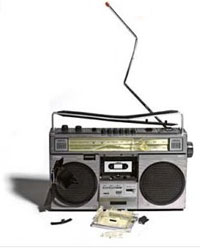
BustedradioAlec Foege has written a book –Right of the Dial– that tells the Clear Channel story. According to the review in the New York Times, Foege tried to give the company the benefit of the doubt.

“I was not out to do a hatchet job,” he writes in the preface to “Right of the Dial,” “but rather to get to the bottom of a company that I suspected had gotten a raw deal as its bad publicity had snowballed.”

The reader need wait only three paragraphs before Foege renders his final verdict: “Having spent a lot of time talking to some of the company’s most prominent critics, as well as some of its most devout supporters, I have concluded that Clear Channel is indeed to blame for much of what it has been accused of.”

The Internet and iTunes and all the rest were going to have a big impact on radio, no matter what. But I have to wonder if local radio stations might not have been better prepared for the challenges if they hadn’t been gutted and commoditized by the Clear Channel’s.

Nawww.

[Thanks, Henry]