
American Photobooth

Boing Boing is truly "A Directory of Wonderful Things." Like American Photobooth, a new illustrated history of photobooths by photographer Nakki Goranin.

"Goranin doesn’t much care for the mall’s machine, which is digital—the print quality is not what it used to be. But, she says, there are only about 250 authentic chemical booths left in the United States…

Before the photobooth first appeared, in the 1920s, most portraits were made in studios. The new, inexpensive process made photography accessible to everyone. "For 25 cents people could go and get some memory of who they were, of a special occasion, of a first date, an anniversary, a graduation," Goranin says. "For many people, those were the only photos of themselves that they had."

Because there is no photographer to intimidate, photobooth subjects tend to be much less self-conscious. The result—a young boy embracing his mother or teenagers sneaking a first kiss—is often exceptionally intimate. "It’s like a theater that’s just you and the lens," Goranin says. "And you can be anyone you want to be."
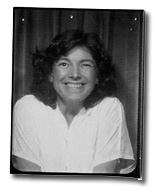
Barbbooth
I have lots of photos of my sweety and a particular fondness for these, taken in one of the pre-digital booths. She really doesn’t seem very self-conscious in these.

Many of my acquaintances are very good photographers. They have expensive equipment and take it seriously. I am way down on the other end of the spectrum. I take a lot of photos and don’t worry too much about the quality. I throw ’em up on flickr (and into iPhoto) and move on. Like high school typing class, I’ve opted for speed over accuracy. So the old photobooth appeals to me on that level.

PS: I could not guess the hours I have spent scanning photograph during the past ten years. Every so often I burn a CD and take it to the safe deposit box. Other than our pups and Barb, I can’t think of anything I value more. And I must add that the Mac –and iPhoto in particular– has made it possible to manage all my digital images. I keep about 1,700 on this MacBook and can find an image with a minimum of effort.

PPS: Speaking of photobooths… I’m told one of the most popular applications on the Mac is Photo Booth, loosely based on the original.

Reading

Go-Go Girls of the Apocalypse by Victor Gischler

Mortimer Tate was an insurance salesman on the verge of a nasty divorce when he holed up in a mountain cave in Tennessee and rode out the end of the world. Go-Go Girls of the Apocalypse begins nine years later, when he emerges into a bizarre landscape filled with hollow reminders of an America that no longer exists.

Hit and Run by Lawrence Block

Keller’s a hit man. For years now he’s had places to go and people to kill. But enough is enough. He’s got money in the bank and just one last job standing between him and retirement. In Des Moines, Keller stalks his designated target and waits for the client to give him the go-ahead. And one fine morning he’s picking out stamps for his collection at a shop in Urbandale when somebody guns down the charismatic governor of Ohio.

I’m not familiar with Gischler but he’s got a knack for titles. I’m a long-time fan of Lawrence Block. If you’ve never been on one of Keller’s hit jobs, you’re in for a treat.

The Singularity Is Near

“The technological singularity is a theoretical future point of unprecedented technological progress, caused in part by the ability of machines to improve themselves using artificial intelligence.” [Wikipedia]

I’m clawing my way through Ray Kurzweil’s The Singularity is Near. It’s not an easy read. Lots of charts and graphs and stuff I skipped in college. But it’s a wonderfully optimistic view of the near future.

“I set the date for the Singularity –representing a profound and disruptive transformation in human capability– as 2045. The nonbiological intelligence created in that year will be one billion times more powerful than all human intelligence today.”

“Despite the clear preponderance of nonbiological intelligence by the mid-2040s, ours will still be a human civilization. We will transcend biology, but not our humanity.”

I’m only about a third of the way through the book but I think “transcend biology” might be good news if I’m still around in 2045. I’ll be 93 and in serious need of a tune-up.

I originally posted this on 8/13/08 and re-post here with some of my a-ha’s.

Continue reading →

“Happiness Is A Choice”

I’ve been thinking some about fear and happiness recently, so these excerpts from an article by Roger Fransecky (“Happiness Is A Choice”) caught my attention:

“Dan Baker’s book, What Happy People Know, confirms the wisdom of the research into what (Dr. Martin) Seligman calls “authentic happiness” and “learned optimism.” Baker notes that a major barrier to happiness is fear. He writes, “We all have a neurological fear system embedded deep within our brains, a neural network that once helped us survive as a species, but now limits our lives. The biological circuitry of fear is the greatest enemy of happiness.”

We’ve written about how fear binds us, edits our hopes and diminishes our potential for happiness. Baker reminds us that fear is the repository for our past traumas, our fear of the future and our archaic instinctual terrors. Fear can be a gift, our way of staying out of the darkness and moving into the light of awareness and new beginnings. But if our fears own us, we have to break free…by awareness of those fears, and through the courage to challenge our fears to see if they are still real.”

For additional information on “neurological fear systems embedded deep within our brains,” reference the work of Dr. Warren Chapin.

“Freedom is a shitty business model”

“(Blogging is) headed everywhere, because the underlying pattern of cheap amateur publishing is what’s important, not the current manifestations. The word blog itself is going to fade into the middle distance, in the same way words like home page and portal did. Those words used to mean something relatively crisp and specific, but became so overloaded as to be meaningless.

So forget about blogs and bloggers and blogging and focus on this — the cost and difficulty of publishing absolutely anything, by anyone, into a global medium, just got a whole lot lower. And the effects of that increased pool of potential producers is going to be vast.

The thing that will change the future in the future is the same thing that changed the future in the past — freedom, in both its grand and narrow senses.

A lot of the fights in the next 5 years are going to be between people who want this kind of freedom in their technologies vs. business people who think freedom is a shitty business model compared with control.

The internet means you don’t have to convince anyone that something is a good idea before trying it, and that in turn means that you don’t need to be a huge company to change the world.”

From Clay Shirky’s  Here Comes Everybody: The
Power of Organizing Without Organizations.