Transparent journalism

Sausage
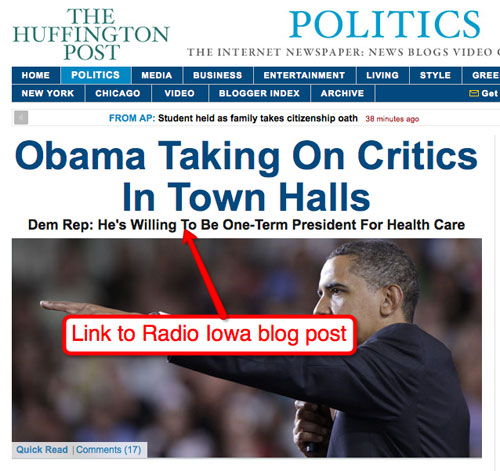
If you’re in the news business, you should read this blog post by Radio Iowa (a Learfield network) News Director O. Kay Henderson. It’s a good example of a reporter allowing her readers/listeners to see how the sausage is made.

The post (and the story to which it refers) is about the network’s coverage of remarks made by Democratic presidential candidate Joe Biden at the Iowa State Fair on Wednesday. Kay appropriately headlines her post "Splitting hairs with the Biden camp." (Read the post)

In the old (pre-blog) days, if the subject of a news story thought it inaccurate or unfair, the reporter could respond, "I stand by my story" and that would be the end of it.

In this instance, Kay has used her blog to add context to the story and I think everyone is better off for it. Here’s what we reported. Here’s what people thought about our report. And here’s some background we didn’t include in the story.

This is why I think every news organization should be blogging. We rely on journalists to cover important news. It’s important that we trust them to do it fairly and accurately. Letting us see how they do the job makes it easier.

Buying blog love

A co-worker dropped off a copy of a statement he received for some batteries he recently purchased (from Tenergy Corporation/All-Battery.com). At the bottom of the statement:

We pay $30 for your professional reviews and opinions.

Please review the products listed on all-battery.com

  • The review must be more than 400 words and shall be objective and must be posted on any well known forum or website
  • Constructive comments are always welcome
  • Must copy your review to "Product Reviews" section at http://forums.all-battery.com
  • Upon approving your review, we will send a $30 Gift certificat to you thru Email or PM

I’ve been reading about this kind of paid review but this is the first pitch I’ve seen. This raises so many interesting (to me) question:

  • Will they "approve" my review if I say something negative about their product or company?
  • What do they mean by "constructive comments?"
  • Will I get my gift certificate if I write nice things but disclose to my readers that I’m getting paid?
  • How many of their customers have blogs and websites? How many post to forums?

This just doesn’t smell right to me. If I discovered that a blogger was getting paid for reviews, I’d have trouble trusting anything else he/she wrote. If the company’s motives are pure, why not clearly state that the offer applies to any well-intentioned, objective review. And if someone has something critical to say, wouldn’t that be worth a $30 certificate?

There’s a way to do this, of course. If someone in the Casio (digital camera) marketing department noticed that I use/like/blog about their cameras, they could send me a new model and ask me to try it out and blog my impressions. Good or bad. They won’t have to give me the camera, because if it’s good, I’ll probably buy it. AND write nice things about the product.

Traditional website vs. blog

Here’s a really good example of the difference between a "traditional" website… and a blog. The Fair Fan Blog ("…taking pictures from the top of the ferris wheel so you don’t have to") is a project of Learfield Interaction. The bloggerista is Laura (Last Name Withheld to Protect Her Hotness) and she’s off to a bang-up start.

MO Dept Conservation blogging

Lorna Domke is in charge of “Outreach and Education” for the Missouri Department of Conservation and she has added a blog to her communication tool kit.

Lorna Domke“I get to learn a lot about what’s going on all over the state in forestry, fisheries, wildlife, resource science, protection and private lands services. We have lots of ways to get the word out including our regular website, the Missouri Conservationist magazine, and news releases. But on this blog, I’m going to share odds and ends of what I’m hearing from other divisions and what’s of seasonal interest.”

Lorna is the wife of my pal Henry, who blogs at HealthCareFineArt.com. Another TBF (Two Blog Family). If you know of others, leave a link in the comments.

Our short-list of state departments or agencies with blogs is growing: Attorney General (Consumer Protection); Missouri Gaming Commission; Children’s Trust Fund; KidsFirst; Dept. of Agriculture (Farmers’ Markets) Department of Mental Health; Lottery. I’m sure there are more that I haven’t discovered yet (Three of these are the work of former Learfielders).

It’s just a trickle now but as people discover how much more effective a blog is than the traditional website, this will become a flood.

10th anniversary of blogging

“We are approaching a decade since the first blogger — regarded by many to be Jorn Barger — began his business of hunting and gathering links to items that tickled his fancy, to which he appended some of his own commentary. On Dec. 23, 1997, on his site, Robot Wisdom, Mr. Barger wrote: “I decided to start my own webpage logging the best stuff I find as I surf, on a daily basis,” and the Oxford English Dictionary regards this as the primordial root of the word “weblog.”

[WSJ Online Thanks, Henry]

Blurring the lines between fan and sportswriter

Thanks to Edward for pointing to this story on the Kansas City Star website about sports blogging:

Meet the new American sports fan — an Internet-induced mix of sportswriter, play-by-play announcer, talking head and regular guy. His name is Will McDonald and, from his one-bedroom apartment in Cleveland, the University of Iowa doctoral student, painstakingly records, on his blog, the comings and goings of each Kansas City Royals game.

For the sports world — the fans, the players, the leagues and the teams — the rise of the blogger has raised complicated questions about broadcasting rights, how to reach an audience, and where the sports fan stops and the journalist begins.

The lines have blurred so much, in fact, that the New York Islanders plan to give bloggers their own box next season. So much that the NCAA escorted a reporter out of the press box two weeks ago for blogging a live baseball game. So blurred that sports teams are holding meetings about how to handle the rise of the blogger, and no one seems to know what comes next.

I could be wrong, but I think the Islanders are on the right track.

Self-portrait

Self-portraitDeLoss asks: “Whatever happened to that picture of you staring at a monitor? The background was dark and you were quite close to the screen, as if trying to detect something. I always thought that was a good shot for your
blog.”

Me too. When I started blogging, I thought I should include a photo but didn’t want to look like more of a dumb-ass than necessary. So I sat my camera (on timer) on a stack of books, turned off the lights and came up with this. Still pretty much how I see myself.

Not for sale

I received the following email today:

"I can pay you $35 for a text ad on your (website). The ad –for a free personals web site– would consist of a couple of lines of text with links to the web site. I can pay via PayPal, or send you a check. Would you be interested?"

The post on which he wanted to place an ad was about the anniversary of Sgt. Pepper’s Lonely Hearts Club Band. The only possible connection I could see was "lonely hearts" and "personals" but that’s a reach.

I thanked him for his interest but turned down the $35. But it got me thinking. Would I have taken $350? No. $3,500? I know it’s ridiculous, but I don’t think I would. This space just ain’t for sale.

Blogger removed from NCAA baseball game for blogging

A blogger from the Courier-Journal of Louisville, Ky., was expelled from a college playoff game for live-blogging.

According to the Courier-Journal, staff blogger Brian Bennett was approached by NCAA officials in the fifth inning of a game between the University of Lousville and Oklahoma State, told that blogging “from an NCAA championship event ‘is against NCAA policies (and) we’re revoking the (press) credential and need to ask you to leave the stadium.'”

This hits close to home. The company I work for is one of half a dozen big players in collegiate sports marketing. We pay millions for exclusive broadcast and marketing rights for the sporting events at our partner schools. Does that extend to a reporter blogging int he stands? Does it extend to a fan blogging in the stands? I think our “company position” would be that it does. If and when it comes up, I think we have to handle it correctly but I’m not sure just that would be.