In a recently-released TED video, author Simon Sinek explains what he sees as the secret to Apple’s success and makes a case for the real reason the company is so innovative–even though it has “the same access to the same talent, the same agencies, the same consultants, the same media.”
Category Archives: Art/Style
It was easier for Leonardo
Reply
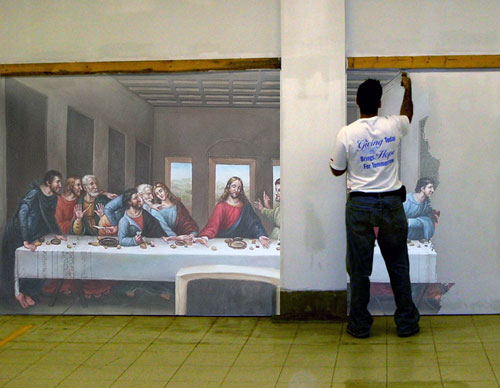
Learfield’s Jeff Martin makes work fun during United Way “volunteer day” a couple of years ago.
ArtStudio app for iPad

I got so bummed out by all the bitching about why the iPad sucks, I had to take a little art break. I have zero skills in the drawing/painting department, yet find this little drawing app more fun than a Jordanian gigolo.
Stephen Fry on Steve Jobs and the iPad
Of all the early reviews of the iPad, this one by Stephen Fry soars above the rest for me. During his visit to Apple HQ, he gets time with Jonathan Ive and Steve Jobs. Fry is shameless and open in his love of all things Apple reminds me of the decision to buy my first Mac.
“We are human beings; our first responses to anything are dominated not by calculations but by feelings. What (Jonathan) Ive and his team understand is that if you have an object in your pocket or hand for hours every day, then your relationship with it is profound, human and emotional. Apple’s success has been founded on consumer products that address this side of us: their products make users smile as they reach forward to manipulate, touch, fondle, slide, tweak, pinch, prod and stroke.”
On Steve Jobs:
“For some, his personal magnetism is almost of a dangerous, Elmer Gantry kind.”
Jobs on Life and Career:
“I don’t think of my life as a career,” he says. “I do stuff. I respond to stuff. That’s not a career — it’s a life!”
Fry’s hand-on review of the iPad:
“It is possible that the public will not fall on the iPad, as I did, like lions on an antelope. Perhaps they will find the apps and the iBooks too expensive. Maybe they will wait for more fully featured later models. But for me, my iPad is like a gun lobbyist’s rifle: the only way you will take it from me is to prise it from my cold, dead hands.”
[via @jonzissou]
“Some things need to be believed to be seen”
Excerpts from Adam Bryant’s interview with Guy Kawasaki:
- “I learned from Steve Jobs that people can change the world. Maybe we didn’t get 95 percent market share, but we did make the world a better place. I learned from Steve that some things need to be believed to be seen.”
- “We believed in the Mac division that we were making the world a better place by making people more creative and productive. Google, at its core, probably believes it’s making the world a better place by democratizing information.”
- “Make yourself dispensable — what greater accomplishment is there than the organization running well without you?”
- “You should conduct first- and second-round (hiring) interviews by phone, not in person.”
- “(Business schools) should teach students how to communicate in five-sentence e-mails and with 10-slide PowerPoint presentations.”
That last bullet is my new objective. If you get a longer email from me, remind me of this post.
What’s wrong with Folgers?
“Self expression the new entertainment”
Found this wonderful quote from Arianna Huffington on Seth Godin’s blog:
“Self expression is the new entertainment, We never used to question why people sit on the couch for seven hours a day watching bad TV. Nobody ever asked, ‘Why are they doing that for free?’ We need to celebrate [this desire to contribute for free] rather than question it.”
There you go. That’s it. That perfectly sums up why I can spend almost every waking moment doing what I’m doing right now. Even the most modest form of self expression is endlessly entertaining.
“Digital-age monks illuminating manuscripts”
From an op-ed piece on NYTimes.com, by Sheelah Kolhatkar:
“You can tell when a print journalist has lost his full-time job because of the digital markings that suddenly appear, like the tail of a fading comet. First, he joins Facebook. A Gmail address is promptly obtained. The Twitter account comes next, followed by the inevitable blog. Throw in a LinkedIn profile for good measure. This online coming-out is the first step in a daunting, and economically discouraging, transformation: from a member of a large institution to a would-be Internet “brand.”
“While most people are worried about getting paid for their work, I’m more concerned that journalists might be the digital-age equivalent of monks illuminating manuscripts, a group whose skills will soon disappear.”
I feel bad for anyone that has lost a job, but can’t help wondering why the reporter in this piece didn’t already have the online presence. It’s like going camping without a flashlight.
MacBook Book

Irresistible.
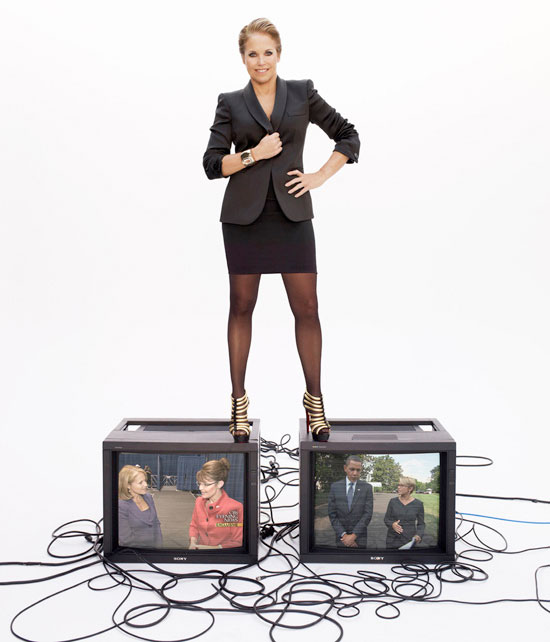
Katie Couric promotional ad