Steampunk gas mask

Leathergasmask

Three reasons why I don’t own this steampunk gas mask: a) I can’t imagine where I’d wear it, b) It’s probably hot as hell, c) and damned expensive. But I’d be set for all Halloweens to come.

Like many others, I developed an appreciation for steampunk from the novels of William Gibson.

“Steampunk is a subgenre of fantasy and speculative fiction which came into prominence in the 1980s and early 1990s. The term denotes works set in an era or world where steam power is still widely used—usually the 19th century, and often set in Victorian era England—but with prominent elements of either science fiction or fantasy, such as fictional technological inventions like those found in the works of H. G. Wells and Jules Verne, or real technological developments like the computer occurring at an earlier date.” – Wikipedia

Mike Spooner: Creator of Worlds

Michael_spoonerRemember that kid that sat behind you grade school that was always drawing? Ever wonder what happened to him? Well, if he (or she) was as talented as Michael Spooner, he did okay.

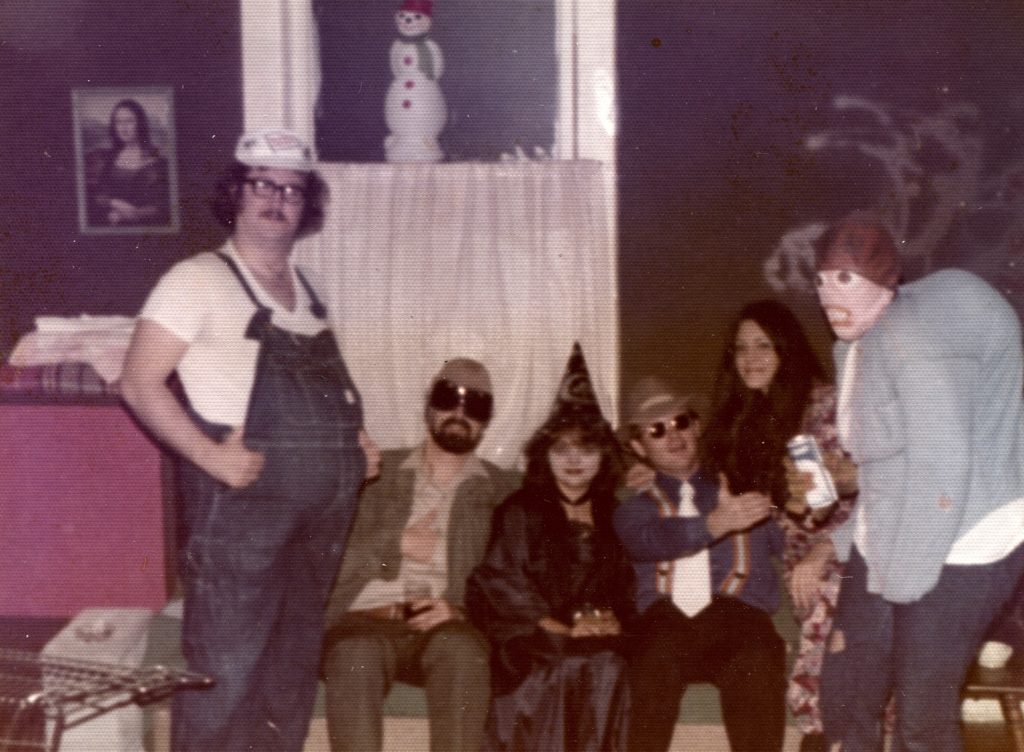
Michael (we knew him as Mike back then) and I were classmates 45 years ago in Kennett, MO. Michael and I ran in different crowds but Kennett was a small place and everybody knew everybody.

In a previous post I mentioned that Michael stumbled across smays.com a few days ago and pinged me. He included some old snapshots and his resume, to let me know what he’s been up to.

He got into animation as a  Layout Artist with Ralph Bakshi’s feature production of Tolkien’s, Lord of the Rings. He spent some years at Disney where he worked on –just to name a few– Goof Troop, The Little Mermaid, Aladdin, The Emperor’s New Groove, Treasure Planet and Lilo and Stitch. He also assisted on early development design of Dreamworks’ Shrek. And he Co-Art Directed Warner Brothers first full-length animated feature, Quest for Camelot. If you have kids or an appreciation for animation, check out his bio. He was also kind enough to share a dozen or so examples of his work.

Treasure475

I called Michael up this morning and asked him to share some of his adventures and we wound up talking for an hour. I’ve cut the interview into three segments about about 20 minutes each.

AUDIO: Interview Part 1

AUDIO: Interview Part 2

AUDIO: Interview Part 3

Today, Michael owns Spoonerville Animation Design, an independent visual development studio, providing both traditional and CGI design concepts and lives in the western suburbs of Chicago with his writer-wife Beverly, and son Philip.

Michael is a visiting artist and lecturer, presenting in universities, art schools and animation studios throughout the United States.

J. Michael Spooner – Visual Development Design Consultant

Michael Spooner has worked in the animation industry for twenty-five years with such notable studios as Walt Disney, Warner Brothers and DreamWorks.

Michael’s professional career in art began in 1976, when he was invited to join the faculty at Art Center College of Design in Los Angeles, after graduating with distinction. He taught for twelve years, simultaneously working as a freelance illustrator for clients that included the Public Broadcasting System, Zondervan Publishing House, Masda Motors, the National Football League, NBC Television, Paramount Pictures and Twentieth Century Fox.

Michael ventured into animation as a Layout Artist with Ralph Bakshi’s feature production of Tolkien’s, Lord of the Rings. Shortly after he worked with Filmation Studios on He-Man, Bravestar and Fat Albert and on the Bagdasarian feature, The Chipmunk Adventure.

Joining the Walt Disney Television Animation team in 1988 as a Visual Development Artist and Production Designer, Michael set the style for such episodic shows as, Chip ‘n’ Dale’s Rescue Rangers, Talespin, Goof Troop, The Little Mermaid, New Bonkers and Aladdin. He also worked on the direct-to-video production of Aladdin and the King of Thieves.

In 1994, Michael and his family moved to Paris, France, where he headed up the Production Layout team for Disney’s feature film, A Goofy Movie.

Returning to Los Angeles in 1995, Michael Co-Art Directed Warner Brothers first full-length animated feature, Quest for Camelot. Following that he worked independently as a Visual Development Designer Consultant on Disney’s Dinosaurs, The Emperor’s New Groove, Treasure Planet and Lilo and Stitch. Michael also assisted on early development design of Dreamworks,’ Shrek.

Michael moved to the Chicago area in 1999 to become Vice President of Visual Development and Artist Education with Big Idea Productions, home of the popular 3D animated video series, Veggie Tales. There he developed and headed up the Visual Development process in Story, Concept Design, Modeling and Layout. He also served as Art Director on various productions and as an Art Direction Consultant on Big Idea’s first feature animated film, Jonah.

Today, Michael owns Spoonerville Animation Design, an independent visual development studio, providing both traditional and CGI design concepts for clients such as Big Idea, Inc., Star Farm Productions, ReelFX Creative Studios and Walt Disney Animation Studios.

He lives in the western suburbs of Chicago with his writer-wife Beverly, and son Philip.

Michael is a visiting artist and lecturer, presenting in universities, art schools and animation studios throughout the United States.

You may reach him at: spoonerville1@sbcglobal.net or 630 301-0895

Art Text

Webheadsgraphic200_2The tagline on the Art Text website is: “Where text becomes art,” and that’s pretty much right on. I’ve been looking for an app that would compensate for my lack of graphic design skills and this comes close. If you have the Photoshop chops you can probably do everything that Art Text does but even then it’s going to take you longer. This graphic for the Coffee Zone took about 5 minutes to create.

Concrete Art


Clarence Lee Shirrell is one of those lucky people who seem to really love his work. He has a “lawn ornament farm” on Interstate 55 just north of Cape Girardeau, MO. I stopped by this week because I happened to notice Miss C, Clarence’s camel (“You can pet her. She won’t spit at you.”)

I can’t explain my fascination with concrete art (if I may use that word). I think it has more to do with the subjects chosen than the process. Which I assume involves pouring concrete into a mold. I think Clarence Lee said he buys the pieces already cast, so is there a big lawn ornament outfit somewhere and how do they decide what pieces will sell? And who came up with the 8 foot polar bear throwing a snowball?

I had a dozen questions for Clarence Lee but didn’t have time to ask them. For example, which is the better seller: the life-size (whatever that might be) demon or the Virgin Mary. And where would you put the demon?

How did he find Crista Meyer, the lady who paints some of his pieces. And do painted pieces sell better than unpainted? And what prompted the loin cloth on the buff young (Greek?) man. Did someone complain about his tiny concrete pecker and balls (yes, I peeked)?

Perhaps the most interesting thing I found at Concrete Castings was the cryptic message on the back of Clarence Lee’s business card: “Finished files are the result of years of scientific study combined with the experience of many years.”

I think that might be up there with “What’s the frequency, Kenneth?”

Interview: Jason Rodgers, Fez-o-rama

RogersWith one of his custom designed fezzes sitting comfortably on my head, I got Jason Rodgers on the Skype horn today to find out the story behind the fezmonger and Fez-o-rama.

Some are born to the fez, others are called. I believe Jason falls into the latter group. I was surprised –don’t ask me why– to learn that Jason is trained in fashion design and might have written a text book or two.

I asked him about celebrity clients, his favorite designs, The Cult of the Eye, his fictional partner, “Joe,” and ukuleles.

AUDIO: Interview with Jason Rogers 11 min MP3

Jason is the newest member of The Royal and Exalted Order of the Fez.

“They’re not talking to you”

Herecomes

“Who would want to be a publisher with only a dozen readers? It’s also easy to see why the audience for most user-generated content is so small, filled as it is with narrow, spelling-challenged observations about going to the mall and pick out clothes. And it’s easy to deride this sort of thing as self-absorbed publishing — why would anyone put such drivel out in public? It’s simple. They’re not talking to you. We misread these seemingly inane posts because we’re so unused to seeing written material in public that isn’t intended for us.”

From Clay Shirky’s “Here Comes Everybody: The Power of Organizing without Organizations” This is a fascinating book that takes an academic –but easy to read– look at social networking and how it’s changing society.

Tiny dancer

A couple of posts back there’s a little animation depicting life and death in five seconds. A little depressing and dark, even for me. But it reminded me of a more life-affirming animation I posted a few years ago. If this blog remains “alive” for 100 years (I’ve got a plan), it’s fun to think about this little lady dancing away, hour after hour.