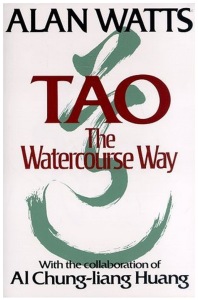
 Excerpts from Tao: The Watercourse Way by Alan Watts.
The Tao which can be spoken is not the eternal (or regular) Tao.
Our organisms have ways of intelligent understanding beyond words and conscious attention.
The supposition that knowing requires a knower is based on a linguistic and not an existential rule.
Alphabetic writing is a representation of sound. A sign for a sound which is the name of a thing.
Li is the pattern of behavior which comes about when one is in accord with the Tao, the watercourse of nature.
We and our surroundings are the process of a unified field, which is what the Chinese call Tao. #
Technology is destructive only in the hands of people who do not realize that they are one and the same process as the universe.
It is the great and imaginary terror of Western man that nothingness will be the permanent end of the universe. We do not easily grasp the point that the void is creative, and that being comes from nonbeing as sound from silence and light from space.
I find it impossible to conceive any form whatsoever without the component of relatively empty space. […] I cannot get away from the sense that space and my awareness of the universe are the same.
How would you know that you are alive unless you had once been dead? How can one speak of reality or is-ness except in the context of the polar apprehension of void.
There is something in us which may be called upon for a higher wisdom than can be figured out by logic.
The nervous system can integrate more variables than the scanning process of conscious attention.
It is a matter of realizing that oneself and nature are one and the same process. […] The whole cosmos is implicit in every member of it, and every point in it may be regarded as its center.
There is no point in trying to suppress the babble of words and ideas that goes on in most adult brains, so if it won’t stop, let it go on as it will, and listen to it as if it were the sound of traffic or the clucking of hens.
Tao is just a name for whatever happens. […] Yet the Tao is most certainly the ultimate reality and energy of the universe, the Ground of being and nonbeing.
Tao cannot be defined in words and is not an idea or concept.
Verbal description and definition may be compared to the latitudinal and longitudinal nets which we visualize upon the earth and heavens to define and enclose the positions of mountains and lakes, planets and stars. But earth and heaven are not cut by these imaginary strings.
It is basic to the Taoist view of the world that every thing-event is what it is only in relation to all others.
Nature has no “parts” except those which are distinguished by human systems of classification.
The Tao is the pattern of things, but not the enforced law. […] The universe is a harmony or symbiosis of patterns which cannot exist without each other.
Just as every point on the surface of a sphere may be seen as the center of the surface, so every organ of the body and every being in the cosmos may be seen as its center and ruler.
As the universe produces our consciousness, our consciousness evokes the universe.
The only single event is the universe itself.
Pantheism: The idea that the universe, considered as a mass of distinct things and events, is simply God by another name.
But if, as is the case, the Tao is simply inconceivable, what is the use of having the word and saying anything at all about it? Simply because we know intuitively that there is a dimension of ourselves and of nature which eludes us because it is too close, too general, and too all-embracing to be singled out as a particular object.
Taoists do not look upon meditation as “practice,” except in the sense that a doctor “practices” medicine. […] Meditate for the joy of meditation.
“You” cannot go along with “things” unless there is the understanding that there is, in truth, no alternative since you and the things are the same process — the non-streaming Tao. The feeling that there is a difference is also that process. There is nothing to do about it. There is nothing not to do about it. […] In realizing that you are the Tao, you automatically manifest its magic.
As a way of contemplation, (Tao) is being aware of life without thinking about it.
To be anxious to survive is to wear oneself out. […] If, deep down inside, you want most desperately to survive and be in control of things, you cannot genuinely take the attitude of not worrying about it. You must allow yourself the freedom to worry — to let the mind think whatever it wants to think.”
Hebrew, Islamic, and Catholic scholastics, as well as Protestant fundamentalists, are like tourists who study guidebooks and maps instead of wandering freely and looking at the view.
True knowledge can be encompassed only by instinct and by actual experience.

 I suspect many people feel awkward when they find themselves stopped a few feet from a — what is the correct term — panhandler? Beggar seems harsh. Let’s go with panhandler. As you coast up the exit ramp you silently hope you make the light or get stuck far enough down the ramp to avoid having to engage with the man/woman. (“Can you help a brother out?”)