
Digital marketing no longer experimental

At Forrester Research they “…interview as many marketers as we can about their plans, identify trends and project future likely conditions, and then we put together some numbers to make a projection.”

That’s the way Josh Bernoff explains it in a recent blog post that focuses on a five-year interactive marketing forecast. A few tidbits from the study:

“Unlike the last recession, digital marketing is no longer experimental. Now it looks more like advertising is inefficient, relative to digital. More than half of the marketers we surveyed said that effectiveness of direct mail, television, magazines, outdoor, newspapers, and radio would stay the same or decrease within three years. In contrast, well over 70% expected the effectiveness of channels like created social media, online video, and mobile marketing to increase.

The result is that digital, which will be about 12% of overall advertising spend in 2009, is likely to grow to about 21% in five years. Along the way overall advertising budgets will decline.

This is huge.

It means we are all digital marketers now, since digital is at the center of many campaigns anyway.

It means media is in trouble, or at least in the middle of a transformation. For example, online video ads, which will be about $870 million this year, will grow to over $3 billion in 2014. What will this do to networks plans to put more of their shows online in places like Hulu. How will it accelerate some newspapers plans to become more and more centered around online?

And it means that social “media”, which will account for $716 million this year between social network campaigns and agency fees, will generate $3 billion in five years. And this doesn’t even count displays ads on social networks (which are in the display ads category.) Of all the parts of digital marketing, social network marketing one is poised for the most explosive growth.

Pundits have been declaring the end of mass media and advertising for years now. From my 14 years of experience analyzing this stuff, I’ve learned that things die very slowly, but there are real trends you can see. If you’re in advertising, you’d better learn to speak digital, because that’s the way the world is going.”

This was the point I was trying to raise in a company meeting earlier this year when I asked if any of the attendees could imagine a time when there was no advertising.  That “advertising” and marketing as we now know it would probably be unrecognizable at some point in the not so distant future. And are we ready for that?

All I need is this bowling ball. And this ash tray.

Steve Rubel lists five ways in which he is simplifying his technology:

  1. Eliminating any bookmarks, software/webware that I haven’t used in the last seven days
  2. Cutting back to two devices for everything – a laptop and a cell phone. Period, end of story
  3. All critical data seamlessly syncs between these two devices. If a service doesn’t allow me to sync stuff via the cloud and access it both online and off, it’s toast
  4. He’s dumped tons of of stuff: RSS feeds and virtually every email newsletter
  5. Setting up lists on Friendfeed to help me find signals in the noise

That sounds really good to me. I’m feeling more cluttered every day. Too many atoms, too many bytes (bits?)

  • #1 will be a snap for the bookmarks. I’ll have to nut up to kill some of the software I’m not using. Wish me luck.
  • #2 is equally appealing. I could get by with my MacBook and my iPhone. But the big iMac at work belongs to the company, so… and the Mac Mini at home really gets very little use.
  • #3 The whole Mac/Mobile Me experience has made me very reliant on sync’ing. I have a couple of apps that don’t but not many.
  • #4 is pretty easy to do. Got my RSS subscriptions under 50. If I add one, I’ll try to find one to delete
  • #5 I’ve never been able to get with the Friendfeed thing. I’ll take another look but…

Exploiting expertise

Mindy McAdams (Teaching Online Journalism) points us to a speech by David Schlesinger, editor-in-chief for Reuters News, to the Intl. Olympics Committee Press Commission (June 23, 2009).

“We in the traditional media … must concentrate our efforts on defining and developing that which really adds value.

That means understanding what really can be exclusive and what really is insightful. It means truly exploiting real expertise.

It means, to my earlier point, using all the multimedia tools available and all the smart multimedia journalists to provide a package so much stronger than any one individual strand.

It means working with the mobile phone and digital camera and social media-enabled public and not against them. Working against them would be crazy.”

The last few days playing with the iPhone, Twitter, Posterous and YouTube make his last point really hop off the page.

I think the long-term success of our news networks –of everyone’s news networks– will depend on understanding and implementing these ideas. Okay, maybe the short-term success.

Mobile Media

Hard to beat the iPhone for audio and video if you want immediate and easy upload to YouTube. The stills are not as good as the Casio delivers. (Can you guess which took the photo below?)

sunset

Posterous is fun and easy but not sure that it gives me much that Twitter does not, especially since YouTube now talks to Twitter. There is something about seeing the media nicely presented, in-line on the Posterous page, but you have to get folks there. I’m looking forward to seeing how Tweetie gets video from the iPhone to my Twitter stream.

It all gets a little confusing with literally too many choices. But I do like being able to share the media quickly, even a some sacrifice in quality. I’m guessing I’ll wind up using Twitter, YouTube and Mobile Me for on-the-fly. The blog will get posts like this, after I’ve had a time to reflect and look more closely at the available media.

iPhone MobileMe

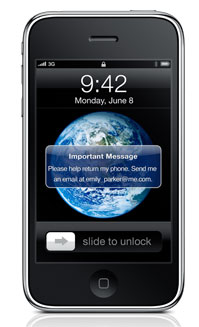
iphone-returnI got a brief look at the new OS for the iPhone yesterday and must say I was impressed. Copy and paste works smooth as buttah. And a bunch of other stuff I didn’t get to play with but the feature that made me squeal like a 12 year old girl was one I had not heard about. From the iPhone website:

“If you misplace your iPhone, MobileMe can help you find it. Log in to me.com to view a map that shows the approximate location of your iPhone. If it’s nearby, have it play a sound to help you find it, or display a message on the Home screen to help someone return it to you.

Your iPhone contains information you don’t want in the hands of a stranger. So if you lose your iPhone and displaying a message on it hasn’t resulted in its safe return, you can initiate a remote wipe and restore factory settings. If you eventually find your iPhone, you can restore your data by enabling your MobileMe account on iPhone.”

How about this option? If you know your phone is stolen and being used by the thief –or someone he sold it to– you turn the phone on and make it play a pre-recorded sound clip: THIS TURD STOLE MY IPHONE! Over and over.

My new phone arrives this Friday and I confess I’m a little giddy with anticipation.

PS: If you click the headline of this post it displays the “related posts” feature we added yesterday. One of which is from a year ago, titled: “Why no iPhone for smays.com.”