When newsletters were printed and mailed

In 1988 if I wanted to communicate with the 60 radio stations affiliated with our news networks, I printed it and put it in an envelope and mailed it (USPS). Took as long as four days to reach some stations. No fax machines yet and email still years away.
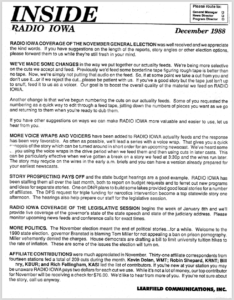
This has such a Pony Express feel to me, here in 2017. The idea of a monthly, printed newsletter seems… quaint. But I recall almost every company and association doing a monthly (sometimes quarterly) newsletter. Somebody spent hours writing these things, often with multiple managers “signing off” before they went out.

When desktop publishing (and laser printers) came along, newsletters got ugly, fast. That was my opinion and I my philosophy was text-only; short paragraphs; one page, front and back. I read somewhere, “No more than an hour to write and a minute to read.” I think I knew, in my secret heart, that nobody read these things anyway. But I did them, every month for years. I kept most of them and they provide tiny snapshots of what was going one with our networks at the time.

Today we have Facebook pages and Twitter feeds and maybe even a blog or two. But I’m seeing some Big Names moving back to newsletters. Easier to monetize? More likely to be read?
Clyde’s first business plan

It’s pretty easy to come up with an idea for a new business. It’s really hard to write good business plan for a new business. In 1972, 28-year-old Clyde Lear put together a proposal for regional radio network. He showed it to a half dozen local businessmen who invested in him and his idea. Last year Clyde’s company was valued at more than one billion dollars. It’s not really his company anymore, he sold it a few years ago.

Clyde kept that first business plan and it’s interesting reading. I worked for Clyde for 30 years and have known him for 40 so it might be more interesting to me than you. He’s graciously allowed me to share some of it here. It begins with the concept, his “big idea.” An excerpt:

Regional news and farm networks have been especially lucrative. The growing farm economy required quick dissemination of farm information. Much of this information is a necessity to the agribusinessman. Further, the advertiser wanting to market his good — machinery, seeds, services, fertilizer, feed, chemicals — looks for the way he can get the greatest number of farmers and ranchers to hear his message at the lowest possible cost. The regional farm network is the answer.

Advertising rates, proposed programs, projected expenses, descriptions of other networks. In 1972 there were 113 radio networks in the U. S. and Clyde researched eleven of them. Clyde’s First Business Plan – Other Networks (PDF)

Ohio Farm Network: This is a full-time farm network, but distribution is by tape, and five days late. Programming is entirely morning about 20 minutes in length. It is entirely a pre-sold program, based on a percentage of the rate card of each station. One man handles all the programming and all the selling. The overhead is low, and sales, by comparison to the others, are moderate at best, seldom reaching $10,000 per month.

If you’ve ever thought about starting your own business, or if you started your own business, you might find this bit of history interesting. The company that Clyde and others built from his original idea doesn’t look much like his original dream but that was never a static thing. Clyde’s First Business Plan – Background (PDF)

Jimmy Haggett at WSM

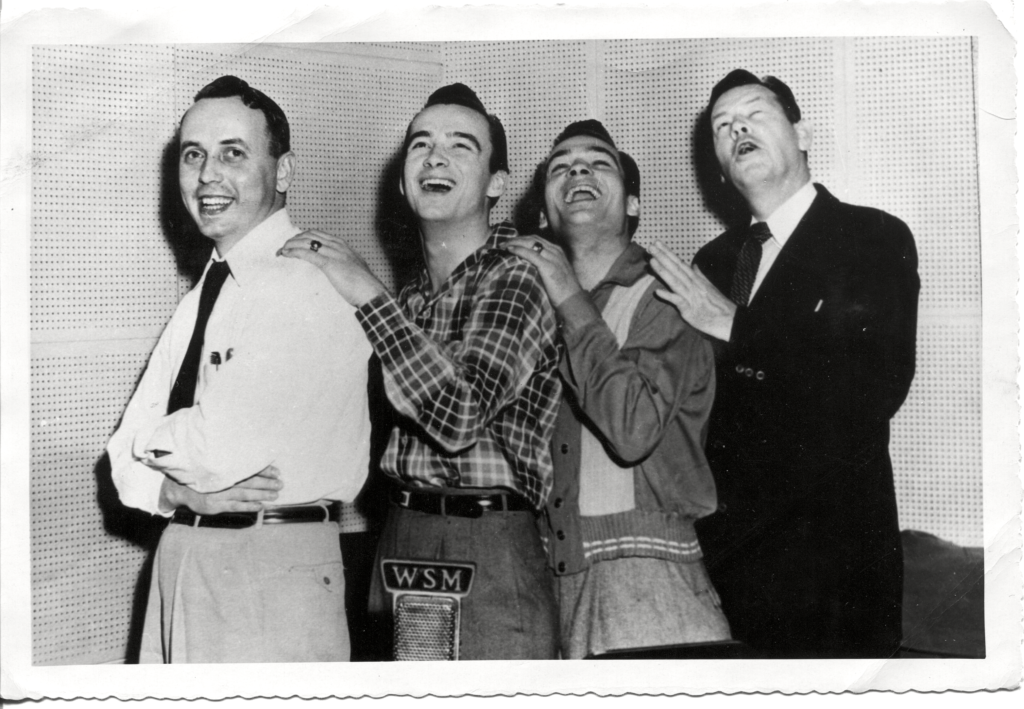
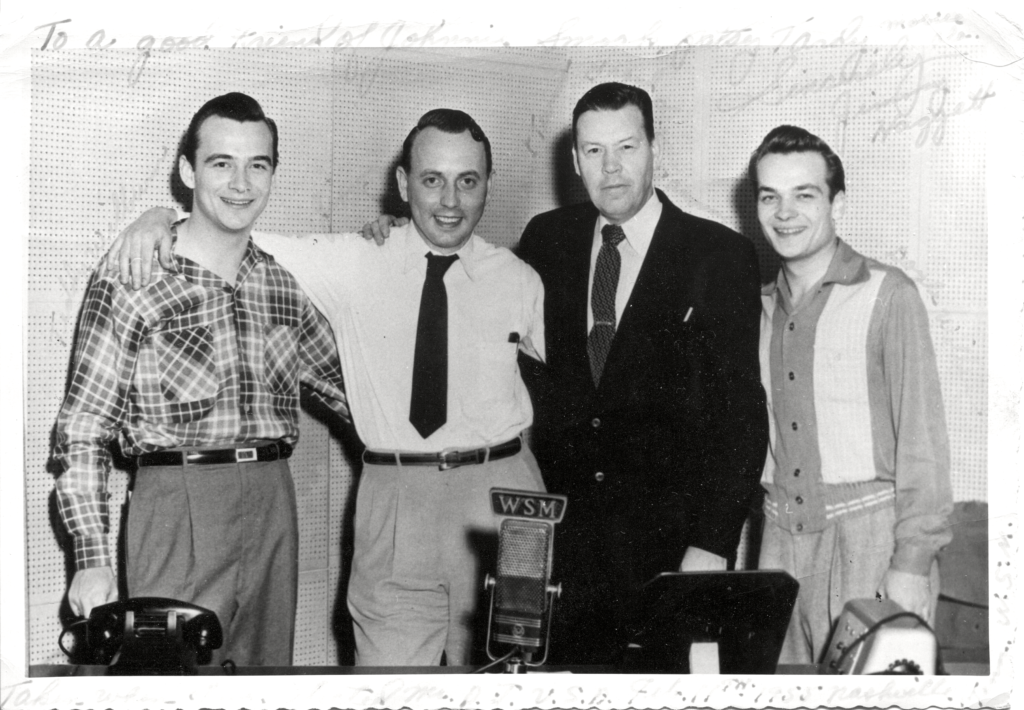
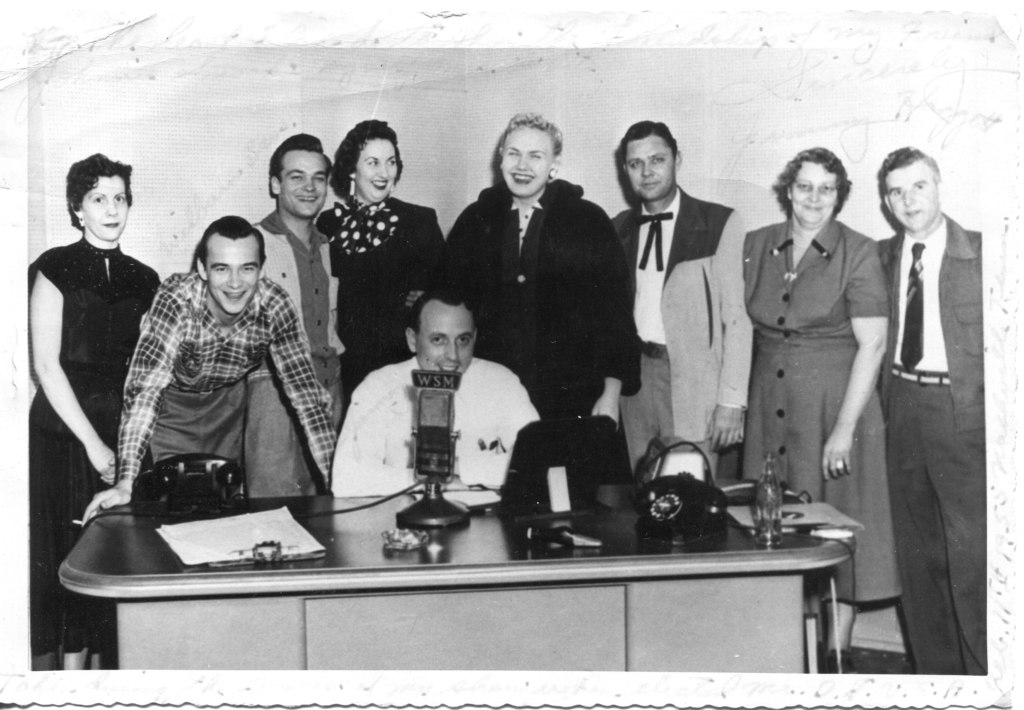
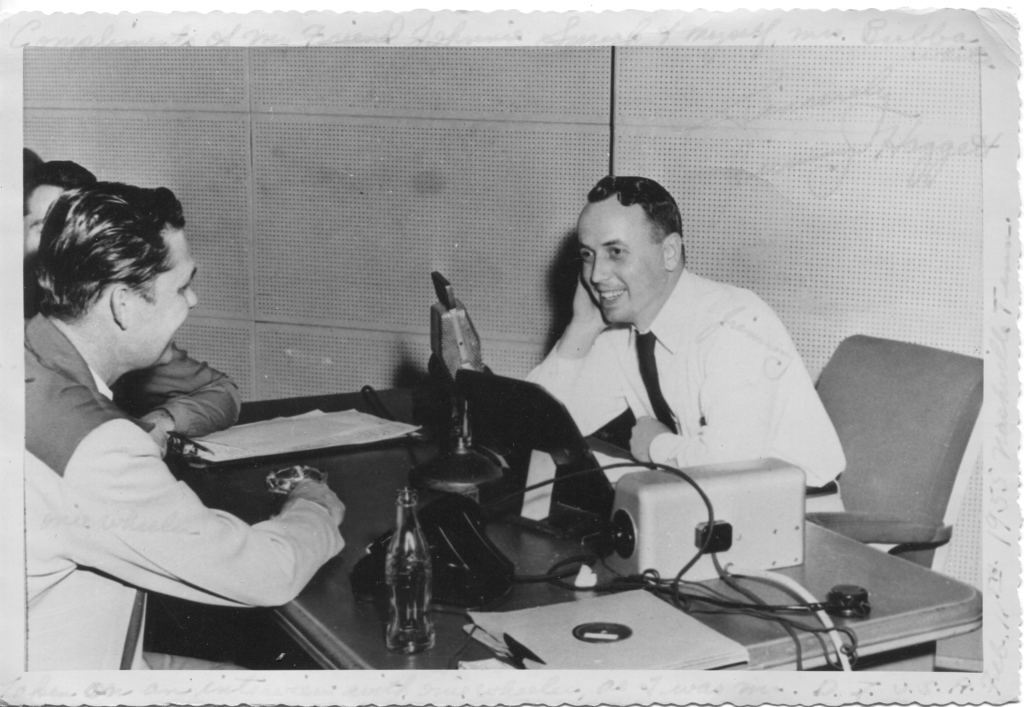
I have a fondness for old photos. Especially photos from the early days of radio. My friend Charles Isbell sent me some good ones this week. They were found in an old house being torn down in Caruth, Missouri. They feature Jimmy Haggett, a musician and DJ who worked northeast Arkansas and southeast Missouri in the 50s. He and my father worked at KBOA at one point. You can find a bio at the link above.

UPDATE from John Carpenter: “(These) Jimmy Haggett PR photos are all from Friday, February 11, 1955 at WSM Radio in Nashville. He’d been chosen “Mr. Disc Jockey, U.S.A.” for that month by the Country Music Disc Jockey Association. The award was noted in the March 1956 issue of “Cowboy Songs” magazine, in their “Disc Jockey Roundup” column: “A member of the CMDJA, Jimmy appeared over WSM, Nashville as ‘Mr. D.J., U.S.A.’ in February 1955, and appeared on Grand Ole Opry the following night.”


L-R: Unknown, Teddy Wilburn,Doyle Wilburn,unknown, Betty Jean and One Wheeler, unknown, unknown

As for the other people in the photos, two of the young men are The Wilburn Brothers (Teddy and Doyle). Looks like the photos were taken at WSM in Nashville, so perhaps some of the others are performers. If you recognize anybody, please leave a comment.

Interviewing Onie Wheeler. “Compliments of my friend Johnnie Smogh & myself, Mrs. Bubba White. Sincerely, Jimmy Haggett.”

Jimmy with Teddy and Doyle in the photos above/below. Would like to know who the other gentleman is. Will work on it.

How was your day, Ian?

In chapter 8 of The Inevitable, Kevin Kelly talks about Remixing. “Unbundling existing products into their most primitive parts and then recombining in all possible ways.” He spends a good bit of time talking about video and the amazing new ways we will find to create and use it.

I will have my AI (we’ll all have one, or more than one) pull all of the available video of Ian Emmerson. He lives in the UK somewhere. Don’t know where. Or what he does for a living. But there’s a bazillion cameras in the UK so there will be no shortage of video.

My AI will edit each day’s video into a montage (of sorts). Ian waiting for one of those big red double-decker buses; Ian trudging into the building where he works; Ian in his cubicle; Ian getting fish and chips from a curb-side truck; Ian (alone) in the pub, having a pint before going back to his ‘flat.’ Pretty much the same stuff every day with an interesting character tossed in from time to time. Or, perhaps, just a character.

Each ‘episode’ will end with one of Ian’s songs, like the one below. I’ll let the AI pick the tune, based on that day’s ‘footage.’ I’ll probably let the AI pick a name for the series but I kind of like, “How was your day, Ian?”

“I am a fair witness, not a participant.”

“A fair witness is a character type from the 1961 science fiction novel Stranger in a Strange Land by the American author Robert A. Heinlein.”

“The novel tells the story of Valentine Michael Smith, a human who comes to Earth in early adulthood after being born on the planet Mars and raised by Martians. The novel explores his interaction with — and eventual transformation of — terrestrial culture.”

“Several later editions of the book have promoted it as “the most famous science fiction novel ever written”. While initially a success among science fiction readers, over the following years word-of-mouth caused sales to build, requiring numerous subsequent printings after the first edition. Eventually Stranger in a Strange Land became a cult classic.”

“A fair witness is a fictional profession invented for the novel. A fair witness is an individual trained to observe events and report exactly what he or she sees and hears, making no extrapolations or assumptions. A photographic memory is a prerequisite for the job, although this may be attainable with suitable training.” Continue reading →