
“Humanity’s Database”

That’s the title of David Pogue’s review of The Facebook Effect by David Kirkpatrick. A few excerpts:

“(Kirkpatrick) has written what amounts to two books about it: the first and second halves of “The Facebook Effect.” The first part is a fascinating but flawed corporate history, starring Facebook’s reticent creator, the Harvard dropout Mark Zuckerberg; the second is a thoughtful, evenhanded analysis of the Web site’s impact.”

“Not long from now, Facebook will be a frighteningly centralized database containing the information of about a half-billion people. Its advertisers already use this data (“You can show your ad only to married women aged 35 and up who live in northern Ohio,” Kirkpatrick notes), but apart from that, nobody can predict what the company will do with our information.”

“Despite its foibles, “The Facebook Effect” leaves you with a deep under standing of Facebook, its philosophies and, most startlingly, its power. You come away with a creepy new awareness of how a directory of college students is fast becoming a directory of all humanity — one that’s in the hands of a somewhat strange 26-year-old wearing a T-shirt and rubber Adidas sandals.”

Several times while reading Mr. Pogue’s review I found myself saying, “Yeah. I didn’t think of that.”

Lucy: Red Ball (2010)

Red Ball is a simple game. Someone (with opposable thumbs) throws the ball and Lucy runs madly after it and brings it back. And repeat.
Lucy loves playing ball more than anything (rawhide chews and rolling on dead animals a close 2nd and 3rd). She can do it for hours, with periodic trips to our faux creek to cool off.

As we play this game, I wonder if there’s anything in my life with such a high joy-to-effort ratio. Nothing comes immediately to mind. Except Red Ball.

Murals by Rebecca


The brief (4 min) video above is with a co-worker who paints wall murals. She thought a video might help show-and-tell her art. I mention this here because it was just so easy to do with iMovie and the Comic Book theme added a little pizzazz. I need to check to see if there are more themes out there. I’m surprised that Apple only provide half a dozen.

Lesson learned from this mini-project: Edit out my questions wherever possible.

“Why network news hasn’t mattered since the seventies”

Matt Taibbi opens up a family-size can of whup-ass on CBS Chief Foreign Correspondent Lara Logan. Here are a couple of grafs:

“Anyone who wants to know why network television news hasn’t mattered since the seventies just needs to check out this appearance by Logan. Here’s CBS’s chief foreign correspondent saying out loud on TV that when the man running a war that’s killing thousands of young men and women every year steps on his own dick in front of a journalist, that journalist is supposed to eat the story so as not to embarrass the flag. And the part that really gets me is Logan bitching about how Hastings was dishonest to use human warmth and charm to build up enough of a rapport with his sources that they felt comfortable running their mouths off in front of him. According to Logan, that’s sneaky — and journalists aren’t supposed to be sneaky.”

“As to this whole “unspoken agreement” business: the reason Lara Logan thinks this is because she’s like pretty much every other “reputable” journalist in this country, in that she suffers from a profound confusion about who she’s supposed to be working for. I know this from my years covering presidential campaigns, where the same dynamic applies. Hey, assholes: you do not work for the people you’re covering! Jesus, is this concept that fucking hard? On the campaign trail, I watch reporters nod solemnly as they hear about the hundreds of millions of dollars candidates X and Y and Z collect from the likes of Citigroup and Raytheon and Archer Daniels Midland, and it blows my mind that they never seem to connect the dots and grasp where all that money is going. The answer, you idiots, is that it’s buying advertising! People like George Bush, John McCain, Barack Obama, and General McChrystal for that matter, they can afford to buy their own P.R. — and they do, in ways both honest and dishonest, visible and invisible.”

I’ve stopped watching television news for the same reason I’ve stopped donating to political campaigns and answering our land-line phone. Almost all bullshit.

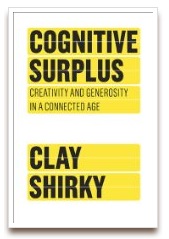
Cognitive Surplus

From Amazon: “For decades, technology encouraged people to squander their time and intellect as passive consumers. Today, tech has finally caught up with human potential. In Cognitive Surplus, Internet guru Clay Shirky forecasts the thrilling changes we will all enjoy as new digital technology puts our untapped resources of talent and goodwill to use at last.”

A few of my highlighted excerpts from Cognitive Surplus by Clay Shirky (more after the jump).

“The postwar trends of emptying rural populations, urban growth, and increased suburban density, accompanied by rising educational attainment across almost all demographic groups, have marked a huge increase in the number of people paid to think or talk, rather than to produce or transport objects.” – page 4

“Someone born in 1960 has watched something like fifty thousand hours of TV already, and many watch another thirty thousand hours before she dies.” – page 6

“…in the whole of the developed world, the three most common activities are now work, sleep, and watching TV.” – page 6

“Americans watch roughly two hundred billion hours of TV every year. … We spend roughly a hundred million hours every weekend just watching commercials.” – page 10

“As long as the assumed purpose of media is to allow ordinary people to consume professionally created material, the proliferation of amateur-created stuff will seem incomprehensible.” – page 19

“Imagine that everything says 99 percent the same, that people continue to consume 99 percent of the television they used to, but 1 percent of that time gets carved out for producing and sharing. The connected population still watches well over a trillion hours of TV a year; 1 percent of that time is mor than one hundred Wikipedias’ worth of participation per year.” – page 23

“In 2010 the global internet-connected population will cross two billion people, and mobile hone accounts already number over three billion. Since there are something like 4.5 billion adults worldwide (roughly 30 percent of the global population is under fifteen), we live, for the first time in history, in a world where being part of a globally interconnected group is the normal case for most citizens.” – page 23

Continue reading →