Because I’m eager for the movie to begin, I don’t fully appreciate the creativity and effort that goes into making the title for a film. I promise to pay closer attention.
Author Archives: Steve Mays
Discussions in Google Docs
May 14, 1984
The recent death of Derry Brownfield, one of our company’s founders, stirred up lots of memories for those of us that have been with the company for a while. Reflections on how decisions that seemed minor at the time we made them turned out to be life-changers.
Long before blogs –or personal computers– I kept a journal (sporadically) and came across one while cleaning my home office last weekend. The entry for May 14, 1984, was written (on onion skin paper) after accepting a job at Learfield. For some reason I listed the reasons for taking the job.
1. A great career opportunity. LC is into satellites, communications, etc.
2. More money
3. Opportunity to grow in position and money
4. Get Barb off the highway and to a city where she’ll have more more professional opportunities
5. Jeff City is a city of 32,000 more or less. A good size
6. I won’t have to get up at 4am
7. I won’t have to work every weekend forever
8. I will be challenged more than spinning a feew 45s, reading the weather, and (writing) a couple of dozen commercials every day.
9. I will get off holidays from time to time.
10. I will have an opportunity to work with very talented people.
11. KBOA can only get worse and worse
I hope that last one isn’t painful for those who do or have worked at KBOA in the intervening years. It was just my opinion at the time.
Most of us wonder about the road not taken. Interesting to see my specific thinking from 27 years ago. Barb loves what she’s doing; I still get up at 4 a.m. but just to pee; holidays and weekends off, check; and lots of talented people. Good call 1984 Steve.
“The twisted psychology of bloggers vs. journalists”
NYU journalism professor Jay Rosen identifies five sources of stress on today’s journalists.
- A collapsing economic model, as print and broadcast dollars are exchanged for digital dimes.
- New competition (the loss of monopoly) as a disruptive technology, the Internet, does its thing.
- A shift in power. The tools of the modern media have been distributed to the people formerly known as the audience.
- A new pattern of information flow, in which “stuff” moves horizontally, peer to peer, as effectively as it moves vertically, from producer to consumer. Audience atomization overcome, I call it.
- The erosion of trust (which started a long time ago but accelerated after 2002) and the loss of authority.
This is an insightful look at the friction between journalists and bloggers. A must-read for either species.
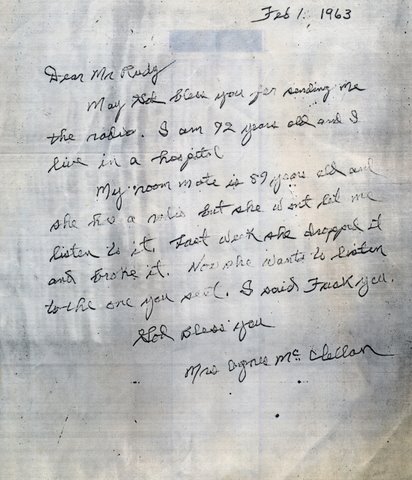
Fan letter to Mr. Rudy
I had heard this story over the years but always assumed it was apocryphal. Too good to be true. Rudy Pylant (“Mister Rudy”) was a local radio personality in my hometown. His fans were legion and he got lots of letters. Like this one his daughter recently discovered and shares.