
The Underpopulation Bomb

Kevin Kelly on what we should be worried about:

The picture for the latter half of this century will look like this: Increasing technology, cool stuff that extends human life; more older people who live longer, millions of robots, but few young people. Another way to look at the human population in 100 years from now is that we’ll have the same number of over-60-year olds, but several billion fewer youth.

Here is the challenge: this is a world where every year there is a smaller audience than the year before, a smaller market for your goods or services, fewer workers to choose from, and a ballooning elder population that must be cared for. We’ve never seen this in modern times; our progress has always paralleled rising populations, bigger audiences, larger markets and bigger pools of workers. It is hard to see how a declining yet aging population functions as an engine for increasing the standard of living every year. To do so would require a completely different economic system, one that we are not prepared for at all right now.
Consciousness

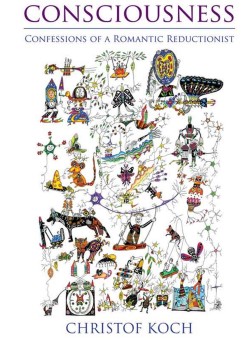
Conscious book cover“The idea that humans are special, that they are singled out by the gift of consciousness above all other creatures, stems from the deeply held Judeo-Christian belief that we occupy a privileged place in the order of things, a belief with a biblical but no empirical basis. We are not special. We are just one species among uncountable others.”

“Imagine a construction set of a thousand different types of LEGO bricks of distinct colors, shapes, and sizes. The human cerebral cortex has sixteen billion bricks chosen from these types, assembled according to fantastically elaborate rules, such as a red 2×4 brick is linked to a blue 2×4 but only if it is near a yellow 2×2 roof tile and a green 2×6 piece. From this is born the vast interconnectedness of the brain.”

“It is not the nature of the stuff that the brain is made out of that matters for mind, it is rather the organization of that stuff – the way the parts of the system are hooked up , their causal interactions.”

— Consciousness by Christof Koch

Django Unchained

From Bob Cesca’s review of Quentin Tarantino’s Django Unchained:

“The abomination of slavery in the United States and especially the psychopathy of slave owners is what will lastingly stick with me about the movie, and I’m strangely grateful for it. I’m grateful to have been reminded of the shocking truth that half of this nation as recently as 150 years ago treated African Americans as livestock to be abused and exploited however they pleased, and why, until 1861, the other half did nothing to stop it. In the end, perhaps Tarantino sought to make us all want to be Django and Dr. Schultz — to inflict justice and retribution upon the purveyors of that loathsome, nightmarish endeavor.”

I felt like I was watching something more than a gory western but would not have been able to explain why. Mr. Cesca’s review captures what I was thinking and feeling about this movie.

Twitter Radio

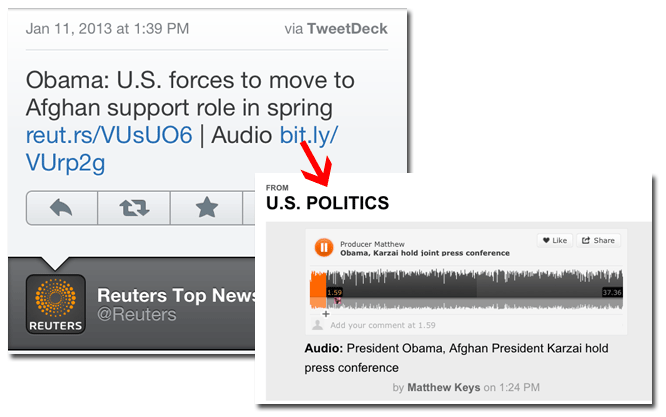
Twitter is my first source for breaking news. If anything big (that I care about) happens, it will show up first in my Twitter feed. I guess a cable news channel might come close or a good all-news radio station (do those still exist?) but my Twitter stream is non-stop in my pocket. Smart news organization (NPR and Reuters, for example) know they need to have their stories where I am, rather than try to get me to come to where they are.
twitter-radio