
A word or two about how I use Twitter

Far and away my first source for news. I’ve been on Twitter since early 2007. The first place I look in the morning and last thing I check before hitting the hay.

The 140 character limit is still my favorite feature and I hope that never changes. I follow 145 people but am continuously pruning and tweaking that list. I follow a few friends but most of my favorite tweeters are authors, reporters and publications.

To the extent I am able to tell, I only follow people who appear to be composing their own tweets. I like links to useful and interesting stuff. I avoid anonymous accounts. Before adding an account, I take a look at their profile page and read some of their tweets. If they don’t tweet with some regularity, I don’t add. If their tweets are mean, racists or sexist… no add.

I keep hearing that Twitter is in trouble. If it ever goes away it will leave a big hole in the internet. For some of us. For a while at least. In conclusion, I’d say Twitter is only as good as the people you follow and the time you spend in curating that list.
The Ruthless War on Stuff

I have a mental list of topics I try to avoid because — in my experience — they seem to make people a little (or a lot) crazy. Politics and Religion, of course. Apple products. And Marie Kondo, the best-selling author of The Life-Changing Magic of Tidying Up. I read her little book and did exactly what it said I should do to “change my life.” But I try to keep what I learned to myself (like religion and politics and Steve Jobs). But this New York Times piece is too good not to share. A few excerpts:

“By the time her book arrived, America had entered a time of peak stuff, when we had accumulated a mountain of disposable goods — from Costco toilet paper to Isaac Mizrahi swimwear by Target — but hadn’t (and still haven’t) learned how to dispose of them. We were caught between an older generation that bought a princess phone in 1970 for $25 that was still working and a generation that bought $600 iPhones, knowing they would have to replace them within two years. We had the princess phone and the iPhone, and we couldn’t dispose of either. We were burdened by our stuff; we were drowning in it.”

The success of Ms. Kondo’s book (and system) gets a big dollop of derision and smirking: “A parody book called “The Life-Changing Magic of Not Giving a [expletive],” and another one called “The Joy of Leaving Your [expletive] All Over the Place.”

But the lady seems to walk the walk: “The only visible possessions in her hotel room for a two-week trip from Tokyo were her husband’s laptop and a small silver suitcase the size of a typical man’s briefcase.”

The “organizing industry” is big in the U.S. and some of the old hands are quick to dismiss Kondo’s approach. Okay, a little more than just “dismiss”:

“Somehow the extra step of thanking the object or folding it a little differently enrages them. This rage hides behind the notion that things are different here in America, that our lives are more complicated and our stuff is more burdensome and our decisions are harder to make.”

A well-written article, whatever your thoughts on, or approach to, tidying up.

Silence

In the future, people will be prepared to pay for the experience of silence.

I extremely fortunate in this regard. I have a lot of silence in my life. I live at the end of a gravel road, surrounded by woods. No screaming children in my life (at least none I can’t avoid). Barb doesn’t need me to entertain her so I can experience hours of silence if I choose. I don’t take this for granted. The flip side is I have less tolerance for noise than I once did. From the article below (This Is Your Brain On Silence):

“Two hours of silence per day prompted cell development in the hippocampus, the brain region related to the formation of memory, involving the senses. […] The growth of new cells in the brain doesn’t always have health benefits. But in this case, Kirste says that the cells seemed to become functioning neurons.”

“There isn’t really such a thing as silence,” says Robert Zatorre, an expert on the neurology of sound. “In the absence of sound, the brain often tends to produce internal representations of sound.

“If you want to know yourself you have to be with yourself, and discuss with yourself, be able to talk with yourself.”

I do a good bit of this kind of introspection and, occasionally, wonder if it’s good for me. The article says yes. Shhh.

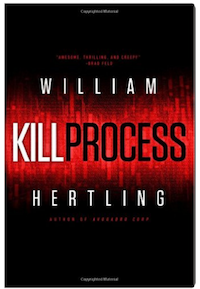
Kill Process

killprocess“By day, Angie, a twenty-year veteran of the tech industry, is a data analyst at Tomo (think Facebook), the world’s largest social networking company; by night, she exploits her database access to profile domestic abusers and kill the worst of them. […] When Tomo introduces a deceptive new product that preys on users’ fears to drive up its own revenue, Angie sees Tomo for what it really is–another evil abuser. Using her coding and hacking expertise, she decides to destroy Tomo by building a new social network that is completely distributed, compartmentalized, and unstoppable. If she succeeds, it will be the end of all centralized power in the Internet.”
Kill Process by William Hertling

This is one of the geekier/techy novels I’ve read in awhile. The author went to great pains to get the hacker stuff right. (Or right-ish)