
Can We Be Saved From Facebook?

If I had to pick a favorite quote from Matt Taibbi’s Rolling Stone piece on Facebook it would have to be: “When a tumor starts growing teeth and hair, you don’t comb the hair. You yank the thing.” If you love some Facebook or hate it… or don’t think about it at all, you’ll find this long article interesting. Here’s a few excerpts:

Facebook doesn’t push Nazism or communism or anarchism, but something far more dangerous: 2 billion individually crafted echo chambers, a kind of precision-targeted mass church of self, of impatience with others, of not giving a shit.

Whether Facebook is just a reflection of modern society or a key driver of it, the picture isn’t pretty. The company’s awesome data-mining tactics wedded to its relentless hyping of the culture of self has helped create a world where billions of people walk with bent heads, literally weighted down with their own bullshit, eyes glued to telescreen-style mobile devices that read us faster than we can read them.

An astonishing 45 percent of Americans get their news from this single source. Add Google, and above 70 percent of Americans get their news from a pair of outlets. The two firms also ate up about 89 percent of the digital-advertising growth last year, underscoring their monopolistic power in this industry.

(Former Facebooker Antonio Garcia Martinez) describes the company’s corporate atmosphere as an oddball religion where Zuckerberg is worshipped as an infallible deity – sort of like Scientology, but without Tom Cruise or space invaders.

But by the Eighties and Nineties, everyone in media was realizing that audiences cared more about seeing graphics, panda births and newscasters withstanding hurricane winds than they cared about news. The innovation of stations like Fox was to sell xenophobia and racism in addition to the sensationalist crap. But even Fox couldn’t compete with future titans like Facebook when it came to delivering news tailored strictly for the laziest, meanest, least intellectually tolerant version of you. Facebook knew more about you personally, what you might like and also what might tickle your hate center, than any TV, radio station or newspaper ever had.
AirPods and the Three Stages of Apple Criticism

“I really wish I was exaggerating, but these seven reasons are the main ways Apple critics attempt to explain why someone would choose to buy products critics believe are both overpriced and inferior to their competition. Because if you’ve already come to the conclusion that Apple products are overpriced and inferior, but hundreds of millions of people still buy them, the only conclusion must be that there is something seriously wrong with the people who buy them.” (Jonathan Kim)

Every week I see someone new come into the coffee shop with AirPods. Rare to see any other brand of Bluetooth headphones. Same with the Apple Watch. If you happen to spot something other than an Apple Watch, look around because there’s one of those two-wheeled scooters leaning against a wall close by.

Going Postal

Once a month every company should survey (anonymously) all employees, asking which of their co-workers is most likely to come to work shooting. Maybe the top three most likely employees. Not sure what you’d do with that information but it wouldn’t surprise me if this woman’s name would have made the list.

Once ‘smarter’ AIs are running offices (monitoring all communication; video; etc) they’ll spot the shooters days in advance. Their metal detectors will know they’re packing when they walk through the door.

Now, take a few minutes to make your own list. The three people in your life most likely to go postal. You’re welcome.

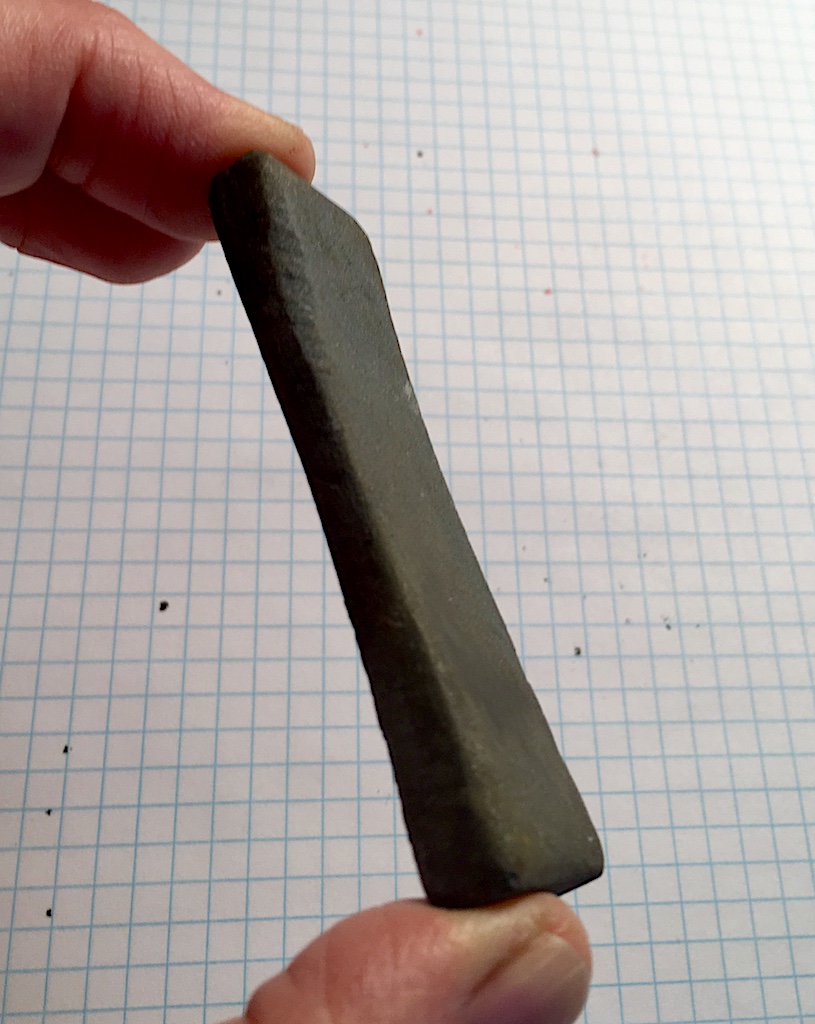
My grandmother’s whetstone

I found this whetstone in a box of keepsakes when I cleaned out the attic of my parents home (many years ago). It belonged to my maternal grandmother, Inus Perry.

Neither my mom or dad carried a pocket knife or a pen knife (a British English term for a small folding knife) but I never saw my grandmother without one. And she kept it razor sharp with this stone, or one exactly like it (Eventually they became so thin they’d break).

I remember the blades on my grandmother’s knife (one long, one short, both sharp) showed similar wear from constant use and sharpening. Over time the edge would become thinner, concave.

I suspect pocket knives — of the sort I’m remembering — were a rural, small town thing. People needed and used knives on the farm and kept them when they moved to town. There were a couple of wooden benches just outside the county courthouse where old men passed the time. Known by one and all as “the spit and whittle club,” these guys endlessly swapped pocket knives, back and forth. Pausing from time to time to squirt a stream of tobacco juice into the dirt.

I still see men carrying knives but, as with all else, they’re more high tech these days and you are unlikely to see them lovingly dragging the blade back and forth on a whetstone. No emotional connection. Just a tool. If there is anything more zen than sharpening a knife on a whetstone, I can’t imagine what it might be.