
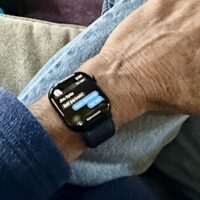
Apple Watch continues to amaze

It took me ten years to take the Apple Watch plunge but after five weeks I can’t imagine how I got by without it. Can’t recall a single day during the past month that I didn’t find myself staring at my wrist in amazement.

While sitting on the couch with my morning coffee I heard a tiny ping and felt a gentle vibration on my wrist letting me know I had received a message. With little/no thought I voiced a reply.

You have to understand, this is big juju for one who remembers a time before mobile phones (and fax machines and ATM’s and credit cards!) And I’m probably using 2% of the watch’s capabilities. It’s like rummaging around in a magician’s closet. “Ooh! Look at this!”

As hoped, I am leaving the iPhone at home or in the other room more often. Marginally less screen time. And it turns out the health and fitness hype is not hype, at least not for me. I’m exercising daily and getting more sleep.

I still have high hopes for “Apple Intelligence” and what it might be able to do with all the data my watch is collecting and has access to.

“Almost Cut My Hair”

(Wikipedia) “Almost Cut My Hair” is a song by Crosby, Stills, Nash & Young, originally released on the band’s 1970 album Déjà Vu. It was recorded at Wally Heider Studios on January 9, 1970.

The song describes a real-life dilemma faced by many hippies: whether to cut one’s hair to a more practical length, or leave it long as a symbol of rebellion.[3] It was written by David Crosby, and features solo vocals by Crosby, with the rest of the band joining in on instruments rather than on vocal harmony, as in many of their other songs. […] It was one of only two songs from the album that Neil Young joined in on, despite not writing.

Although the notion of long hair as a “freak flag” appeared earlier, notably in a 1967 Jimi Hendrix song “If 6 Was 9”, Crosby’s song has been credited with popularizing the idea of long hair as a deliberate and visible symbol of the wearer’s affiliation with the counterculture, and opposition to establishment values. The song also evokes the singer’s “paranoia” at seeing the police; James Perone writes that, “more than any other song of the entire era”, it “captures the extent to which the divisiveness in American society … had boiled over into violence and terror”.

It became one of Crosby’s signature songs, and “probably his most important political song”.Crosby himself stated “It was the most juvenile set of lyrics I’ve ever written … but it has a certain emotional impact, there’s no question about that.”