“Google+ is a bank”

Dave Winer believes Google+ wants to “move money around the same way Amazon does. They need your real name because it’s a business.”

“Google-Plus is their integrated communication system. Over time, it’s going to be at the core of everything they do, from auctions, to paying for things with Android phones, to their groupon and yelp clones. They’re going everywhere, and this is the system that will tie it all together. So, at the outset, of course they need real identities. That Google-Plus account you’re playing with today is going to be your bank account next year.”

“Why the impossible happens more often”

Kevin Kelly is one of the brilliant thinker/writers I look to for hope (along with Scott Adams, Clay Shirky, William Gibson and a few other). Following are from a post on why the impossible happens more often these days:

“Collectively we behave differently than individuals. Much more importantly, as individuals we behave differently in collectives. This has been true a long while. What’s new is the velocity at which we a headed into this higher territory of global connectivity. We are swept up in a tectonic shift toward large, fast, social organizations connecting us in novel ways. There may be a million different ways to connect a billion people, and each way will reveal something new about us. Something hidden previously.”

“Most of what “everybody knows” about us is based on the human individual. Collectively, connected humans will be capable of things we cannot imagine right now. These future phenomenon will rightly seem impossible.”

“My prediction is that in the coming years our biggest surprises — the ones that aren’t predicted — will be the result some new method of large scale social interactions. While we will get good at predicting the next advance of technological innovation, we won’t get very good at predicting what happens with the hive mind. And exploring the hive mind — the thousands of ways in which we can connect and reconnect ourselves — will be the chief activity of our civilization in the near term. If I am right then we’ll have to get better at believing in the impossible.”

Tailor-made usually, but not always, better

We’re talking websites now. The new theme here started me thinking about this.

This theme was created by StudioPress and was very affordable. Took me 15 minutes to download and install. My only contribution to the design was picking a color scheme I liked.

When I started blogging 10 years ago, I spent HOURS futzing with the design of the blog. Graphics, colors, fonts… anythign that could be changed, I changed.

And with each tweak, the site looked a little less professional. I thought I was making it “better,” but looking back, no way.

I have a theory that –in most instances– an off-the-shelf design, like the ones I get from StudioPress (and there are lots of good places to buy themes) is going to look better than a site designed from the ground up.

This is based on two assumptions:

1. The client will be very involved in the design of the custom theme

2. NO change is made to the stock theme.

When paying a lot of bucks for a custom design, the typical clinet will insist on a lot of input. The designer will try to stay close to her original vision, but it’s difficult. And once the client gets his hands on the site, he will –if humanly possible– fuck it up. We can’t help it. We have to tinker.

Let us consider now the design of the stock theme. There IS no client yet. The designer has the time and freedom to create a perfect theme, if there is such a thing. Every element carefully chosen to work with every other element.

Yes, a good developer can take one of these themes and customize them in such a way as not to destroy the original, but the client will make that very hard (see above)

Am I concered that hundreds or thousands of websites are using this exact theme? Nope. Only a fraction of said sites would ever have enough traffic to make it likely someone would notice. And if they do, well, it’s like to gorgeous models wearing the same gown to the ball. They both look great.

It’s taken me a while to get to this place. To be willing to accept that I can only make the original worse… not better.

If you want to comment on my little theory, join me over at Google+. I’ll cross post there.

“How Google Dominates Us”

James Gleick’s The Information was one of the more interestisng books I’ve read this year. And this piece in the New York Review of Books he talks about “How Google Dominates Us. A few of my favorites:

  • “The business of finding facts has been an important gear in the workings of human knowledge, and the technology has just been upgraded from rubber band to nuclear reactor.”
  • “When (we) say Google “possesses” all this information, that’s not the same as owning it. What it means to own information is very much in flux.”
  • “(Google has) been relentless in driving computer science forward. Google Translate has achieved more in machine translation than the rest of the world’s artificial intelligence experts combined.”
  • “The merchandise of the information economy is not information; it is attention. These commodities have an inverse relationship. When information is cheap, attention becomes expensive. Attention is what we, the users, give to Google, and our attention is what Google sells—concentrated, focused, and crystallized.”
  • “Google makes more from advertising than all the nation’s newspapers combined”
  • “The perfect search engine, as Sergey and Larry imagine it, reads your mind and produces the answer you want. The perfect advertising engine does the same: it shows you the ads you want. Anything else wastes your attention, the advertiser’s money, and the world’s bandwidth.”

Almost every article about Google worries about the potential danger of someone having so much information about us. And yet, few seem concerned about how much power, information and control governments have over us. I’ll trust Larry and Sergey over any politician that has come along in my lifetime.

The Ego Trick: In Search of the Self by Julien Baggini

Excerpts from The Ego Trick: In Search of the Self by Julien Baggini
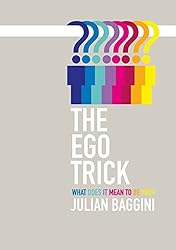

We all tend to think there’s a connection between the four-year-old child on our first day of school and us now. What makes us the same is we believe we’re the same. Sense of self over time is therefore the story that we tell ourselves that keeps us together. pg 39

The Ego Trick – The remarkable way in which a complicated bundle of mental events, made possible by the brain, creates a singular self, without there being a singlular thing underlying it. pg 123

There is an Ego Trick, but it is not that the self doesn’t exist, only that it is not what we generally assume it to be. pg 151

Consciousness of self emerges from a network of thousands or millions of conscious moments. pg 40

We are constantly rewriting our histories to keep our inner biographies coherent. pg 40

The self is a construction of the mind, one flexible enough to withstand constant renovation, partial demolition and reconstruction. pg 41

We all ignore and do not commit to memory facts and events that conflict with the way we see ourselves and the world. We remember selectively, usually without conscious effort or desire to do so. And yet because we believe memory records facts, objectively, we fail to see that all this means that we are constructing ourselves and the world. pg 49

“I have a belief that dementia actually makes you more like yourself, so rather than rob you of your self, it robs you of all the exterior things that you pile on through life, all the baggage that you carry and the layers. What you’re left with at the end of the day with dementia is the core person, the soul, or whatever term you want to put on it. We’ve described it as an onion. If you peel an onion, from the brown skin outwards, you’ve got lots and lots of layers. When you get right to the centre of the onion you get to a little pearl in the middle and you can’t peel any more off it. It seems to me that is the real essense of the person.” – pg 54

We are nothing but our parts, but we are more than just our parts. pg 69

The self is not a single thing, it is simply what the brain and body system does. pg 83

18th century philosopher David Hume: “For my part, when I enter most intimately into what I call myself, I always stumble on some particular perception or other, of heat or cold, light or shade, love or hatred, pain or pleasure, colour or sound, etc. I never catch myself, distinct from some such perception.”

(Baggini) Our minds are just one perception or thought after another, one piled on another. You, the person, is not separate from these thoughts, the thing having them. Rather you just are the collection of these thoughts.

(Hume again) “nothing but a bundle or collection of different perceptions, which succeed each other with an inconceivable rapidity, and are in a perpetual flux and movement.” pg 119

“non-reductive physicalism” — The self is not a substance or thing, it is a function of what a certain collection of stuff does. In other words, we are made up of nothing more than physical stuff, but to describe our true nature, you need more than just a physical vocabulary. You cannot full describe what it is to be a person in the language of biology; but that does not mean a person has non-biological parts. pg 120-121

“The Buddha’s idea of self therefore is something we create. Your identity, your sense of being a person is formed through your actions, and that is only possible becasue there is not a fixed self. There is no unchanging essence or substance to which those attributes are then attached at all.” — Stephen Batchelor pg 148

“The existence of the self as an independent, eternal and atemporal unifying principle is an illusion.” — Thupten Jinpa pg 148

The self is not an illusion. What is illusory is an idea of self which sees it as an unchanging, immortal essence. pg 148

The self is an illusion, but not just an illusion. But still, I would prefer to do away with talk of illusion altogether. Talk of illusion suggests there is a way of perceiving onself free from that illusion. But there isn’t. pg 150

The solidity of self is an illusion; the self itself is not. pg 152

“We are responsible for our actions not because they are our products but because they are us, because we are what we do.” — Christine Korsgaard pg 168

The Ego Trick: In Search of the Self
