Will advertising become obsolete?

What does Seth Godin think of advertising? Is it unnecessary? Here is his answer from a blog post at Real Time Advertising Week

“Not unnecessary. Gradually becoming obsolete, though. The cost of the ads goes up, the impact goes down. How can it not? Once people get a TiVo and a Facebook account, the way they allocate their attention changes. And that means the people you most want to reach don’t necessarily want to be reached.”

His answer has been on my mind since I read it. Advertising is “gradually becoming obsolete?” How does someone who works at a company that runs on advertising revenue react to such a statement? A few possibles:

  • Seth Godin is a smart guy and he’s been right more than he’s been wrong so we’re fucked
  • He’s right but it’s going to take a lot longer than he thinks it will
  • He’s partially right. Some advertising is becoming obsolete, but not the advertising that drives our company
  • Advertising is changing and we might call it something else but companies will always be willng to pay to to reach their customers with selling messages
  • He’s wrong. Advertising is here to stay. Period.

Did I miss any?

Frankly, to even wonder about this feels… heretical. Like questioning the flatness of the earth. I’ve written ads; I’ve voiced and produced ads; I’ve helped sell ads. Always taking it as a matter of faith that they worked. If they didn’t, why are businesses buying all these commercials we air on our (pick your medium)? And that they’d always be around.

Your thoughts?
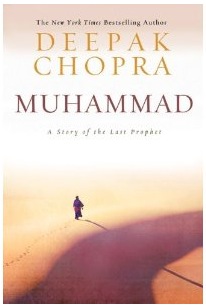
Muhammad: A Story of the last Prophet

I finished the novel Muhammad yesterday and have been pondering what to say about it. I found the story interesting and well-told. I’ve read a number of other books by Deepak Chopra and like the way he writes.

I think I’ll let smarter, more knowledgable folks review the book. No shortage there. So, what can I say about the novel?

If you were a kid, or have a kid, or you’ve been to a kid’s party, you’ve seen those guys that make balloon animals. Before blowing up those long skinny balloons they twist and shape into giraffes and stuff, they usually stretch the balloon. And as they inflate the balloon, they sometimes bend and turn it.

That’s what much of my reading has been like in the last few years. My thinking gets stetched and expanded, often to the breaking point.

One guy makes a hat, the next a horse. I enjoy them all and try to remember it’s all the same air inside the different colored balloons.

I knew almost nothing about the Prophet Muhammad. Now I know more. And maybe a little about the people who follow his teachings.

I fear many of those who would discuss this with me a) haven’t read the book and b) would be intent on explaining why Islam is wrong. (In their world, there is only one balloon and it’s blue and round.)

For that reason, I’ll limit comments to those who have read the book. So be prepared with a specific page reference.

Rapportive. Making Gmail just a little better

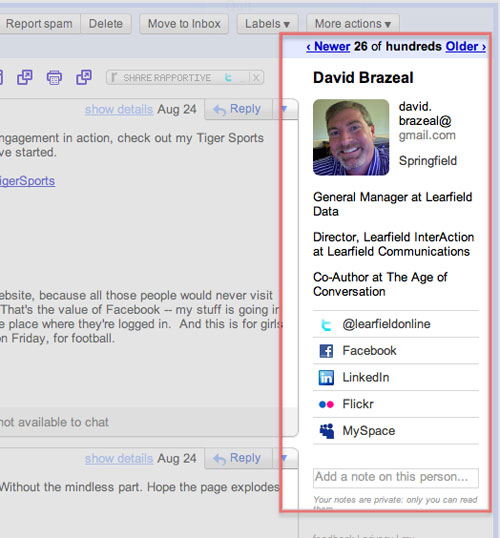
Gmail is –and has been for some time– my primary email tool. The reasons for this grow longer every day. The most recent is a little add-on called rapportive.

Once installed, rapportive searches the web for each of your email contacts and displays profile information (if available), links to social networks, even recent tweets. There’s also a place for notes about that contact.

It looks like rapportive replaces the Google Ads but I’m not sure why Google would allow that.

If your first reaction is, “I don’t want the people I email knowing this stuff about me,” well, you need to run out and buy some stamps and envelopes. If you want to get into my in-box, transparancey is the price of admission.

It’ll take a week or two to know if this is as useful as it first appears. If you are a fan of Gmail, give rapportive a try (it’s free) and let me know what you think.

Social media and news

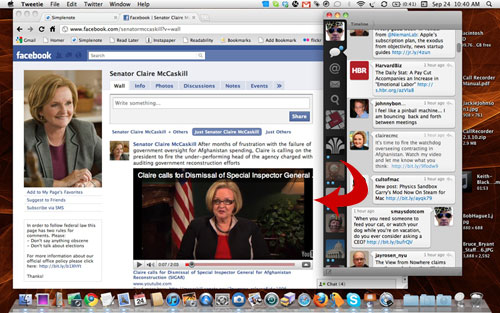
This morning Missouri Senator Claire McCaskill tweeted that it’s time to “fire the watchdog overseeing contracting in Afghanistan.” She included a link and invitation to her Facebook page where she posted a video explaining her positon and asking “what do you think?”

I’m sure this is happening hundreds of times a day but this still feels like something significant is happening. The senator has 40,000+ followers on twitter (not sure about Facebook). I’m sure elections have been won and lost by that many votes, but that’s not my point.

How would the senator have made her position known pre-twitter/facebook? Press release emailed to hundreds of media outlets? Radio interviews with big news stations in St Louis and Kansas City? Maybe a few seconds for a satellite interview with a couple of TV stations (or the networks)?

And for all I know she’s still doing this but in every instance, the media controls the experience. And there would be little or no opportunity for engagement with the people.

It’s not difficult for me to imagine a time in the very near future where Twitter replaces the emailed (faxed?!) news release. That’s probably already happening. And I am seeing more and more YouTube and Facebook video showing up in “newscasts.”

Real Journalists would insist that much is lost by them not having an opportunity to ask the senator “the hard questions.” But the’ll be hard pressed to find many viewers/listeners/readers who agree their questions add much. Not saying they’d be right, just that they don’t agree.

I’m going to go back to Senator McCaskill’s Facebook page and read some of the comments. And if anyone can put me in touch with her social media advisor(s), I’d really like to talk to them because they seem to know what they’re doing.

In Missouri, judges now calculate cost of punishment

Missouri (where I live) isn’t known as a hot bed of technology. Or, perhaps it is and I was just unaware. Always a possibility. Anyway… I came across a fascinating story by Monica Davey (New York Times). Judges in Missouri are the first in the country to use a computer algorithm to compute the cost of the sentence they hand down. From Ms. Davey’s story:

“Months ago, members of the Missouri Sentencing Advisory Commission, a group of lawyers, judges and others established by state lawmakers years ago, voted to begin providing judges with the cost information on individual cases.

The concept is simple: Fill in an offender’s conviction code, criminal history and other background, and the program spits out a range of possible sentences, statistical information about the likelihood of Missouri criminals with similar profiles to commit more crimes, and, most controversially, the various options’ price tags.

For someone convicted of endangering the welfare of a child, for instance, a judge might learn that a three-year prison sentence would run more than $37,000 while probation would cost $6,770. A second-degree robber, a judge could be told, would carry a price tag of less than $9,000 for five years of intensive probation, but more than $50,000 for a comparable prison sentence. The bill for a murderer’s 30-year prison term: $504,690.”

This makes perfect sense to me. Good to see Missouri out in front on something like this.

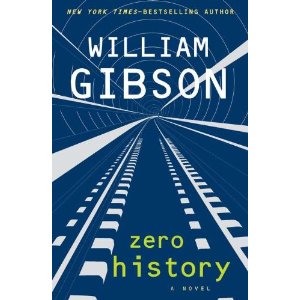
zero history

zero history is the final novel in William Gibson’s trilogy that started with Pattern Recognition. Hollis Henry is back from book two, Spook Country. I wouldn’t presume to review the work of Mr. Gibson. Here are a few of his words that got some highlighter:

“It was like being on the bottom of a Coney Island grab-it game, one in which the eclectically ungrabbed had been accumulating for decades. He looked up, imagining a giant three-pronged claw, agent of stark removal.” – pg 9

“His attempted smile felt like something froced from a flexible squeeze-toy.” – pg 10

“An overly wealthy, dangerously curious fiddler with the world’s hidden architectures.” – pg 18

“We do brand vision transmission, trend forecasting, vendor management, youth market recon, strategic planning in general.” – pg 21

“Addictions (start) out like magical pets, pocket monsters.” – pg 53

Continue reading

On the nightstand

The Grand Design – Stephen Hawking & Leonard Mlodinow. From Amazon: “The three central questions of philosophy and science: Why is there something rather than nothing? Why do we exist? Why this particular set of laws and not some other? No one can make a discussion of such matters as compulsively readable as the celebrated University of Cambridge cosmologist Hawking (A Brief History of Time).”

How to Disappear: Erase Your Digital Footprint, Leave False Trails, and Vanish without a Trace . From Amazon: “Written by the world’s leading experts on finding people and helping people avoid being found, How to Disappear covers everything from tools for disappearing to discovering and eliminating the nearly invisible tracks and clues we tend to leave wherever we go. Learn the three keys to disappearing, all about your electronic footprints, the dangers and opportunities of social networking sites, and how to disappear from a stalker.”

I Live in the Future and Here’s How It Works – Nick Bilton. From Amazon: “I Live in the Future & Here’s How It Works captures the zeitgeist of an emerging age, providing the understanding of how a radically changed media world is influencing human behavior.”

    Interview with William Gibson

    My favorite author, far and away. Just finished his new novel, Zero History. Here are a few bits that caught my attention in the interview:

    • I find Twitter to be the most powerful aggregator of sheer novelty that humanity has yet possessed.
    • “I think the concept of “mainstream” is probably becoming archaic in some sense.”
    • “The mainstream is more digestible by osmosis”
    • “I wonder if we’ll ever have consensus (again)?”
    • “Generally, we don’t know what we were doing with something until we quit doing it.”
    • “When I see Glenn Beck –to the very small extent I do, if I can help it– it’s like Devo’s vision made flesh”
    • “I now write with the assumption that someone will google every unfamiliar word and term as they go through the book.”
    • “The footnote now lives in cyberspace, a click away”