LibraryThing: Legacy Libraries

I started using BookBuddy this past July but still catalog my books in LibraryThing. While tweaking an entry today I noticed I had been given the Vigesimal Veteran badge (awarded to members who have been using the site for more than twenty years).

While I have more than 1,000 books in my LibraryThing catalog, I don’t use many of the features of the site. When I do poke around a bit, I usually discover something interesting, like Legacy Libraries.

Legacy Libraries are the libraries of historical people (as well as a few institutions), entered into LibraryThing by dedicated members working from a variety of sources, including published bibliographies, auction catalogs, library holdings, manuscript lists, wills and probate inventories, and personal inspection of extant copies. The project began with Thomas Jefferson’s library, which a small group of volunteers began cataloging in September 2007.

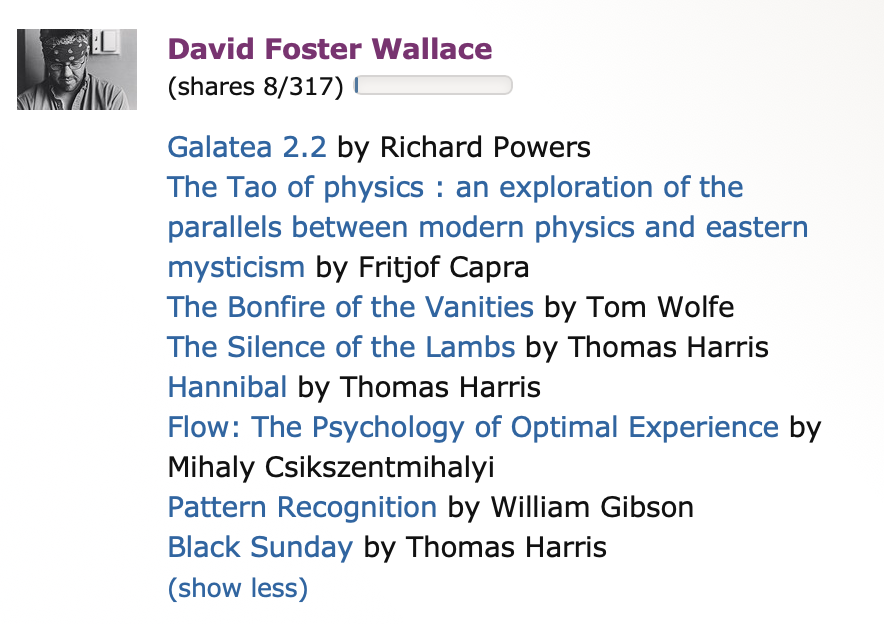
It always pleases me to discover someone who shares my taste in books. Even more so if that person happens to be famous or noteworthy. Three examples: David Foster Wallace, Walker Percy and Terence McKenna.
LibraryThing

LibraryThing is a social cataloging web application for storing and sharing book catalogs and various types of book metadata. It is used by authors, individuals, libraries, and publishers. It went live on August 29, 2005 and has 2,600,000 users and over 155 million books catalogued. (Wikipedia)

I started using LibraryThing in September of 2005 and currently have 896 books in the database: 596 fiction, 236 non-fiction… by 336 authors. Some of my favorites:

John Sandford (43)
Michael Connelly (33)
Lawrence Block (31)
Sue Grafton (23)
Elmore Leonard (23)
John D. Macdonald (22)
Robert B. Parker (22)
Ross Thomas (21)
Bill Granger (15)
John Grisham (15)
William Gibson (14)
Carl Hiaasen (13)
Neal Stephenson (13)
Robert K. Tanenbaum (12)
James S. A. Corey (11)
Gregory Mcdonald (11)
Robert Parker (11)
James Patterson (11)
Nelson DeMille (10)

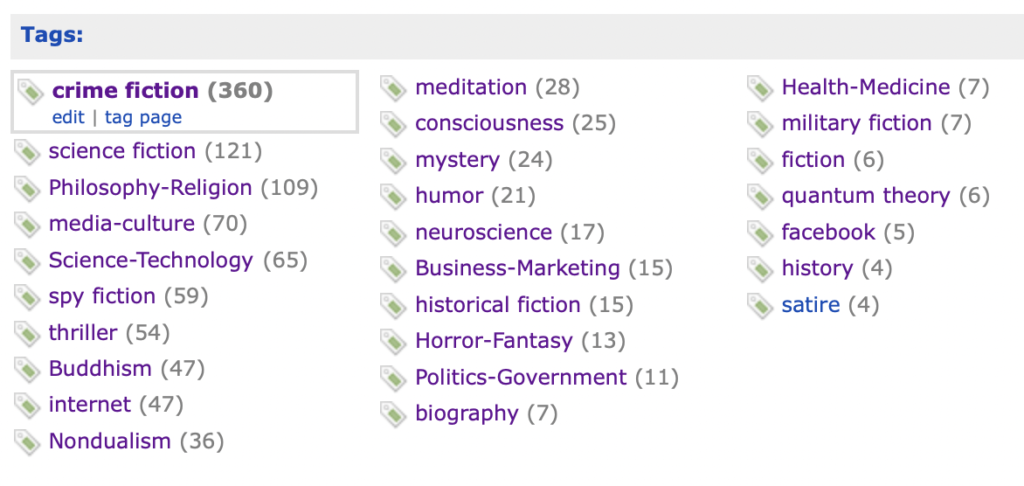
I continue to fine-tune my tags. Still the best snap-shot of my interests.

PS: Amazon says I’ve purchased more than 700 books starting in 1998.

LibraryThing (update)

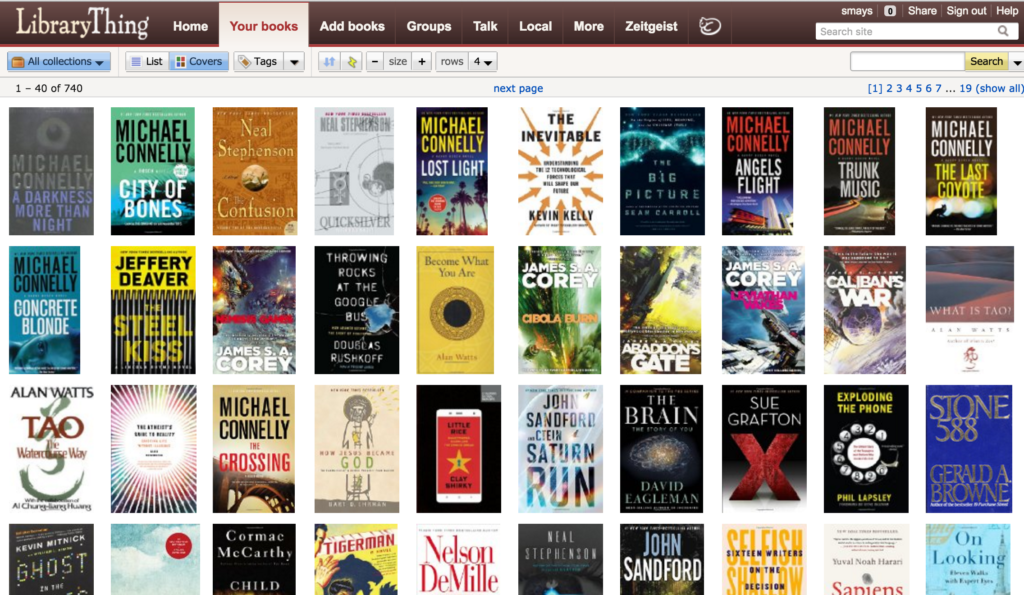
Screen Shot 2016-06-20 at 11.09.48 AMI started using LibraryThing to manage my library in 2005, about a month after the service launched. I was using a spreadsheet for this task but quickly fell in love with the tools and features LibraryThing provided. I find their smartphone app very handy.
I have 740 titles in my LibraryThing long ago gave away most of the books. Someone calling themselves eandino2012 has more than 81 thousand titles in her/his LibraryThing.

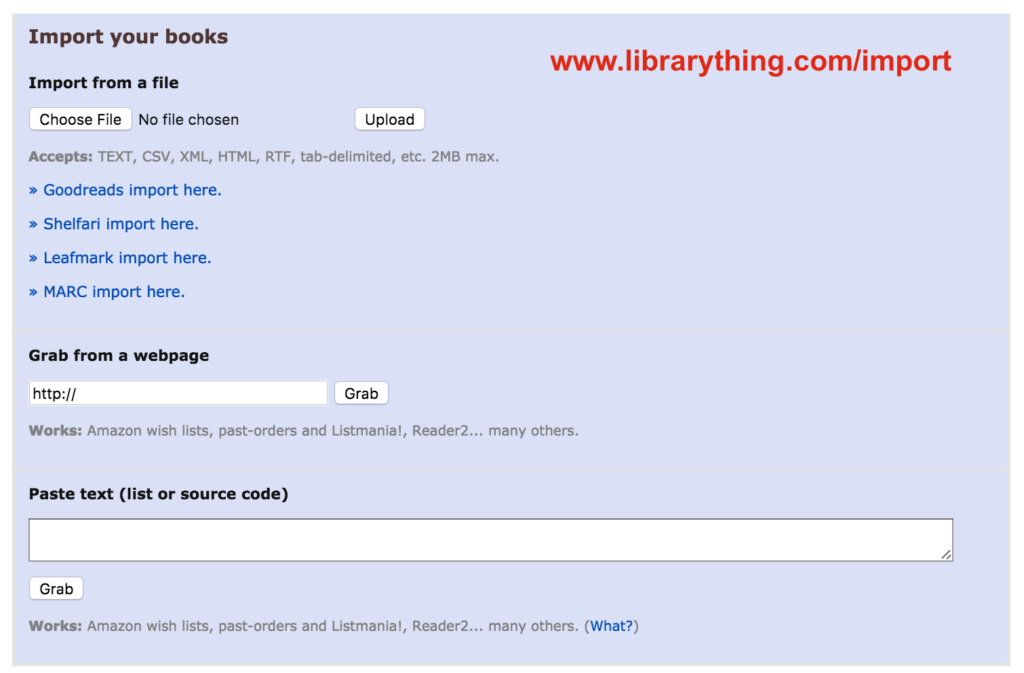
If you’ve considered using a service like LT or Goodreads but dreaded the task of uploading all your book titles, LT has a good import tool (see below) and their smartphone app can scan ISBN barcodes. Neither of those were around back in 2005 so I entered mine one at a time.
import

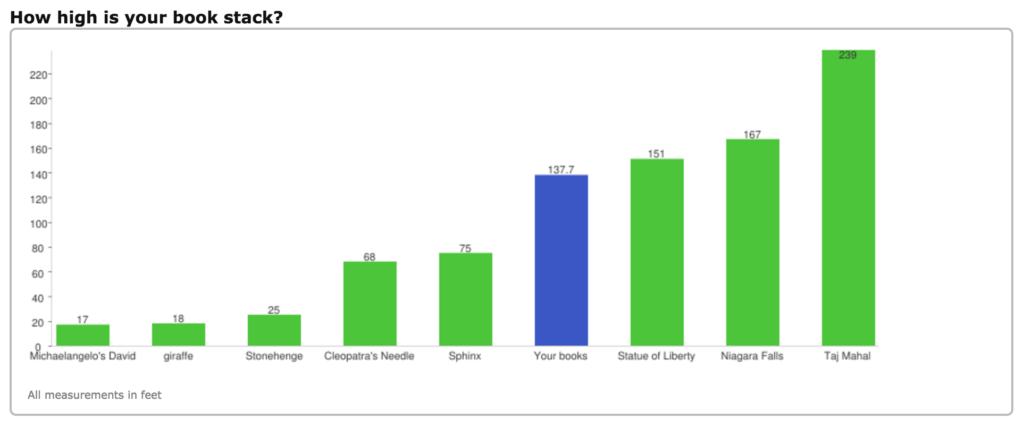
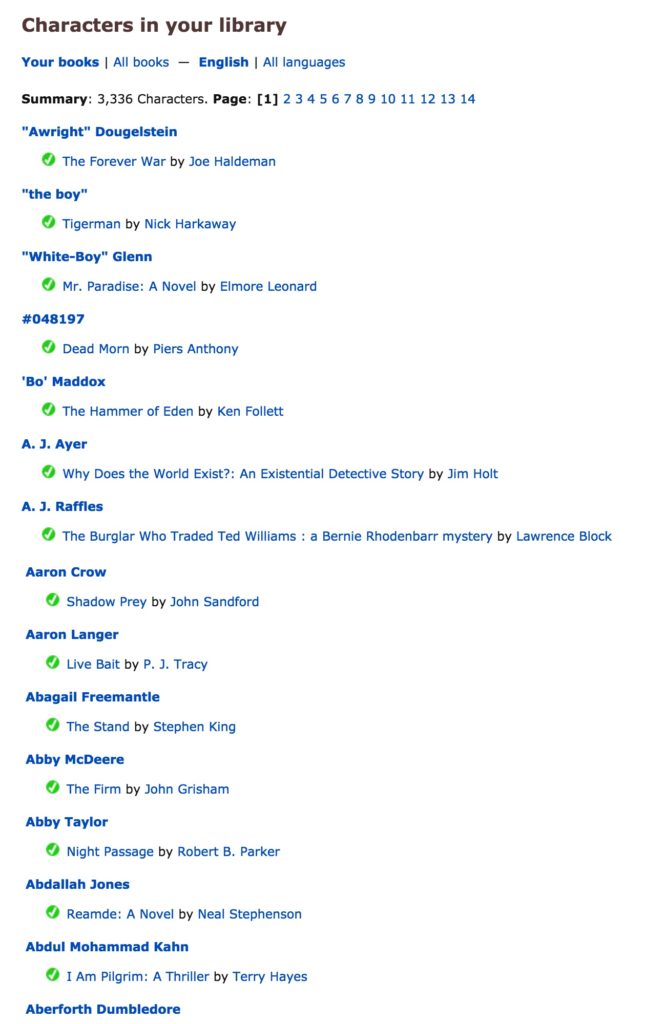
LT does some fun stuff (total cubic feet of your books; how high if stacked, etc) and some useful (to me) stuff: list of all characters in the books in your LT.

height characters

I know of no better use of my time than reading. Books are important to me. LibraryThing is a way to extend the pleasure I get from books.

Buddhism Without Beliefs by Stephen Batchelor

buddhism-beliefsI’m not really sure what Stephen Batchelor is trying to say in Buddhism Without Beliefs. I think his main idea is there in the title. Excerpts below got some highlighter… real reviews at Amazon.  This wasn’t one of my favorite books on the topic.


Awakening is no longer seen as something to attain in the distant future, for it is not a thing but a process — and this process is the path itself. […] It is an authentic way of being in the world.

The dharma is not something to believe in but something to do. [ Wikipedia: In Buddhism dharma means “cosmic law and order”, but is also applied to the teachings of the Buddha.]

An agnostic Buddhist is not a “believer” with claims to revealed information about supernatural or paranormal phenomena, and in this sense is not “religious.” […] The dharma is not a belief by which you will be miraculously saved. It is a method to be investigated and tried out. […] An agnostic Buddhist eschews atheism as much as theism, and is as reluctant to regard the universe as devoid of meaning as endowed with meaning.

Buddhism could be described as “the culture of awakening.”

Religions are united not be belief in God but by belief in life after death.

Regardless of what we believe, our actions will reverberate beyond our deaths. Irrespective of our personal survival, the legacy of our thoughts, words, and deeds will continue through the impressions we leave behind in the lives of those we have influenced or touched in any way.

Life is neither meaningful nor meaningless. Meaning and its absence are given to life by language and imagination.

Anguish emerges from craving for life to be other than it is.

Dharma practice is founded on resolve. […] An ongoing, heartfelt reflection on priorities, values and purpose. […] Dharma practice is the process of awakening itself: the thoughts, words, and deeds that weave the unfolding fabric of experience into a coherent whole.

The process of awakening is like walking on a footpath. When we find such a path after hours of struggling through undergrowth, we know at last that we are heading somewhere. Moreover, we suddenly find that we can move freely without obstruction. We settle into a rhythmic and easy pace. […] What counts is not so much the destination but the resolve to take the next step.

Focused awareness is difficult not because we are inept at some spiritual technology but because it threatens our sense of who we are.

The stiller the mind, the more palpable the dazzling torrent of life becomes.

The world is so saturated with the meanings given to it that those meanings seem to reside in the things themselves.

At every moment we are either inclining toward or engaged in an act: a physical movement, an utterance, a thought. Even when you decide not to act, you are still doing something: refraining.

As you sit in meditation, notice how what you are doing is the enactment of an earlier resolve. By attending to the details of this present moment, by choosing not to recollect the past or plan for the future, you are engaged in a process of creating yourself in a specific and deliberate way.

What are we but the story we keep repeating, editing, censoring, and embellishing in our heads? [I am] an unfolding narrative.

We cannot attain awakening for ourselves: we can only participate in the awakening of life.

When belief and opinion are suspended, the mind has nowhere to rest.

Library Thing fun facts

Library Thing is an only database for keeping track of your books. And it does so much more than that. Today,for example, I discovered a page that illustrates the height of my books if stacked (higher than the Sphinx, shorter than the Statue of Liberty):

And that they would fill 21 U-Haul book boxes or 5 IKEA Billy bookcases. Or, if I tore the books apart and laid all the pages end to end, they would stretch for 13.25 miles.

Interesting, but not very useful. And then I found a page that listed all the characters in the books in my library. Now that is handy. Can’t remember one of the bad guys in a John D. MacDonald novel? You can find it here. [Boone “Boo” Waxwell, Bright Orange for a Shroud]


If you are daunted by the prospect of entering all of your books into the Library Thing database, I believe there are scanner apps for your smart phone.


Muhammad: A Story of the last Prophet

I finished the novel Muhammad yesterday and have been pondering what to say about it. I found the story interesting and well-told. I’ve read a number of other books by Deepak Chopra and like the way he writes.

I think I’ll let smarter, more knowledgable folks review the book. No shortage there. So, what can I say about the novel?

If you were a kid, or have a kid, or you’ve been to a kid’s party, you’ve seen those guys that make balloon animals. Before blowing up those long skinny balloons they twist and shape into giraffes and stuff, they usually stretch the balloon. And as they inflate the balloon, they sometimes bend and turn it.

That’s what much of my reading has been like in the last few years. My thinking gets stetched and expanded, often to the breaking point.

One guy makes a hat, the next a horse. I enjoy them all and try to remember it’s all the same air inside the different colored balloons.

I knew almost nothing about the Prophet Muhammad. Now I know more. And maybe a little about the people who follow his teachings.

I fear many of those who would discuss this with me a) haven’t read the book and b) would be intent on explaining why Islam is wrong. (In their world, there is only one balloon and it’s blue and round.)

For that reason, I’ll limit comments to those who have read the book. So be prepared with a specific page reference.

MothBoard

I just came across the coolest thing while reading the Library Thing blog:

“MothBoard allows you to create simple, private discussion boards for free, and without registration. Boards normally expire in two weeks, but you can extend their life indefinitely.”

I’m gonna try this here at smays.com as soon as I think of the right topic. Unlike complex, threaded forums, MothBoard just goes two deep (topic & reply). No endless replies-to-replies-to-replies. And if there isn’t sufficient interest to keep a topic alive, the board dies. As it should. Neat idea, stay tuned.