
Tech improves ER care

It’s the middle of the night and you’re just north of East Jesus, headed to the beach so the kids can play in an oil slick before they’re all gone, and gandma chokes on prune. How do you find the nearest emergency room? According to Telemedicine News, there’s an app for that:

Researchers at Massachusetts General Hospital’s Emergency Medicine Network have launched FindER™, a free iPhone application to help users locate the closest emergency room, provide directions, along with additional information all with a touch of the screen.

FindER uses the iPhone’s GPS to quickly direct patients to emergency rooms anywhere in the U.S. FindER is also designed for quick phone calls to both the care center and if necessary used to contact 911 emergency services. Once the symptoms are determined, information is available on specific emergency rooms that can treat the symptoms and the wait times for ERs.

EliteCare 24 hour Emergency Center in Texas has partnered with Healthagen® to promote their emergency center through the iTriage® applications. If help in an emergency is needed, the consumer can download the iPhone or android application or go to www.iTriageHealth.com using any capable smart phone or computer to evaluate symptoms. At that point, iTriage will pinpoint the locations and provide turn-by-turn directions to the closest type of facility needed anywhere in the country.

Helping patients receive live ER wait times via text messages in the middle of an emergency is a new way to reach consumers. To do this, ERTexting in Miami manages a new free 4ER411 system. This new service available in hospitals all over the U.S. enables patients to text their zip code to 4ER411 and then receive their local participating hospital ER wait times.

To help deliver the patient’s medical information directly to a first responder or emergency room physician, Emerging Healthcare Solutions Inc. has a smartphone application under development called “e-911”. The “e-911” App automatically delivers the user’s medical information to first responders or to doctors when 911 is dialed from an iPhone. The “e-911” will first be made available for Apple’s iPhone and after assuring product quality, the e-911 will then be offered through Google’s Android and Research in Motion’s BlackBerry
“The Internet Weakens Authority”

There are a handful of people I regularly read in an effort to understand what’s happening in the world: Scott Adams, Seth Godin, Clay Shirky, Bruce Sterling, William Gibson and Terry Heaton (I’ve left some out).

In this essay, Mr. Heaton explores what he calls the “second Gutenberg moment” we are experiencing:

“It isn’t technology that’s changing culture as much as it is the ability of people to act on long-held dissatisfaction. People, therefore, are the issue, empowered, connected and, yes, angry people. Nobody’s “in charge” of the revolution underway, but more and more people are realizing that if we’re going to fix what’s wrong, we’re going to have to do it ourselves.”

We’re sure to see some of that in November. And then there’s the question of who controls the knowledge:

“One-directional authority — especially that which is based in deliberately protected knowledge — cannot maintain control for long, once that knowledge is acquired and spread throughout its constituency. All that we know today in terms how we govern our lives will evaporate and be replaced by something very different in the decades to come.”

We see this in every institution: Busines, Religion, Education, Media, Medicine, Finance. I was certainly “guilty” of this when I was a Manager. Deciding what information got passed along and to whom. I still see it every day. But it’s getting harder.

Employees are connected. Nobody is walking around the office leaving memos on people’s desks. Email, Facebook, Twitter, texting… shit, the boss is often the last know something.

I’m confident I’ll be around for the disruptions to come and expect many will be painful, but necessary. I’m looking forward to them.

Gas Station TV

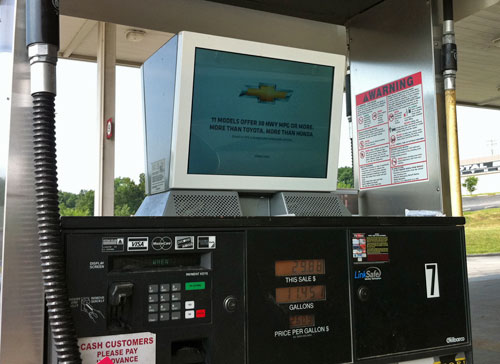
My first look at GSTV (Gas Station TV) was at a Phillips 66 station on I-55. It probably took me no longer than 3 or 4 minutes to fill up and I guess there really isn’t much to do with that time, so why not. There were these really short sports/weather/news segments with commercial messages between each. Really can’t imagine someone paying for these but they obviously do. I foresee a time when we pay a premium to AVOID being hammered by ads. Ransom Ads.

iPad turns on instantly

I haven’t posted on the iPad for a while because we’re transitioning the little slab of magic from a Steve Device to a Barb Device. I’m sure it will still by lying around the house and I’ll pick it up as needed, but it’ll have her stuff on it.

I was pleased to see that Scott Adams appreciates the iPad for some of the same reasons we do:

“By far, the iPad’s most wonderful feature, compared to laptops, is the fact that it turns on instantly. There’s no boot-up sequence. That one advantage makes the iPad an entirely different product from a laptop. Once powered on, the iPad doesn’t start begging me to update things nor force me to make decisions. It doesn’t remind me of all the ways it is protecting me. It doesn’t tell me to order printer ink or ask me to fill out a survey. A regular laptop is like your boss: always making you wait before giving you busy-work assignments. The iPad is more like a punctual lover. It’s always ready for fun. And if you are tempted to do some work on the iPad, its non-keyboard quickly changes your mind. You wouldn’t say a lover is a crippled version of a boss. (Insert your own inappropriate humor here.) So any comparison of an iPad to a laptop simply doesn’t work.”

“Another interesting phenomenon of the iPhone and iPad era is that we are being transformed from producers of content into consumers. With my BlackBerry, I probably created as much data as I consumed. It was easy to thumb-type long explanations, directions, and even jokes and observations. With my iPhone, I try to avoid creating any message that are over one sentence long. But I use the iPhone browser to consume information a hundred times more than I did with the BlackBerry. I wonder if this will change people over time, in some subtle way that isn’t predictable. What happens when people become trained to think of information and entertainment as something they receive and not something they create?”

I believe iPads are among the prizes being offered as incentives in one of the sales contests underway at our company. And our company chairman placed an order after watching some of the Mac heads playing with theirs at the Coffee Zone.

Frankly, I’m a little releived to be handing off our iPad to Barb. I LIKE creating informaiton and with the iPad it was so easy to just lean back in a big stuffed chair and graze.

KBOA photos (high rez scans)

One of my first attempts at a website was KBOA830.com. That was about 13 years ago and I’ve moved it around several times since then. The impetus for the site was a bunch of photos from the late ’40s, given to me by one of the original employees of the station.

When flickr came along, I uploaded the photos there but the scans were low rez because I didn’t know what I was doing. I’ve thought about rescanning but that’s one tedious chore.

A couple of months ago I boxed up 120 of the prints and sent them off to ScanCafe where they were “scanned by hand” for about 29 cents each. It took a while (I think the scanning is done in India) but the prints were safely returned along with a DVD of 300dpi images.

KBOA

Turns out I can’t delete the lorez images yet because I’ve linked to them from the KBOA site. Once I get that all sorted out I can get rid of the duplicates.

If you have a box of prints (or 35m slides or negatives), send them to ScanCafe (or one fo the similar services) and get them digitized. And then put them online, because that is the only hope you have of giving them a life beyond your own.

Footnote: I never tire of looking at these images. The tower and the transmitters and the studios… all of the expensive stuff it took to communicate in 1947. If you had something to say to your community (forget the world) you had to build/buy/go to work for one of these entities (radio station, TV, newspaper). All changed now. And changing. I love it.

Survey of radio newsrooms (1988)

A big part of my job during my early days at Learfield was affiate relations. Periodically, I would survey the stations to learn more about how they used our news and sports. Here’s a snapshot from 1988.

  • 2/3 of stations had a full-time news person (I’ll bet it’s not 1/3 today)
  • I was insensitive or stupid or both in asking about sex. It was a different time.
  • Almost half had a wire service?! Amazing. Can’t be more than 10% now.
  • “Cassette recorders” – Ah, my favorite. A world before digital recording.

Back in those pre-web days, we also did a newsletter each month. One page, front and back. I typed it on a typewriter, made copies and put them in the mail. Example: Missourinet newsletter – Jan87

The whole process now seems … quaint. Typewriters and envelopes, once a month. But there was a simplicity that seems appealing in retrospect.