Missouri prison life in 1800’s

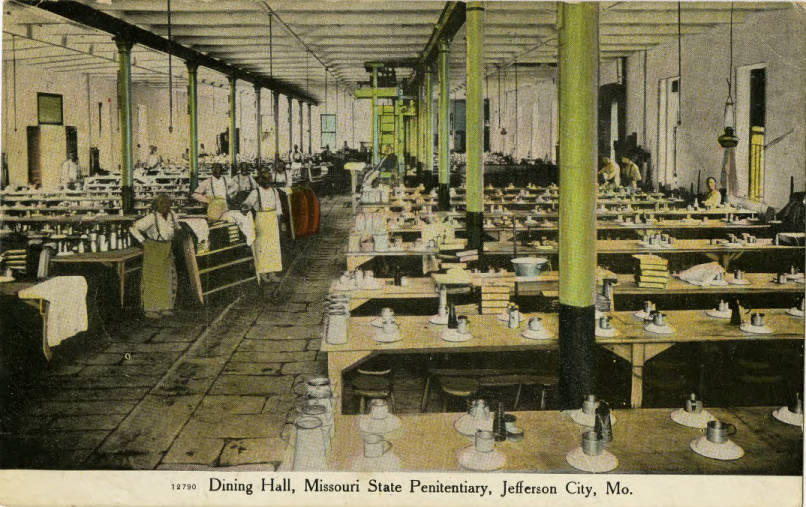
The Twin Hells, by John N. Reynolds, claims to be “A Thrilling Narrative of Life in the Kansas and Missouri Penitentiaries.” I haven’t read the entire account yet but will share this excerpt about the Missouri penitentiary:

“The inmates of the Missouri penitentiary are well clothed. In this respect, this prison has no rival. All the prisoners presented the appearance of being cleanly, so far as their clothing is concerned. All are dressed in stripes. None are exempt. Here are nearly two thousand men on an equality. None of them can look down upon others, and say, I am more nicely dressed than you. I never saw a convict dude in the entire lot. The prisoners are well fed. For breakfast, the bill of fare consists of bread, coffee, without milk or sugar, and hash. There is no change to this bill of fare. If the prisoner has been there for ten years, if not in the hospital, he has feasted upon hash every morning. Boiled meat, corn bread, potatoes and water makes up the dinner, and for supper the convict has bread, molasses and coffee. The principal objection to this diet is its monotony. Whenever a change of diet becomes a strict necessity, the prisoner is permitted to take a few meals in the hospital dining-room. Here he receives a first-class meal. This is a capital idea. A great deal of sickness is prevented by thus permitting the convict to have an occasional change of diet. On holidays, such as Thanksgiving day, Christmas, etc., an extra dinner is given, which is keenly relished by all. I have before me a statement of the expenses for a Sunday breakfast and dinner. There are only two meals given on Sunday. The hash was made up of 612 pounds of beef, 90 pounds of bacon, and 30 bushels of potatoes. Fifty-one pounds of coffee were used, and four and a half barrels of flour. The entire meal cost $68.38.”

It appears the account above is from the late 1800’s. I have not idea of the time period represented by the postcard below (from Bob Priddy’s extensive collection of Missouri postcards)

Updating MissouriDeathRow.com

MissouriDeathRow.com was one of the first websites I did. And it looks like it. This was before flickr and Typepad and such. So I’m doing a little make-over. Hope to have it complete by the end of the year.

I’m starting with images and documents related to those executed in Missouri’s gas chamber. First time out, I just posted photos of the condemned. This time I’m posting the… not sure what to call it… the record or card for each inmate [flickr slideshow].

I scanned these from the state archives. For some reason, I find them fascinating.

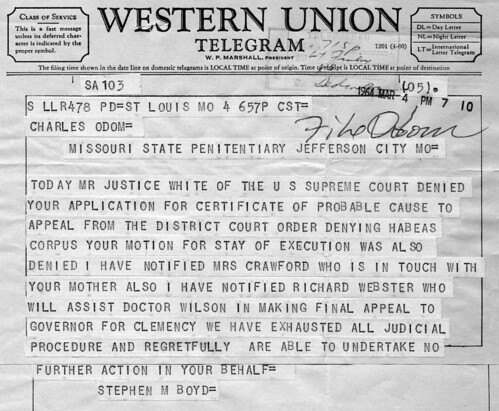
The state archive has a file on each of the inmates executed in the gas chamber. I spent a week going through these, scanning as much as time allowed. Letters, notes, telegrams…

On June 24, 1962, Odom and another Death Row inmate attempted an escape. Odom’s file contained a report by the guard on duty at the time. I’ve also included  (from his appeal to the Missouri Supreme Court) a description of the crime for which Odom was executed.

Lucy: Chewed glasses

Lucy the Golden Retriever ate not one, but two, $400 Palm Trio cell phones (back when they cost that much). But her favorite forbidden fruit is reading glasses (dirty underpants don’t count). I drop a pair about twice a week and Lucy scoops ’em up and heads for her spot under the bed. I only pay about $8 for a pair of cheap readers online but we worry about here swallowing glass or a sharp piece of plastic. Yeah, I know… I could wear one of those little cords around my neck that are so popular with librarians. Naw.

“You can’t create larger audiences by trying to create larger audiences”

The following excerpts are from an interview Mark Ramsey (Hear 2.0) did with Tom Asacker, a marketing and branding adviser and author (A Little Less Conversation: Connecting with Customers in a Noisy World).

One of the larger challenges facing radio?

“It seems that we’ve got a catch-22 on our hands, right?  We need to get out on the street and keep selling in order to keep revenue coming in, so nobody wants to slow down in order to change the way they’re doing things, to really rethink it, because that might take away from sales time.  I mean we’re putting out fires, and nobody wants to step back and say, “Wait a minute.  Is there a better way of doing this?”

“It’s a difficult thing with an industry that’s been around this long, with people that are well entrenched in relationships up and down the chain.  It’s tough to get people to change — to just say, “Put on the brakes, and let’s rethink radio.”  But I think that that’s what needs to be done:  Let’s rethink radio.  Just like Steve Jobs said, “Let me rethink the MP3 player.”  He didn’t say, “Well, we can do the MP3 player and slap this thing on it”; he said, “Stop, and let’s rethink the MP3 player.”

That’s a tough thing to do.  It takes guts.”

Yes, it does. And he offers this rather brilliant (IMO) insight on creating audiences:

“You can’t create larger audiences by trying to create larger audiences. You can only create larger audiences by trying to get deeper with smaller audiences.

Think about how to get deeper and make more relevant, valuable connections with individuals in a culture or a subculture.

Don’t think about audience size.  Think about the depth of the relationship and how important it is and how valuable it is.  The more you do that, the bigger the audience gets.”

That’s probably true of friends as well. Best way to have a lot is to be a good one. You can listen to the entire interview at Hear 2.0.

“News has cooties”

Jeff Jarvis recalls "the golden age" of newspapers when "cities had many papers, many voices, many views, and papers still spoke for and with the people." And that's where we're headed again with the internet but "now it's the people talking."

"I have no doubt that there is a sustainable business in local news. The problem is that, at least for the present, the current and former owners of local news ruined it. Thanks to them, news has cooties."

Online advertising

“The Tribune Company owns businesses (which) make money by placing ads in between (broadcast) or alongside (print) scarce content. That model, I’m afraid, is dying for two reasons. One, content isn’t scarce anymore. Two, advertisers have other, cheaper ways of reaching the people formerly known as the audience. I’m not sure there’s any form of government help that can protect traditional media from that.”

— Terry Heaton on Tribune bankruptcy

“This change has been more like seeing oncoming glaciers ten miles off, and then deciding not to move.”

— Clay Shirky

Fortune: “The genius behind Steve”

Steve Jobs gets a fair share of the credit for the cool products Apple produces. The company is also extremely efficient and well operated and much of the credit for that goes to Chief Operating Officer Steve Cook. For a look behind the scenes of the well-oiled machine that is Apple, check out this article in the November issue of Fortune. The following excerpt will get you started:

“Tim cook arrived at Apple in 1998 from Compaq Computer. He was a 16-year computer-industry veteran – he’d worked for IBM (IBM, Fortune 500) for 12 of those years – with a mandate to clean up the atrocious state of Apple’s manufacturing, distribution, and supply apparatus. One day back then, he convened a meeting with his team, and the discussion turned to a particular problem in Asia.

“This is really bad,” Cook told the group. “Someone should be in China driving this.” Thirty minutes into that meeting Cook looked at Sabih Khan, a key operations executive, and abruptly asked, without a trace of emotion, “Why are you still here?”

Khan, who remains one of Cook’s top lieutenants to this day, immediately stood up, drove to San Francisco International Airport, and, without a change of clothes, booked a flight to China with no return date, according to people familiar with the episode. The story is vintage Cook: demanding and unemotional.”

You are what you ring

There are just so many ways to be an asshole with a mobile phone. You can be the jerk that lets you know he’s hot shit by barking orders to the folks back at the office. Or the dildo that can’t remember to turn off the ringer in a movie or conference, no matter how many times he’s reminded.

I’m still a mobile newbie but my plan is to excuse myself when I get a call while with others, and step away to quietly take the call or arrange to call them back.

And then there are ring tones. No way around it, your ringtone says something about you. I know this from the disdainful looks I always got when my Tracfone busted out with one of the classic tones.

The new iPhone comes with some nice ringtones but none of them are really me. (Well, maybe the quacking duck) Fortunately, I stumbled across the Zen collection from iRing Pro.

These aren’t ring “tunes.”
These aren‘t some 11-year-olds’ ringtones. You’ll find no annoying songs, or silly sound effects. The Zen Collection consists of smart, attractive, livable alerts engineered to ensure universal appeal, and provide a high tolerance for routine use and repetition.

I heard you the first time.
iRingPro iPhone Ringtones are timed with moderately longer pauses between ring repeats. So there is no hurried fumbling, no urgency. You have time to see who’s calling, often before the second ring. You’re in control, not your phone.

You are what you ring.
A phone’s ring broadcasts many things about its user. iRingPro iPhone Ringtones ensure that what is perceived when your phone rings is technically advanced, considerate, and envyingly fashionable. Now, more than ever, a professional presence can make the difference.

Also from their website: “You own the best phone money can buy, we believe it should sound like it.” Hell, yeah.

Media 101

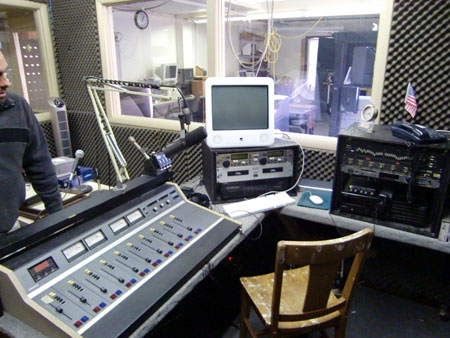
My recent visit to Central Methodist University included a tour of the campus which wound up in the studios of what was –I believe– the student radio station. I’m not sure when or why the station went off the air but the plan is to bring it back as an internet station.

During the few minutes I chatted with a couple of instructors and students about the project, I got the impression the approach will be… traditional, for lack of a better term. By that I mean, they’ll have a control room and studios with the usual assortment of recording and mixing hardware. Instead of pumping it all out to a transmitter and tower… they’ll stream it.
As for programming, they plan to do what we used to call “block programming.” An interview program followed by a news program followed by… Music licensing issues prevent them from programming music.

The way college radio stations have always been programmed. I don’t doubt the students can learn some useful skills and gain some valuable experience doing this but I’m not sure it will prepare them for the future that is already here.

So what would I do if they put me in charge of the program for a semester?

I’d start by dropping the term “radio” and go with “media.” Not “new media,” just media.

I’d assemble production teams made up of a producer and host (and co-host?). These teams would be responsible for one 25 minute program a week. Can be any topic (more on that in a moment)

A Senior Producer and Managing Editor would coordinate these teams (using Basescamp or some similar online collaboration tool) and insure quality standards and deadlines were being met.

All or most of these programs would be produced as live feeds and podcasts. Instead of a “college radio station” (Internet or otherwise), you’d have a portal site (I hate that term) that featured each of the individual programs with a link to that programs blog (where the hosts and producer interact with listener/viewers). Show notes, comments, etc.

The central feature of the portal page would be a video section. It could be a live stream of one of the shows being recorded or some live event on campus. Or just a live webcam from the student center.

Equipment. Each team would have a laptop, a digital camera (video capable) and a small webcam. All shows would be produced on location. No reason to schlep back to a studio jammed with expensive equipment.

I wouldn’t limit this project to just students. I’d open it up to the community as well, but with students producing.

Once these podcasts are up, it’s an easy matter to track which ones produce a following. If nobody downloads, you fix the podcast or replace it. But you aren’t limited to the 24 hours of a real-time station. You can have as many programs as you have people to produce and watch/listen.

So what are the students learning here?

  • How to write, edit and tell a story
  • How to shoot and edit video and share it with the world
  • How to build an online community or tribe
  • How to produce a live webcast
  • How to take and edit photos
  • How about a course in Smart Phone Reporting?

…and so on and so forth. I’m not an educator so there could be lots of things wrong with this approach. I’m pretty sure it would cost a lot less than a more traditional approach while involving many more students (in and out of the communications program). If you have suggestions on this mythical program, please include them in the comments. Or, if you see flaws, post those as well.

PS: I think this might be a powerful recruitment tool, as well.

UPDATE/12.08.08: On a recent edition of NPR’s Morning Edition, Steve Inskeep interviewed journalist Sreenath Sreenivasan who, within an hour of the attacks in Mubai, began hosting a web radio call-in show with other Indian journalists, relaying what they knew. Sreenivasan used a service called Blog TalkRadio:

“BlogTalkRadio is the social radio network that allows users to connect quickly and directly with their audience. Using an ordinary telephone and computer hosts can create free, live, call-in talk shows with unlimited participants that are automatically archived and made available as podcasts. No software download is required. Listeners can subscribe to shows via RSS into iTunes and other feed readers.”