ACR_MOV_3 from ACRNM on Vimeo.
William Gibson’s “favorite 21st-century designer.”

Okay, this post is for William Gibson fans only. Specifically, fans of his novel, Pattern Recognition. Here’s a grossly over-simplified plot summary. Actually it’s not even that, but I had to provide some context, so…
“…a cult-like group of Internet obsessives strives to find meaning and patterns within a mysterious collection of video moments, merely called “the footage,” let loose onto the Internet by an unknown source.”
This morning on his Twitter feed, Gibson posted:
“That putative Lady Gaga virus is as seriously Footage-y as anything I’ve seen on YouTube.”
Curious, I found my way to this video:
UPDATE: There were a couple of videos on YouTube to which I had linked but they’ve been pulled. Very suspicious.
I don’t have a post to go with the quote above, but it’s so good I had to write down. I found it on William Gibson’s Twitter feed and he retweeted John Perry Barlow, who overheard it at at dinner party.
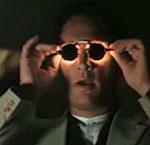 “It’s the year 2007 in Los Angeles, Harry Wyckoff (James Belushi) is a patent attorney and family man. His wife Grace (Dana Delany) is a formidable suburban housewife and mom who also owns a chic Melrose Avenue boutique. Grace is the daughter of Tony and youthful Josie Ito (Angie Dickinson), a socialite radiant with charisma (and with an agenda of her own). Harry and Grace have two children: little Deirdre has been a slow developer, yet to speak a word, and elder son Coty (Ben Savage) — a television addict — has just got an acting job on a new sitcom, Church Windows, alongside fabu superstar and fashion icon Tabba Schwartzkopf (Bebe Neuwirth). However, Wyckoff is plagued by strange dreams — of himself being pursued by a rhinoceros, and visions of a strange tattoo of a palm tree.”
I saw this mini-series in 1993 and 2007 seemed a long way off.
The Sprawl trilogy is William Gibson’s first set of novels, composed of Neuromancer (1984), Count Zero (1986), and Mona Lisa Overdrive (1988). One of the “characters” in Neuromancer is Wintermute, “one-half of a super-AI entity.” On page 274 of Count Zero, we find a description of Wintermute creating art.
“She caught herself on the thing’s folded, jointed arms, pivoted and clung there, watching the swirl of debris. There were dozens of the arms, manipulators, tipped with pliers, hexdrivers, knives, a subminiature circular saw, a dentist’s drill … They bristled from the alloy thorax of what must once have been a construction remote, the sort of unmanned, semiautonomous device she knew from childhood videos of the high frontier. But this one was welded into the apex of the dome, its sides fused with the fabric of the Place, and hundred of cables and optic lines snaked across the geodesics to enter it. Two of the arms, tipped with delicate force-feedback devices, were extended; the soft pads cradled an unfinished box.
Eyes wide, Marly watched the uncounted things swing past.
A yellowing kid glove, the faceted crystal stopper from some vial of vanished perfume, an armless doll with a face of French porcelain, a fat, gold-fitted black fountain pen, rectangular segments of perf board, the crumpled red and green snake of a silk cravat … Endless, the slow swarm of spinning things…”
I love the image and I love the idea of an artificial intelligence creating art. In this story, futuristic Joseph Cornell style boxes.
“Totally ubiquitous computing. One of the things our grandchildren will find quaintest about us is that we distinguish the digital from the real, the virtual from the real. In the future, that will become literally impossible. The distinction between cyberspace and that which isn’t cyberspace is going to be unimaginable. When I wrote Neuromancer in 1984, cyberspace already existed for some people, but they didn’t spend all their time there. So cyberspace was there, and we were here. Now cyberspace is here for a lot of us, and there has become any state of relative nonconnectivity. There is where they don’t have Wi-Fi.
In a world of superubiquitous computing, you’re not gonna know when you’re on or when you’re off. You’re always going to be on, in some sort of blended-reality state. You only think about it when something goes wrong and it goes off. And then it’s a drag.”
— From Rolling Stone interview with William Gibson

What was William Gibson listening to while writing Spook Country? Among others, a group called Brad Sucks. I never heard of ’em but if Mr. Gibson likes their music, I figured I’d take a listen. And liked what I heard. Brad Sucks invites you download their music for free but I clicked the iTunes link and bought the CD for ten bucks (after sampling each of the songs on the CD).
"In 2001, I started using the Internet (blogs, MP3s, P2P) to spread my music and not worrying so much about copyright violation. I’ve even been giving the source of my songs away for remixers to play with. I figured that spreading my music should be the number one goal and so far it’s worked out pretty well."
Does Brad Sucks get radio airplay? Comment if you know.
“A nation consists of its laws. A nation does not consist of its situation at a given time. If an individual’s morals are situational, that individual is without morals. If a nation’s laws are situational, that nation has no laws, and soon isn’t a nation.”
“Are you really so scared of terrorists that you’ll dismantle the structures that made America what it is? If you are, you let the terrorists win. Because that is exactly, specifically, his goal: to frighten you into surrendering the rule of law. That’s why they call him ‘terrorist.’ He uses terrifying threats to induce you to degrade your own society.”
— Spook Country, William Gibson (pg. 136-137)
Spook Country is William Gibson’s newest novel. According to amazon.com it will be released on August 7, 2007. Fragments of the novel have been posted non-sequentially on Gibson’s blog for some time now, and have led to much speculation on the content and plot of the novel. From the US publisher Putnam’s catalog:
“Tito is in his early 20s. Cuban by ancestry, he speaks fluent Russian, lives in one room in a Nolita warehouse, and does delicate jobs involving information transfer.
Hollis Henry is a journalist, on investigative assignment from a magazine called Node. Node doesn’t exist yet, which is fine, she’s used to that, but it seems to be actively preventing the kind of buzz that magazines normally cultivate before they begin to exist. That would be odd, and even a little scary, if Hollis allowed herself to think about it much, which she can’t afford to do.
Milgrim is a junkie. A high-end junkie, hooked on prescription anti-anxiety drugs, but he figures he wouldn’t survive 24 hours if Brown, the mystery man who saved him from a misunderstanding with his dealer, ever stopped supplying the little bubble-packs. What Brown is up to Milgrim can’t say, but it seems to be military – at least, Milgrim’s very nuanced Russian is a big part of it, as is breaking into locked rooms.
Bobby Chombo is a ‘producer’, and an enigma. In his day job, Bobby is a trouble-shooter for military navigation equipment. He refuses to sleep in the same place twice. He meets no one. Hollis Henry has been told to find him.”
Gibson is far and away my favorite author. Yet another reason to go on.
“The thing that’s going to be quaint about “cyberspace” (that already is, really) is the inherent assumption that it’s a realm unto itself; that it’s in any way elsewhere or other. Glancing sideways is becoming more generally recognized as about the best way of doing what we used to call futurism.”
–William Gibson