
Why Does the World Exist?

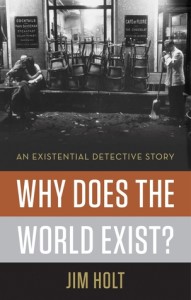
whydoestheworldexistI’m not losing any sleep over this question, unless you count some late nights reading books like Jim Holt’s Why Does the World Exist? Holt is an American philosopher, author and essayist. Mr. Holt tells his “existential detective story” by talking with “philosophers, theologians, particle physicists, cosmologists, mystics and one very great American novelist.”

This is one of those books I found myself rewinding every few pages in an effort to simply understand the words, the sentences. So I can’t review it but here’s what the NYT had to say.

I do manage to come away with something from books like this. First, an appreciation for how long really smart people have been thinking about questions like why-something-not-nothing. Second, how little I really know and understand about… everything. Okay, here’s a third thing: nothing that happens in our (humans) blink-of-an-eye existence is of much consequence when viewed against the backdrop of a 14 billion year old universe. Global warming; Rush Limbaugh; a nuclear Iran. Specs of dust. A few excerpts:


“For the vast majority of Americans there is no such thing as the “mystery of existence.” If you ask them why the universe exists, they’ll say it exists because God made it. If you then ask them why God exists, the answer you get will depend on how technologically sophisticated they are. They might say that God is self-caused, that He is the ground of His own being, that His existence is contained in His essence. Or they might tell you that people who ask such impious questions will burn in hell.”

The life of the universe, like each of our lives, may be a mere interlude between two nothings.

Perhaps we see too little of reality to be aware of the reason behind it, or because any such reason must lie beyond the intellectual limits of humans.

Nothing is popularly held to be better than a dry martini, but worse than sand in the bedsheets. A poor man has it, a rich man needs it, and if you it for a long time, it’ll kill you. On occasion, nothing could be further from the truth, but it is not clear how much further.

Nothingness – A possibility reality, a conceivable state of affairs: that in which nothing exists.

In the thirteenth century, the Catholic Church declared it to be an article of faith that the world had a beginning in time.

The entities making up the physical world are like the pieces in a game of chess: what counts is the role defined for each piece by a system of rules that say how it can move, not the stuff the piece is made of.

“Words like ‘theism’ and ‘atheism’ and ‘God,’ they’ve moved around so much that they’re practically meaningless. Who really cares? I do consider myself a Spinozist, however, for two reasons. First, I think Spinoza was right that we’re all tiny regions in an infinite mind. And I agree with him that the material world, the world described by science, is pattern of divine thought.” — Cosmologist John Leslie

Scott Adams’ View of the World

I suppose a lot of people don’t take Scott Adams serious because he’s a cartoonist (the creator of Dilbert). I’ve read all (most?) of his books have found his explanation of… well, pretty much everything, makes the most sense to me. Today on his blog he gives a tidy summary of his world view.

  1. Willpower isn’t a real thing. Some people just have greater urges than others. If I resist a cookie and you don’t, it doesn’t say anything about your willpower, but it might say you are hungrier than I am, or you simply like cookies more than I do.
  2. I don’t believe in a creator. I see humans as a collection of particles bumping into each other. Or maybe we’re a computer simulation created by some earlier civilization. In either case, no group of particles, or arrangement of ones and zeroes, is superior to another.
  3. I have no individual skill that is not topped by at least one person in every demographic group. Every group has people who are smarter than me, stronger than me, kinder than me, more generous than me, more talented, and so on.
  4. There is no logical way to rank talents or virtues. Is one person’s excellent musical skill somehow better than another’s good parenting skills? Is your kindness better than your friend’s work ethic? None of these things can be compared objectively.
  5. Genes are often destiny. You were probably born with your personality and your preferences, in which case you are not to blame. Or you might have been the victim of some sort of nastiness in your past that changed you permanently, and that probably wasn’t your “fault” in any objective way either. Your particles bumped around until something bad happened, nothing more.
  6. For purely practical reasons, the legal system assigns “fault” to some actions and excuses others. We don’t have a good alternative to that system. But since we are all a bunch of particles bumping around according to the laws of physics (or perhaps the laws of our programmers) there is no sense of “fault” that is natural to the universe.

Scott Adams: Universe as computer simulation

Three of my favorite Smart People (Kevin Kelly, Ray Kurzweil and Scott Adams) have convinced me there will be a post-human stage in our evolution. And Scott Adams makes a compelling (to me) case for the computer simulation theory.

“The theory basically goes that any civilisation which could evolve to a ‘post-human’ stage would almost certainly learn to run simulations on the scale of a universe. And that given the size of reality – billions of worlds, around billions of suns – it is fairly likely that if this is possible, it has already happened. And if it has? Well, then the statistical likelihood is that we’re located somewhere in that chain of simulations within simulations. The alternative – that we’re the first civilisation, in the first universe – is virtually absurd.”

Before you dismiss this theory, compare it to this popular creation narrative:

“It is made up of two parts, roughly equivalent to the first two chapters of the Book of Genesis. In the first part, Genesis 1:1 through Genesis 2:3, Elohim, the generic Hebrew word for God, creates the world in six days, then rests on, blesses and sanctifies the seventh day. God creates by spoken command (“Let there be…”), suggesting a comparison with a king, who has only to speak for things to happen, and names the elements of the cosmos as he creates them, in keeping with the common ancient concept that things did not really exist until they had been named. In the second, Genesis 2:4–24, Yahweh, the personal name of God, shapes the first man from dust, places him in the Garden of Eden, and breathes his own breath into the man who thus becomes נֶפֶש nephesh, a living being; man shares nephesh with all creatures, but only of man is this life-giving act of God described. The man names the animals, signifying his authority within God’s creation, and God creates the first woman, Eve, from the man’s body.”

I Am That by Sri Nisargadatta Maharaj

Excerpts from I Am That by Sri Nisargadatta Maharaj


All your problems are your body’s problems. All these lose their meaning the moment you realize that you may not be a mere body. You are nothing perceivable, or imaginable.#

Memory creates the illusion of continuity.

Time, space, causation are mental categories, arising and subsiding with the mind.

Nothing can happen unless the entire universe makes it happen. A thing is as it is, because the universe is as it is.

The world you can perceive is a very small world indeed. And it is entirely private. Take it to be a dream and be done with it.

Continue reading →