“The audience isn’t the audience anymore”

Thanks to Michael Kruse, a staff writer for the St. Petersburg Times for one of the best stories yet on the challenges facing “media exclusivity” in sports. In the interest of full disclosure, the company I work for (Learfield) pays serious money for just the sort of exclusivity described in in this piece, which focuses on a recent change in the media policy of the SEC, one college sports premier conference.

“… earlier this month (the SEC) sent to its 12 schools an eye-opening new media policy. It places increasingly stringent limits on reporters and how much audio, video and “real-time” blogging they can do at games, practices and news conferences. But even more interesting is that the policy also includes rules for fans in the stands. No updating Twitter feeds. No taking photos with phones and posting them on Facebook or Flickr. No taking videos and putting them on YouTube.

A conference spokesman said this policy was meant to try to keep as many eyeballs as possible on ESPN and CBS — which are paying the SEC $3 billion for the broadcast rights to the conference’s games over the next 15 years — and also on the SEC Digital Network — the conference’s own entity that’s scheduled to debut on SECSports.com later this month.”

The reporters covering sporting events have always (well, at least since blogs and such came along) been under certain restrictions regarding blogs and how much audio/video they could put online. The new policy by the SEC is “the most stringent language yet in college sports.”

“Ticketed fans can’t “produce or disseminate (or aid in producing or disseminating) any material or information about the Event, including, but not limited to, any account, description, picture, video, audio, reproduction or other information concerning the Event. …”

Sounds like I couldn’t call my brother and describe a thrilling touchdown run. God forbid, I took a photo or video clip and emailed it to him. The Times story included some really good quotes, like this one from Mike Masnick, editor of the blog techdirt:

“If it reaches the point where it’s not just 15 people doing this, it’s 1,000 people, it gets more and more difficult to stop,” he said. “At which point you either stop letting fans into games or you figure out a way to deal with the fact that fans are going to do this.”

…and this one from new media expert Clay Shirky:

“The idea that people can’t capture their own lived experience is a losing proposition.”

I encourage anyone involved with collegiate sports (and related media) to read the full story. Here’s my take-away:

“The audience isn’t the audience anymore. The SEC’s greatest supporters are now also the SEC’s biggest competitors.”
Shop Talk: SEC Digital Network

The Southeastern Conference is getting ready to launch the SEC Digital Network. They’re working with a company called XOS Digital and are touting: “…nearly 10,000 hours of original and exclusive SEC content anytime, anywhere through online video syndication, digital downloads, and exclusive live-streaming and on-demand video content.”

If I understand this correctly, this does NOT include live streaming of actual game broadcasts. Those are protected by the rights holders. Companies like ours. So what content will be available?

  • Highlights
  • Complete game replays
  • Breaking SEC news in real-time
  • Post-game interviews
  • Tailgate events
  • Behind-the-scenes pep talks
  • Press conferences

The company I work for is associated with some SEC schools: Alabama, Mississippi State and South Carolina.

Remember that saying about the farmer’s pig? We eat everything but the oink? Well, companies like ours pay lots and lots of money for the marketing rights to this big schools and we have to sell everything but the oink to recover that investment.

But you can only put so many commercials in a radio or TV broadcast; only so many logos on a big scoreboard; only so many ads in a program (as you can see, I don’t really know everything we sell).

And if God isn’t making any more land, she’s not making any more avails in a football broadcast. So everyone is looking for ways to generate more programming, more content, to support additional advertising. The SEC Digital Network would seem to be doing this.

And the fans have a nearly insatiable appetite for anything related to their team. And if the SEC does this right, with lots of fan engagement and interaction, and fully mobile… they’ll have a winner.

Twitter in sports about message control

“Twitter lets athletes speak on their own terms. “It’s going to be useful during the season, because after a game, I’ll be able to say my piece instead of just allowing different media outlets to portray me how they want to portray me,” said St. Louis Rams running back Steven Jackson, one of football’s prolific tweeters. Talk to any athlete or coach about the benefits of Twitter, and they’ll put message control at the top of the list. “In this world we live in now, everybody becomes media,” said Shaquille O’Neal, whose enormous following of more than 1 million has fueled Twitter fever in sports. “If something is going to be said, hey, it’s coming from me, it’s coming from my phone.” Journalists may lament athletes passing over the middle men. But honestly, what’s more interesting, a “we gave 110 percent” from the postgame podium, or a tweet like this from Shaq: “Dam manny ramirez, come on man Agggggggggh, agggggggh, agggggh.” — SI.com


“a stats geek behind the scenes tweeting interesting stuff”

I’ve been beating the Twitter drum ever since that digital light bulb came on for me. I did my best to offer some practical applications for our various businesses. But none were as spot-on as StatTweets. From the StatTweet website:

“Most sports-related media outlets that have a Twitter account simply blast everything through a single account. I don’t know about you, but I don’t find this very useful. I prefer Twitter updates targeted at just the teams I’m interested in. And I’m not talking about just a news feed. It needs to be as if each sports team had a twitter account and a stats geek behind the scenes tweeting interesting stuff.

That’s exactly what the StatTweets accounts are intended to do (but it is all automated). Not only can you follow just the teams you are interested in, but you can interact with each account to retrieve team and player stats dynamically.”

When every game is webcast

A few months ago I got a call from Brian Slawin. Someone told him I fooled around with streaming live video and he wanted some ideas on how to stream his daughter’s softball games so family members could watch her play. He gave Qik and Kyte a try but wasn’t happy with the results but he kept at it. This past weekend he packed up his laptop, webcam and Sprint cellular card and headed for the ball field.

“Initially, I was concerned that a wireless cellular card wouldn’t allow enough upload bandwidth to actually stream the signal, but it turned out that even at 100kbps upstream, the signal was rock solid and remarkably clear. My gear includes an HP Pavilion PC, the Sprint card, a Logitech QuickCam Vision Pro, a power strip with 1400 joules filtering and some other cables, etc…

“Turns out I got lucky…my Sprint signal was 5×5 and there was power right at the backstop plus an angled desk/bench that made for the perfect setup.  I used the Justin.tv streaming system and it was tons of fun to have about a dozen parents/friends watch each game and join in the chat with Justin’s embedded chat feature. I made like a play-by-play narrator typing out what was going on…and every now and then playing “Joe Buck” for fun.”

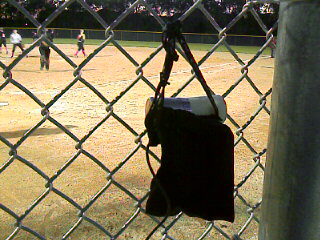
Webcam“I’ll need a better setup than just hanging the web cam from a couple of lanyards and a bag…when it got windy, or when there was a foul ball, the camera shook and I had to reposition it numerous times.  Likely a tripod or perhaps a platform that is more securely attached to the fence and would allow for a higher angle is what I’m going to experiment with next.”
Brian’s company has some big plans.

“I can see a time where we’d actually hire broadcast teams (students in broadcasting programs in local high schools or colleges) to broadcast the games. We’ve already begun working with a softball tournament company on the East coast and are going to try and bring this forward for next summer’s tournaments in the New York, Pennsylvania and New Jersey area.”

“But for now, I’ll continue to enjoy traipsing after my daughter this fall and into next summer as we travel to Junior Olympic softball tournaments throughout the Midwest.  Be sure to visit Warcats18Gold.com for more information about the team and if you’re nearby, be sure to come by and say hello at the Eleventh Annual St. Louis Softball Showcase in Chesterfield, MO Oct 31 – Nov 2.”

During my early radio days (’70s) there was tremendous pressure on the radio station to broadcast high school football and basketball games. We did some high school baseball but I don’t know that we ever found air time for girls softball. There just wasn’t enough time, staff or advertising support. And if one of the local radio stations didn’t broadcast the game… you had to be in the stands.

No more.

New look for Mizzou website

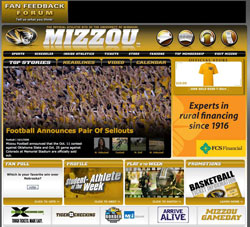
MuoasBranden Miller tweets the new look for MUTigers.com, the website of the Missouri Tigers. Mizzou is one of the universities with which Learfield Sports works, but I have nothing to do with the websites.

But I’ve always thought most of them were cramped, too busy and impossible to navigate. This new design is a huge improvement. I haven’t poked around on the new site yet but plan to later today.

I hope similar make-overs are planned for our other properties.

Webcasting high school football games

“Beginning this Friday, Gannett will have 12 live high school football games showing on widgets posted to USAToday.com and many of our local broadcast and newspaper sites. The games are being produced by our broadcast and newspaper sites as well as a high school AV department. Most of the games are single cam, laptop, aircard + Mogulus productions.” — Liz Foreman, Lost Remote:

Sports journo sees future on the web

Sinkingship250Big time sports journalist Jay Mariotti has resigned from the Chicago Sun-Times:
It’s been a tremendous experience, but I’m going to be honest with you, the profession is dying,” Mariotti said, “I don’t think either paper [Sun-Times or Chicago Tribune] is going to survive. To showcase your work … you need a stellar Web site and if a newspaper doesn’t have that, you can’t be stuck in the 20th century with your old newspaper.”

His bosses have a different take on things and you can read what they have to say at CBS2Chicago.com.

Sprint in the NFL radio business

“Sprint Nextel subscribers will be able to listen to live radio broadcasts of National Football League games this season as part of new partnership between the wireless provider and sports league.

IphonefootballThe live, cell-phone-accessible radio broadcasts—the centerpiece of the new NFL Mobile Live platform–will be available to all Sprint wireless subscribers who purchase a basic data plan as part of their services. In addition, as part of the agreement a select group of premium subscribers will be able to view live broadcasts of the NFL Network’s eight Thursday Night Football games on their phones starting on Nov. 6.” — MEDIA WEEK

Hmmm. Here’s one of several “take away’s” from this story by Mark Ramsey:

“For some reason, many broadcasters confuse the term “content” with “the stuff that’s on our air.” When I use the term “content” I mean the material that’s of serious interest to listeners. Stuff they will seek out. Not filler. Not commodities. McDonalds and NOBU may both offer “food,” but that’s where the similarity ends, and don’t think for a moment the patrons don’t know the difference.

In this case, the content is owned in its entirety by a third party – not a radio company. When it comes to professional sports play-by-play, radio is a distribution channel, not a content owner. Thus we will lose out to the owners of content in deals like this.”

Our company does broadcasts for a whole bunch of big (and small) colleges. We’ve been streaming (via Yahoo!) for years and on satellite radio for the last few years. It seems inevitable that these broadcasts will go directly to phones, sooner or later. Stay tuned? Dialed in?

Go mobile or go home

I will, eventually, have to break down and get a smart phone. I don’t really want one but not having one is going to be a liability in my job. Articles, like this one from the American Journalism Review, make this increasingly clear.

“In January, ESPN reported it had more hits for NFL content on its mobile Web site (4.9 million) than it did on its PC site (4.5 million), according to RCR Wireless News. Those numbers suggest the mobile jock market has legs, since sports fans will access their cell phones to get scores and inside information even while they’re watching games on TV. Two mobile TV partnerships – AT&T’s Mobile TV and Verizon’s V Cast, both of which use Qualcomm’s MediaFlo TV-enabling technology for cell phones – have been launched with the sports market in mind. Both mobile TV services bill themselves as providing full coverage of sporting events, along with some regular network programming in English and Spanish. Content partners include CBS Mobile, NBC 2Go, Fox Mobile, Comedy Central, ESPN Mobile TV, Viacom’s MTV and Nickelodeon, among others.”