“Feel free to play in their walled garden, but don’t forget to cut your own grass.”

“Facebook is an amazing breeding ground for large-scale awareness, and an essential part of a social marketing strategy. But at the end of the day, it’s still someone else’s website. Someone else collects your customers’ email addresses and limits your ability to learn from and remarket to them. If you want to create real, lasting customer relationships, you have to figure out how to use Facebook to get customers back to the place where you have the most control – your own website. That requires a tightly integrated strategy that uses Facebook to deliver customers back to your domain.”

— Alex Blum (read full post)

Spreadable Media

Henry Jenkins the founder and former co-director of the Comparative Media Studies program at MIT, and author of Convergence Culture (what happens when,“old and new media collide.”) In an interview with NeimanLab.org, he talks about his new book, Spreadable Media, which will be out in 2011. A few snippets:

“For things to live online, people have to share it socially. They also have to make it their own — which can be as participatory as just passing a YouTube clip on as a link or making a copycat video themselves.”

“Spreadable media is media which travels across media platforms at least in part because the people take it in their own hands and share it with their social networks.”

“News sites which prevent the sharing of such content amongst readers may look like ways to protect the commercial interest of that content, but in fact, they kill it, destroying its value as a cultural resource within networked communities, and insuring that the public will look elsewhere for news that can be spread.”

And would you believe that within the past month, I had a client say he didn’t want to link to some association sites because he didn’t want to “send people away from my page.”

There are  a lot of old media types who would read this interview and say, “If it doesn’t make me any money… I don’t care how far my story spreads.”

Scott Adams: Facebook Killer

“Facebook is primarily a record of your past. Imagine a competing service that I will name Futureme for convenience. It’s an online system in which you post only your plans, both immediate and future. As with FaceBook, you decide who can see your plans. You might, for example, allow only specific family members to see your medical plans, but all of your friends can see your vacation plans, or your plans to buy a new couch.

The interface for Futureme is essentially a calendar, much like Outlook. But it would include extra layers for hopes and goals that don’t have specific dates attached.

For every entry to your Futureme calendar, you specify who can see it, including advertisers. If you allow advertisers a glimpse of a specific plan, it would be strictly anonymous. Advertisers could then feed you ads specific to your plan, while not knowing who they sent it to. The Futureme service would be the intermediary.

Now imagine that you never have to see any of the incoming ads except by choice. If you plan to buy a truck in a month, you would need to click on that entry to see which local truck advertisements have been matched to your plans. This model turns advertising from a nuisance into a tool. You‘d never see an ad on Furureme that wasn’t relevant to your specific plans.”

Social networking slowly taking over email

“According to a new report issued by Gartner, 20% of business users will use social networks as their primary means of business communications by 2014. Gartner says it expects e-mail clients from Microsoft and IBM will soon start integrating with social networking sites, giving users access to their e-mails, contacts and calendars from their favorite social networking platform. What’s more, Gartner says that contact lists, calendars and messaging clients on smartphones will all be capable of connecting with social networking platforms by 2012.” [via networkworld.com]

This is just really hard for Grown-Ups to wrap their heads around. Even more difficult for those that pooh-pooh Twitter as a silly waste of time.

“Information network” vs “social network”

Ben Parr writes a column for Mashable called The Social Analyst. Here is an exceprt from his comparison of Facebook and Twitter:

“On Facebook, you’re supposed to connect with close friends. Becoming friends with someone means he or she gets to see your content, but you also get to see his or her content in return. On Twitter, that’s not the case: you choose what information you want to receive, and you have no obligation to follow anybody. Facebook emphasizes profiles and people, while Twitter emphasizes the actual content (in its case, tweets).”

“The result is that the stream of information is simply different on both services. You’re more likely to talk about personal issues, happy birthday wishes, gossip about a changed Facebook relationship status, and postings about parties on your Facebook News Feed. On Twitter, you’re more likely to find links and news, and you’re more likely to follow brands, news sources and other entities outside of your social graph. In fact, Twitter tells me that one out of every four tweets includes a link to some form of content.”

I think if you boil it down, for me it’s the difference between “Friending” and “Following”

“Unlike most social networks, following on Twitter is not mutual. Someone who thinks you’re interesting can follow you, and you don’t have to approve, or follow back.”

The Social Network

A movie is going to be made about an important part of your life. Your only imput is to choose from the following:

  • A great director and screenwriter tell a a really interesting story that has people glued to their seats for 90 minutes, but bends or breaks the the truth whenever necessary to make the story interesting. And millions go to see it.
  • A so-so writer and a second-rate director make an exactly-as-it-happened movie that puts the audience to sleep and it hits cable in week 4.

Maybe it’s just the film buff in me but I’d much rather the be subject of a compelling bit of fiction, even if I came off looking like an asshole.

I really enjoyed The Social Network. I never saw an episode of The West Wing so this was my first (?) exposure to the Mr. Sorkin’s snappy diaglogue and it was sharp as a mouse turd.

I read David Kirkpatrick’s The Facebook Effect this summer (not the boook upon which the movies was based) and it showed Mark Zuckerberg in a more flattering light.

As I watched the story unfold, I found myself hoping Zuckerberg did some of the sleazy things alleged in the movie. It would be pretty shitty to have this really well-made film floating around for the rest of my life portraying stuff I didn’t do.

If Zuckerberg did get the idea for FB from the Winklevoss twins, well, they should have had a lawyer. If he screwed over his friend Eduardo… that’s a weight he’ll have to carry. But all those people on Facebook will never know or care.

Social media and news

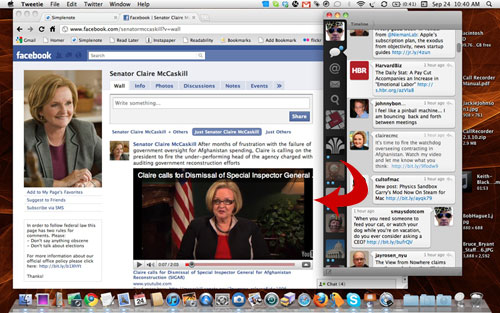
This morning Missouri Senator Claire McCaskill tweeted that it’s time to “fire the watchdog overseeing contracting in Afghanistan.” She included a link and invitation to her Facebook page where she posted a video explaining her positon and asking “what do you think?”

I’m sure this is happening hundreds of times a day but this still feels like something significant is happening. The senator has 40,000+ followers on twitter (not sure about Facebook). I’m sure elections have been won and lost by that many votes, but that’s not my point.

How would the senator have made her position known pre-twitter/facebook? Press release emailed to hundreds of media outlets? Radio interviews with big news stations in St Louis and Kansas City? Maybe a few seconds for a satellite interview with a couple of TV stations (or the networks)?

And for all I know she’s still doing this but in every instance, the media controls the experience. And there would be little or no opportunity for engagement with the people.

It’s not difficult for me to imagine a time in the very near future where Twitter replaces the emailed (faxed?!) news release. That’s probably already happening. And I am seeing more and more YouTube and Facebook video showing up in “newscasts.”

Real Journalists would insist that much is lost by them not having an opportunity to ask the senator “the hard questions.” But the’ll be hard pressed to find many viewers/listeners/readers who agree their questions add much. Not saying they’d be right, just that they don’t agree.

I’m going to go back to Senator McCaskill’s Facebook page and read some of the comments. And if anyone can put me in touch with her social media advisor(s), I’d really like to talk to them because they seem to know what they’re doing.

Visiting Facebook

“My mother made me a homosexual.”
“If I buy the wool, will she make me one, too?

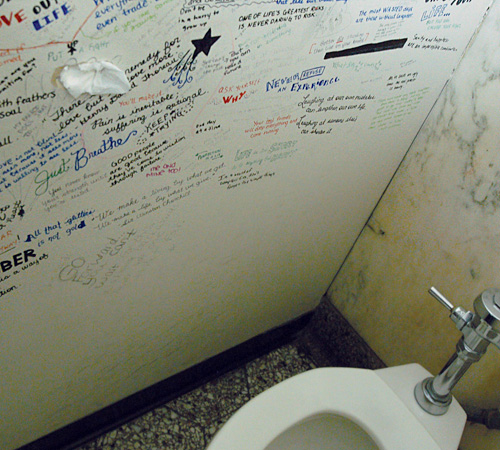
During my college days (late ’60s), graffiti became something of a fad within our little group (along with trivia). I’m talking about the kind of graffiti you found on the walls of bathroom stalls.
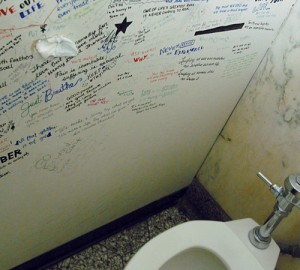
It was common practice to tack a large piece of poster board to the back of your bathroom door with a Bic pin dangling from a string. These “conversations” could go on for weeks or months, becoming ever more baroque and obscure. We took great pride in our wit and when the poster was filled with scribbles, it was put on a wall someplace, like the pop art it was (or pretended to be).

I was reminded of this long-lost art by my first two weeks (back) on Facebook. What I’m seeing is mostly chit-chat. Short shout-outs and “Like’s” …maybe a photo here and there. And I do not mean to disparage these brief communications. I can see how Facebook has become a replacement for some/most email. A quick an easy way to ping your friends.

I think I get this kind of digital chatter. My friend David and I can string out an IM session composed of nothing but witless repartee. It’s fun. But I’m not getting this on Facebook, which probably says something about me and my expectations for the platform. As I try to understand the Facebook phenomenon, the first question that occurs to me is:

“What do I have in common with the people I have Friend’d and who have Friend’ed me?”

If the answer is: We went to highschool together 40 years ago or we work together… is that enough for anything but the most superficial relationship?

Every time I log onto Facebook, I get the same feeling I get at one of those management retreats when the “facilitator” tells everyone to “divide up into groups of four” or “turn to the person next to you and…” My buddy David would explain this by saying, “You just don’t like people.” I hope that’s not true but perhaps I wouldn’t be able to tell.

And on the subject of superficiality, I’ve been on Twitter since early days (6,000+ Tweets). But it’s a very different platform. More about “broadcasting” a thought or idea or link. If others find what you share interesting or amusing, they can “follow” along. If you happen to read their stuff and find it worth your time and attention, you can do the same. But you don’t have to be Friends.

I don’t know that I will ever acquire a taste for the Facebook Kool-Aid but that’s okay. There are lots of places to engage online, in a variety of ways. I’m growing ever more fond of Posterous (but won’t bore you with details). I’m a big Google fan and look forward to their next effort at social networking (Buzz didn’t click for me). And in a few weeks we’ll get a look at Diaspora, an open-source project by four young college students.

At work a few of us have been experimenting with a service called Yammer. It’s pretty much “Twitter” for a business or company. Only people who work for our company (and have a company email address) can use the service. This makes a lot of sense to me. There is sure to be a lighter, personal side to the “yams,” but it’s mainly to improve communication and productivity. I’m very interested in seeing if it gets traction.

As I reread the above it occurs to me that this might be the sort of stuff I’d like to see from my “Friends.” What are they thinking about?

But most folks aren’t comfortable with sharing too much about their lives. And Facebook isn’t the place if they did. So it’s beginning to make more sense to me. Facebook is place. And a good, comfortable place for a lot of people. I can pop in for a quick visit from time to time, but I won’t live here. Hope you’ll come visit.