Perplexity: Origin of the term “blog”

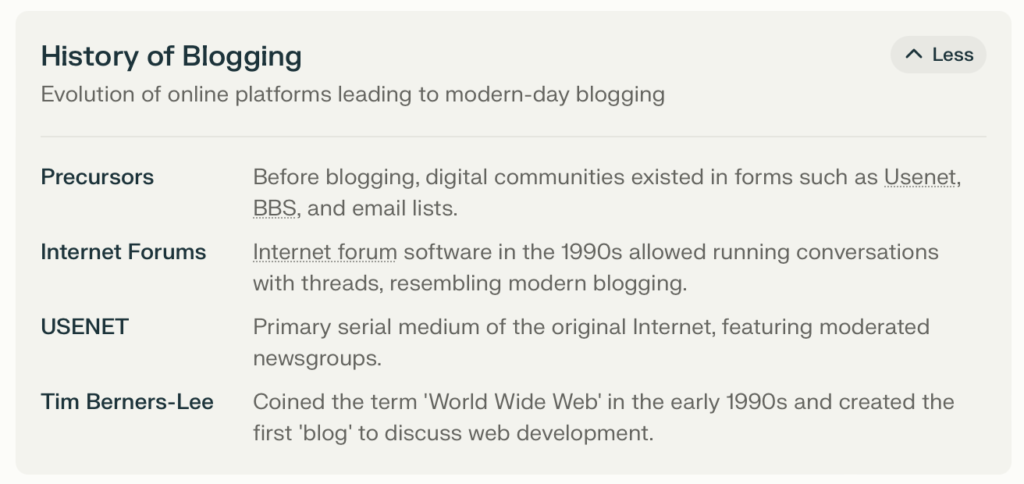
The word “blog” is a shortened form of the term “weblog,” which was coined by Jorn Barger on December 17, 1997. The shorter version “blog” was coined by Peter Merholz, who jokingly broke the word “weblog” into the phrase “we blog” in the sidebar of his blog Peterme.com in April or May 1999.

The term “weblog” itself originated from the practice of logging or recording information on the web, similar to how sailors would log details of their voyages in a ship’s log. The “web” part refers to the World Wide Web, and “log” refers to the act of recording or journaling.

So in essence, “blogging” stems from the concept of maintaining an online log or journal, which evolved from earlier forms of digital communities like Usenet, email lists, and bulletin board systems. The term gained widespread popularity after Pyra Labs used “blog” as both a noun and verb in connection with their Blogger product in the late 1990s.

Hotel California guitar solo

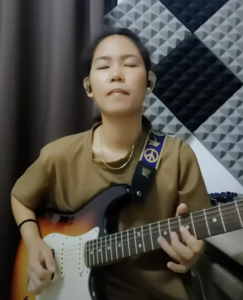
Chen is one of the daughters in a “family band” from the Philippines. She —and what I assume are her two sisters and father— perform amazing covers of hit songs. The still to the right is from a 2 1/2 minute video of her playing the guitar solo from The Eagles’ Hotel California. A couple of things about this short video grabbed me. Her obvious proficiency with this guitar solo but even more was the blissed out concentration that you see in the faces of the best guitar players. In the zone?

A couple of questions popped into my head: How long did it take her to master this iconic solo… followed by, Who wrote and first performed it. I went to Perplexity for the following, including reference sources:

According to interviews and accounts from Don Felder and others involved, the iconic guitar solos and dueling guitar parts on “Hotel California” by the Eagles came together in the following way:

  • Don Felder originally composed the music and recorded a demo for “Hotel California” at his home studio in Malibu in 1976. On this demo, he improvised and recorded sample guitar solos and parts that he envisioned for himself and Joe Walsh to play on the final recording.
  • When it came time to record the guitar solos and leads in the studio in Miami, Felder and Walsh initially started improvising new parts together. However, Don Henley stopped them and insisted they learn and play Felder’s original demo solo parts note-for-note.
  • The problem was Felder didn’t have the original demo tape with him in Miami. He had to call his housekeeper back in Malibu, have her find the cassette, play it over the phone, and Felder re-learned and transcribed his own improvised guitar parts from the demo.
  • Felder estimates that over half of the iconic guitar solos and dueling parts on the final “Hotel California” recording came directly from the original demo he recorded at home, with him and Walsh splitting up and learning those parts.
  • Specifically, Felder played the first half of the ending guitar solo, while Walsh played the second half. They then combined for the harmonized finale section.

So in summary, while Felder and Walsh did collaborate and split the guitar solos, a significant portion was actually Felder improvising alone on his original demo, which Henley insisted they recreate faithfully in the studio.

Personalized Spatial Audio

I developed an appreciation for good audio headphones during my time at KBOA back in the ’70s. Not so much for the music as much as wanting/needing to hear my voice as the listener was hearing it. Too close to the microphone? Too far away? Popping my “P’s?” I’ve purchased a lot of headphones over the years, always searching for the perfect set.

I used Apple’s wired earbuds during the iPod days and thought the music sounded fine. I never purchased another set of “cans.” I purchased my first set of Apple AirPods in 2016 and have been using them ever since. They fit my ears perfectly. So well, in fact, that I forget I have them in. Unfortunately, that means I don’t notice if one falls out which happened last week. The Find My app on my phone told me where I last had the AirPod but I never found it.

When I got my new AirPods my buddy George asked if i had configured them to take advantage of Personalized Spatial Audio. I vaguely recalled reading about this feature but don’t think I ever used it. As good as I thought the AirPods were before, this bit of tech magic was impressive.

(Perplexity) It uses the TrueDepth camera on newer iPhones to scan your face and ears. This captures data about the geometry and contours of your head and ear position. This personalized profile is then used to optimize how spatial audio is rendered through your AirPods or Beats headphones. It adjusts the sound to account for your ear shape and head size, providing a more immersive 3D audio experience tailored specifically to your anatomy.

Songs I’ve listened to a thousand times sound fresh and new. So, yeah, I’ve become one of those people walking around with tiny white things in my ears. More and more I’m using Siri to schedule reminders, send messages, check the weather, jot down a note… you get the idea. My phone stays in my bag more these days and when at home, I leave it on the table and interact via AirPods (as long as phone and pods are on same wifi network.

This will get even more interesting this fall when I take the Apple Watch (with cellular) plunge.

Perplexity says (using British accent) she has no voice

As good as I’ve found ChatGPT to be, it appears Perplexity (another AI tool) might be even better. One of my favorite features of ChatGPT is ability to “converse” with one of several human-like voices. I posted an example of this a few months back. Others nitpick but I find the voice amazingly human-like. Now that I have a Perplexity account I wondered if it has the same feature.

Does not have a voice feature? Sooo, what are we listening to here. I’m sure there’s a logical explanation for this and I’ll update this post if and when. Perhaps it’s just a new feature (that it doesn’t know about?!)

What I was curious about –before this distraction– was why the ChatGPT voice is so natural sounding and the Perplexity voice is canned computer-speak.

Public relations technology in 2006

In 2006 I was asked to be on a panel discussing new technology tools for public relations professionals in the greater St. Louis area. Blogging was still relatively new at the time and I’d been at it for five or six years, consulting for advertisers on our various radio networks. It was a packed house.

2006 was a busy year for technology (social media?). Twitter officially launched in July; Facebook opened up to everyone over 13 years old, leading to explosive growth from 12 million users at the end of 2006 to 50 million by October 2007; YouTube was acquired by Google for $1.65 billion in October, cementing its position as the leading online video platform.

I spent most of my working years on the media side of things rather than the PR side, but one (of many, no doubt) go-to tool was the written press release. These went out (fax, USPS, email) to any media outlet that might do a story (Newspapers, magazines, radio, TV) followed up by a phone call “pitching” the story. I don’t recall there being any way to get a release into the hands of the public. The internet –and, later, social media– changed all that. We started seeing and hearing the word “disintermediation.” Communicating directly to a target audience, bypassing traditional media.

By this time many (most?) businesses, organizations and institutions had websites but it took some technical skill to update these, a task made easier by the advent of blogs. And a well-written, frequently updated blog could be followed thanks to a bit of tech called RSS.

As I prepared to write this post I tried to recall what the field of public relations was like in 2006 (18 years ago!). Instead of googling I used a new (for me) tool called Perplexity that describes itself as an “answer engine” rather than a search engine. If you discount the personal touch, the result was much better than what you just read. I’m too new to this tool/tech to write intelligently about it does feel like a very big deal. I’m already starting to go to Perplexity for answers I once searched for on Google. And all we really wanted was the answer, right? Here’s a short (6 min) video overview of Perplexity and I’ll be sharing my experiences here.