Distrust That Particular Flavor

From collection of William Gibson’s articles, talks and book forwards.

I belong to a generation of Americans who dimly recall the world prior to television. Many of us, I suspect, feel vaguely ashamed about this, as though the world before television was not quite, well, the world. The world before television equates with the world before the Net—the mass culture and the mechanisms of Information. And we are of the Net; to recall another mode of being is to admit to having once been something other than human. pg 11

But I’m not sure I really enjoy the music any more than I did before, on certifiably low-fi junk. The music, when it’s really there, is just there. You can hear it coming out of the dented speaker grille of a Datsun B210 with holes in the floor. Sometimes that’s the best way to hear it. pg 13

I’m sometimes asked whether or not I think the Net is a good thing. That’s like being asked if being human is a good thing. pg 14

Nobody predicted commercials, Hollywood Squares, or heavy-metal music videos. pg 15

“Yet once admitted to the culture’s consensus pantheon, certain things seem destined to be with us for a very long time indeed. This is a function, in large part, of the Rewind button. And we would all of us, to some extent, wish to be in heavy rotation.”

The end-point human culture may will be a single moment of effectively endless duration, an infinite digital Now.

Had nations better understood the potential of the Internet, I suspect they might well have strangled it in its cradle. Emergent technology is, by its very nature, out of control, and leads to unpredictable outcomes.

In terms of the future, however, the history of recorded music suggests that any film made today is being launched up the time-line toward end-user technologies ultimately more intelligent, more capable, than the technologies employed in the creation of that film.”

“Which is to say that, no matter who you are, nor how pure your artistic intentions, nor what your budget was, your product somewhere up the line, will eventually find itself at the mercy of people whose ordinary civilian computational capacity out- strips anything anyone has access to today.”

Genuinely evolved interfaces are transparent, so transparent as to be invisible.

Today, reliance on broadcasting is the very definition of a technologically backward society.

“In the age of the leak and the blog, of evidence extraction and link discovery, truths will either out or be outed, later if not sooner. This is something I would bring to the attention of every diplomat, politician, and corporate leader: The future, eventually, will find you out. The future, wielding unimaginable tools of transparency, will have its way with you. In the end, you will be seen to have done that which you did.”

Postindustrial creatures of an information economy, we increasingly sense that accessing media is what we do.

And that, I would argue, is what the World Wide Web, the test pattern for whatever will become the dominant global medium, offers us. Today, in its clumsy, larval, curiously innocent way, it offers us the opportunity to waste time, to wander aimlessly, to daydream about the countless other lives, the other people, on the far sides of however many monitors in that post- geographical meta-country we increasingly call home. It will probably evolve into something considerably less random, and less fun—we seem to have a knack for that—but in the meantime, in its gloriously unsorted Global Ham Television Postcard Universes phase, surfing the Web is a procrastinator’s dream. And people who see you doing it might even imagine you’re working. – New York Times Magazine, June 1996

I very much doubt that our grandchildren will understand the distinction between that which is a computer and that which isn’t.

The world’s cyborg was an extended human nervous system: film, radio, broadcast television, and a shift in perception so profound that I believe we’ve yet to understand it. Watching television, we each became aspects of an electronic brain. We became augmented.

The physical union of human and machine, long dreaded and long anticipated, has been an accomplished fact for decades, though we tend not to see it. We tend not to see it because we are it, and because we still employ Newtonian paradigms that tell us that “physical” has only to do with what we can see, or touch. Which of course is not the case. The electrons streaming into a child’s eye from the screen of the wooden television are as physical as anything else. As physical as the neurons subsequently moving along that child’s optic nerves. As physical as the structures and chemicals those neurons will encounter in the human brain. We are implicit, here, all of us, in a vast physical construct of artificially linked nervous systems. Invisible. We cannot touch it.

The Power of Now

I read Eckhart Tolle’s classic The Power of Now in August of 2010. My usual practice for books like this is to highlight passages I find interesting and share them here. I highlighted so many parts of this book, I never go around to it. If you haven’t read the book, the lack of context will make most of these seem, well, just weird. I can assure you everyone line has been valuable to me.

nothing I ever did could possibly add anything to what I already had.

Self = a fiction of the mind

You have it already. You just can’t feel it because your mind is making too much noise.

the knower in you who dwells behind the thinker

All I can do is remind you of what you have forgotten.

Not to be able to stop thinking is a dreadful affliction.

You believe that you are your mind. This is the delusion.

The beginning of freedom is the realization that you are not the possessing entity — the thinker. Knowing this enables you to observe the entity. The moment you start watching the thinker, a higher level of consciousness becomes activated. You then begin to realize that there is a vast realm of intelligence beyond thought, that thought is only a tiny aspect of that intelligence. You also realize that all the things that truly matter — beauty, love, creativity, joy, inner peace — arise from beyond the mind. You begin to awaken.

The voice isn’t necessarily relevant to the situation you find yourself in at the time; it may be reviving the recent or distant past or rehearsing or imagining possible future situations. Here it often imagines things going wrong and negative outcomes; this is called worry. This is because the voice belongs to your conditioned mind.

“watching the thinker” — listen to the voice in your head, be there as the witnessing presence. … The thought then loses its power over you and quickly subsides, because you are no longer energizing the mind through identification with it.

aware but not thinking. This is the essence of meditation.

Because you are identified with it … you derive your sense of self from the content and activity of your mind. Because you believe that you would cease to be if you stopped thinking.

(Ego) a false self, created by unconscious identification with the mind. (It) can only be kept going through constant thinking.

Even when the ego seems to be concerned with the present, it is not the present that it sees: It misperceives it completely because it looks at it through the eyes of the past. Or it reduces the present to a means to an end, an end that always lies in the mind-projected future. The present moment holds the key to liberation. But you cannot find the present moment as long as you are your mind.

Thinking and consciousness are not synonymous. Thinking is only a small aspect of consciousness. Thought cannot exist without consciousness, but consciousness does not need thought.

The mind is essentially a survival machine. It is not at all creative.

Emotion (is) the body’s reaction to the mind.

If there is an apparent conflict between them, the thought will be the lie, the emotion will be the truth.

You will not be free of pain until you cease to derive your sense of self from identification with the mind, which is to say from ego.

Glimpses of love and joy or brief moments of deep peace are possible whenever a gap occurs in the stream of thought. Usually, such moments are short-lived, as the mind quickly resumes its noise-making activity that we call thinking.

Pleasure is always derived from something outside you, whereas joy arises from within.

Become present. Be there as the observer of the mind.

The pain that you create now is always some form of nonacceptance, some form of unconscious resistance to what is.

The mind always seeks to deny the Now and to escape from it. In other words, the more you are identified with your mind, the more you suffer.

Time and mind are in fact inseparable. … The mind, to ensure that it remains in control, seeks continuously to cover up the present moment with past and future,

Unconscious = a complete absence of the watcher.

You can always cope with the present moment, but you cannot cope with something that is only a mind projection — you cannot cope with the future.

ultimately all fear is the ego’s fear of death,

End the delusion of time. Time and mind are inseparable. Remove time from the mind and it stops

Nothing ever happened in the past; it happened in the Now.
Nothing will ever happen in the future; it will happen in the Now.

In the Now, in the absence of time, all your problems dissolve.

The moment you realize you are not present, you are present. Whenever you are able to observe your mind, you are no longer trapped in it.

Usually, the future is a replica of the past.

Ultimately, this is not about solving your problems. It’s about realizing that there are no problems. Only situations — to be dealt with now, or to be left alone and accepted as part of the “isness” of the present moment until they change or can be dealt with. Problems are mind-made and need time to survive. They cannot survive in the actuality of the Now.

it is impossible to have a problem when your attention is fully in the Now

The mind unconsciously loves problems because they give you an identity of sorts

Everything is honored, but nothing matters.

To complain is always nonacceptance of what is. … leave the situation or accept it. All else is madness.

Die to the past every moment. You don’t need it. Only refer to it when it is absolutely relevant to the present.

You can always cope with the Now, but you can never cope with the future — nor do you have to. The answer, the strength, the right action or the resource will be there when you need it, not before, not after.

Eternity does not mean endless time, but no time.

Being cannot become an object of knowledge.

You are cut off from Being as long as your mind takes up all your attention. When this happens — and it happens continuously for most people — you are not in your body. The mind absorbs all your consciousness and transforms it into mind stuff. You cannot stop thinking. Compulsive thinking has become a collective disease. Your whole sense of who you are is then derived from mind activity

Feeling will get you closer to the truth of who you are than thinking.

As there is more consciousness in the body, its molecular structure actually becomes less dense. More consciousness means a lessening of the illusion of materiality.

when presence becomes your normal mode of consciousness and past and future no longer dominate your attention, you do not accumulate time anymore in your psyche and in the cells of the body. The accumulation of time as the psychological burden of past and future greatly impairs the cells’ capacity for self-renewal.

see yourself surrounded by light or immersed in a luminous substance — a sea of consciousness. Then breathe in that light. Feel that luminous substance filling up your body and making it luminous also.

nothing in this world is so like God as silence

You “get” there by realizing that you are there already. You find God the moment you realize that you don’t need to seek God.

the moment that judgment stops through acceptance of what is, you are free of the mind.

Ego is the unobserved mind that runs your life when you are not present as the witnessing consciousness, the watcher.

You cannot have an argument with a fully conscious person.

The whole advertising industry and consumer society would collapse if people became enlightened and no longer sought to find their identity through things.

every moment — is the best. That is enlightenment.

there is no objective world out there. Every moment, your consciousness creates the world that you inhabit.

Only those who have transcended the world can bring about a better world.

who you are is always a more vital teaching and a more powerful transformer of the world than what you say, and more essential even than what you do.

to surrender is to accept the present moment unconditionally and without reservation.

You are walking along a path at night, surrounded by a thick fog. But you have a powerful flashlight that cuts through the fog and creates a narrow, clear space in front of you. The fog is your life situation, which includes past and future; the flashlight is your conscious presence; the clear space is the Now.

Surrender does not transform what is, at least not directly. Surrender transforms you. When you are transformed, your whole world is transformed, because the world is only a reflection.

The amazing and incomprehensible fact is not that you can become conscious of God but that you are not conscious of God.


Marshall McLuhan: You Know Nothing of My Work

I knew of Marshall McLuhan as the cultural icon of the 60s. Was familiar with a few of the more popular quotes. But like the subtitle says, I knew nothing of his work. And I probably wouldn’t have read this biography had it been written by anyone else. I’ve read several of Douglas Coupland’s novels and enjoy his style. Some insight into what we are experiencing now can be found in this slightly depressing story of a brilliant man, waaay ahead of his time. Continue reading

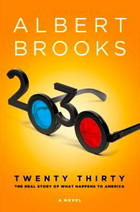
2030: The real story of what happens to America

I’m a big fan of Albert Brooks. Defending Your Life, Lost in America, Taxi Driver, Private Benjamin… pick your favorite. He writes, directs, acts… TV, movies and, now, novels.

I just finished 2030 and found it both depressing and inspiring. Here’s a little taste from a NYT review:

In the future America of “2030,” the national debt has long since surpassed the gross national product. Why anyone would want to be president is “more and more of a mystery.” On the rosy side — well, sort of — a cure for cancer has been found, turning the man who did it, Dr. Sam Mueller, into a billionaire and a guru.

The bad news? Along with a stock of lesser rejuvenating drugs and gadgets, Mueller’s breakthrough has left spry hordes of senior citizens cheerily hogging most of the country’s remaining resources. Seeing their own chance at the good life shrink to zero, young people are forming “resentment gangs” and committing acts of escalating violence against “the olds.” The White House’s first Jewish occupant, the brainy but melancholy Matthew Bernstein, would like to give them a fairer share of the pie, but even he doesn’t dare risk the wrath of AARP.

I have to say that just about everything in this story seemed plausible to me. Brooks fans won’t be disappointed. A few excerpts after the jump… Continue reading

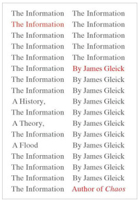
The Information, by James Gleick

Publishers Weekly review on Amazon:

“In 1948, Bell Laboratories announced the invention of the electronic semiconductor and its revolutionary ability to do anything a vacuum tube could do but more efficiently. While the revolution in communications was taking these steps, Bell Labs scientist Claude Shannon helped to write a monograph for them, A Mathematical Theory of Communication, in which he coined the word bit to name a fundamental unit of computer information. As bestselling author Gleick (Chaos) astutely argues, Shannon’s neologism profoundly changed our view of the world; his brilliant work introduced us to the notion that a tiny piece of hardware could transmit messages that contained meaning and that a physical unit, a bit, could measure a quality as elusive as information. Shannon’s story is only one of many in this sprawling history of information.  Gleick’s exceptional history of culture concludes that information is indeed the blood, the fuel, and the vital principle on which our world runs.”

The following got some highlighter during my read:

“In the long run, history is the story of information becoming aware of itself.” pg 12

“With words we begin to leave traces behind us like breadcrumbs: memories in symbols for others to follow.” pg 31

“All known alphabets, used today or found buried on tablets and stone, descend from the same original ancestor.” pg 33

“The written word was a prerequisite for conscious thought as we understand it.” pg 37

Continue reading

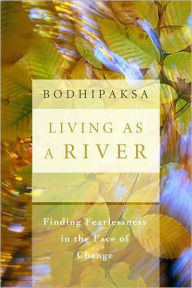
Living As A River by Bodhipaksa

living-riverFinding Fearlessness in the Face of Change

The ultimate act of letting go is to abandon the delusion that consciousness and the world are separate things.

Because we fear our own eventual extinction, we construct the idea of a permanent self.

(The Buddha) saw the self as composed of a number of ever-changing processes.

Knowing that I exist, it’s hard for me to imagine never having existed, and so in my own mind there’s a certain inevitability about my existence.

When we try to imagine death, what comes to mind is imagining an experience of nothingness, as if we’d still be around to have a non-experience. […] We simply cannot imagine not being able to experience anything at all, because experience is all we know, and so we’re forced to imagine experiencing non-experience.

Since we assume that the self existed before conception and will exist after death, we’ll inevitably imagine that it persists — unchanged — throughout life.

Once we start naming things, our language reinforces our underlying tendency to see them as fixed. We name things, and then we assume that because the name is static, so too is the thing named. The mind takes the language it uses to label reality as if it were reality.

It is (the) flow of events that constitutes what we call consciousness. Consciousness is not seen as being something separate that “has” experiences. Consciousness is the activity of experiencing.

The sage at peace recognizes that aging and dying are simply stories we weave for ourselves.

The opposite of suffering turns out not to be simple happiness, but something indefinable.

We may try to shelter ourselves from an awareness of impermanence by identifying with a nation or religion or with an abstract principle such as progress. […] To cling is to seek a stable refuge in the midst of a torrent of impermanence. […] The more our sense of well-being is dependent upon something impermanent, the more there is an undercurrent of fear. […] Fear leads to clinging, which leads to fear.

Insight is not the same as intellectual understanding but is a direct recognition of impermanence in our experience.

Everything that constitutes us is in fact a process, rather than a thing or object.

“Verbal thinking” – a scrolling tickertape of more-or-less connected words that streams endlessly through the mind.

(The body is) a process that has continuity rather than identity. […] There is no being, only becoming. There is no identity, only change.

In sensing my body as a river, I begin to realize that I do not know what I am. I begin to realize that there is nothing — “no thing” — to cling to or to identify with. One cannot hold onto a river.

If the earth were shrunk to the size of a soccer ball, the average depth of the ocean covering it would be sixty-five microns, or about twice the thickness of a grocery-store plastic bag.

Life is the sustainable self-organization of energy within the material world. […] Life itself is flow, and the energy of life cannot be grasped or possessed.

We need to hold definitions lightly, remembering that they are the map rather than the territory.

Despite Copernicus, we tend to think that we are at the center of the universe — that it all exists in order to serve us. But rather, we are scavengers of energy, peripheral to the vast processes unfolding around us.

Clouds make a good analogy for the illusory nature of the self. There’s nothing permanent in a cloud, just as there’s nothing permanent to be found in the self. The cloud is not separate from its environment, just as my self has no separateness. Just as the cloud lacks the essential qualities I assume a “thing” has, so too does my self lack the qualities I assume a self has. In looking at mists or a cloud; we can see a form, often with an apparently well-defined edge, and yet there’s nothing there that can be grasped. The fact that we name something a “cloud” often seems to create in the mind the assumption that the thing that’s being named is as static as the label applied to it. Often we’ll glance at a particular cloud and then look at it a short while later. Nothing much seems to have changed, because the human mind is not well-equipped to perceive change—especially not in something as amorphous as a cloud.

All concepts are simply labels superimposed upon the reality we perceive.

As we move toward the idea of abandoning the idea of a separate selfhood, we may need to go through a phase of treating the whole of creation as if it were us. […] Extend the idea of the self out far enough, and the idea of the self becomes meaningless.

As I sit breathing in my meditation practice, I might find myself wondering exactly at what point a particular molecule of air could be said to be “in” the body. Is it when it crosses some arbitrarily drawn plane enclosed by the rims of my nostrils? Is it once it’s crossed into the bloodstream? Or bonded to a molecule of hemoglobin? Any line I choose to draw would be purely arbitrary. I look for the boundary of my physical self and can’t find one.

Noticing how my gaze can often fixate on a narrow area in front of me, I become aware of the entirety of my visual field, allowing into awareness everything from the center of my visual field to the periphery. It’s like moving from a kind of “dial-up” connection between the world and my brain to a “broadband” one. Doing this generally has a very calming effect on my inner chatter, as if the sheer volume of incoming data I’m paying attention to leaves no bandwidth available for my inner dramas.

All experience takes place in the mind. […] We can know nothing beyond our sensory experience.

Consciousness is the activity of being aware of something. There can, by definition, be no consciousness separate from the things of which it is aware. […] We can never know objective things separate from our sense-impressions, which are interpretations rather than reality.

There can be no consciousness without something to be conscious of.

There is nothing stable within the mind. There is no permanent core. Perceptions, feelings, thoughts, and emotions are simply flowing through us, but are not us. Consciousness is an activity. It’s there when it happens.

Our identity depends on the internalization of the consciousness of others. Consciousness, like all the other elements, is therefore something that extends beyond the individual and that, in some sense, flows through us like a river.

Each event of cognizing is “a consciousness.” Since perceptions come and go, so too will consciousness come and go. Each response to a perception is another consciousness. There is no enduring consciousness, no permanent watcher at the helm of our being, observing everything that happens and making decisions. There are just the multiple overlapping waves of consciousness, rising and falling, rising and falling.

Our decision-making is a post-hoc conscious labeling of activities that begin outside of awareness.

Where is the self when conscious awareness is absent?

Memories are not etched permanently in the brain. Instead, every time a memory is retrieved, it is destroyed and then re-created, and it becomes a memory of a memory. Any current memories we have are copies of copies of copies… many times over depending on how many times we have recalled that particular experience. Because of this process of creating, destroying, and re-creating memories, our recollections are unstable and subject to alteration. Each time we recall an event from our lives, the memory of that event can change. […] We never have a full recollection of anything that’s happened to us, and our memories are constructed from hints, scraps and traces found within the mind.

“We are never conscious of anything but a particular perception; man is a bundle or collection of different perceptions that succeed one another with an inconceivable rapidity and are in perpetual flux and movement.” — David Hume

The underlying principle of selfhood in Buddhism: there is continuity but no identity.

I am a field of awareness in which all my experiences arise.

It’s largely our thoughts, and the emotional qualities associated with them that create our experience. […] In every moment of perception, we are able to choose between (fear and love). Fear is marked by clinging, aggression, doubt, anxiety, and denial. Love is marked by letting go, being flexible, compassionate regard, confidence, and intelligent curiosity. We have these choices in every moment of our lives.

Every time we make a choice, we play a part in forming a new version of the self, and we also remind ourselves of the self’s unfixed nature. We begin to see more and more clearly that our present experience is produced by largely unconscious patterns of thought.

There is no succession of fleetingly short selves, but instead a never-ending process of change. (No self!)

We simply let go of identifying any part of our experience as the self. Since we don’t cling to anything as being the self, we also don’t think of anything as being other than the self. […] There is simply experience, with no absolute distinction between subject and object. There is no idea “I am perceiving.” there’s no idea that there’s a separate world being perceived. There’s just experience.

Buddhism Plain and Simple by Steve Hagen

buddhism-plain-simpleExcerpts from Buddhism Plain and Simple by Steve Hagen.


When the Buddha was asked to sum up his teaching in a single word, he said, “awareness.”

The Buddha never considered himself to be something other than a human being — only someone who was fully awake. […] Buddha is not someone you pray to, or try to get something from. Nor is a buddha someone you bow down to . A buddha is simply a person who is awake — nothing more or less.

Buddhism is not a belief system. It’s not about accepting certain tenets or believing a set of claims or principles. In fact, it’s quite the opposite. It’s about examining the world clearly and carefully about testing everything and every idea. Buddhism is about seeing. It’s about knowing rather than believing or hoping or wishing. It’s also about not being afraid to examine anything and everything, including our own personal agendas.

“Don’t believe me because you see me as your teacher,” he said. “Don’t believe me because others do. And don’t believe anything because you’ve read it in a book, either. Don’t put our faith in reports, or tradition, or hearsay, or the authority of religious leaders or texts. Don’t rely on mere logic, or inference, or appearances, or speculation.”

The point of Buddhism is to just see. That’s all. […] We cannot approach Buddhism with any assumption or belief whatsoever. […] Buddhism begins with fact. It starts with perception — direct experience. […] Truth does not need any explanation. It only needs to be seen.

Belief is at best an educated, informed conjecture about Reality. In contrast, seeing — raw, direct, unadulterated experience — is the direct perception of Reality Itself. […] Base your actions on what you see, rather than on what you think.

We can only be here. We can’t leave. We’re always here.

No solid, unchanging “good” or “bad” can be established. Good and bad aren’t absolutes. They are beliefs, judgments, ideas based on limited knowledge as well as on the inclinations of our minds.

Generally our desire, our actions, our speech, and our thoughts are geared toward bringing about some particular end by exerting control. The buddha-dharma doesn’t ask us to give up control. Instead, it acknowledges that we never had it in the first place.

“I discovered one day that what I was calling “I” cannot be found, and all fear and anxiety vanished with my mistake.”

To hold onto any particular view is to freeze Reality, to try to encapsulate the world into thought.

What you really need and want will never appear as an object to your mind.

The only way we can be free in each moment is to become what the moment is.

We can’t comprehend Reality with our intellects. Reality simply cannot be put into a conceptual form — not even through analogy. […] You can’t conceive of it, but you can perceive it.

The right intention is simply the intention to come back to this moment — to just be present with no ideas of gaining whatsoever.

Meditation is nothing other than the intention to wake up.

The mind will not be ruled. Just attend to what you’re doing. Because in attending to this moment, you’re attending to your own mind.

A buddha recognizes that anything put into speech is never completely reliable. Whatever someone says to you about another person is skewed from the start. It comes through their filter, their likes and dislikes, their education their ambition, and the leanings of their own mind.

As long as you think enlightenment is something special, you won’t wake up.

When we see Reality we are completely beyond the realm of words and concepts. We experience what words cannot express, what ideas cannot contain, what speech cannot communicate. So, in a sense, there’s nothing to say.

Our only choice of consequence lies in whether or not we’re awake.

You can’t want enlightenment like you want other things. There’s absolutely nothing to go after.

Our thoughts and mental states are just as fleeting as the sensations of our bodies. (Like feeling hot or cold. And we have no control over them)

A key point in the practice of mindfulness is never to chastise yourself.

Do right meditation even though it’s useless. Do it for no purpose.

There are two kinds of knowledge and two types of views. One consists of beliefs, opinions, conjectures — having an idea of something. It’s an intellectual grasping of concepts. This is how we commonly think of knowledge.

There is a second type of view, what the Buddha called right view. Right view is not a concept or belief. In fact, it’s no particular thing at all. Right view is simply seeing Reality as it is, here and now, moment after moment. It’s relying on bare attention — naked awareness of what is before conceptual thought arises. It’s relying on what we actually experience rather than what we think.

It’s by our very desire to find meaning that we create meaninglessness.

The Buddha, relying on direct experience alone, not only found no evidence of beginnings or endings, he could find no evidence of any separate, persisting thing (self) that could have a beginning or end.

Our belief in non-existence (death) arises only as the result of hold the notion of existence (of the self) in the first place.

The awakened may have thoughts and concepts just like anyone else. The difference is that they’re aware that what they actually see differs from what they think.

What is Real and True is immediately perceivable without any abstract thought — any concepts — whatsoever.

Seeing doesn’t require conception, language, or memory.

Ultimate Truth can’t be conceptualized or imagined. You cannot hold Ultimate Truth in your mind at all. You can see it. You just can’t hold It as an idea.

Whenever we come up with any concept at all, we simultaneously create one or more opposite concepts.

We tend not to realize the extent to which we make up what we call the world.

Trying to make a leaning mind stop leaning is just another form of leaning. […] Forget yourself. Start noticing if your mind is leaning — showing preferences, making calculations, trying to bring about, trying to push away. […] When your mind is not leaning, it’s none other than Whole Mind.

To awaken is not to hold the idea of awakening. You can’t practice waking up.

What Technology Wants by Kevin Kelly (TED Talk)

I finished Kevin Kelly’s What Technology Wants (PDF) this weekend. I rank this book up there with Ray Kurzweil’s The Singularity is Near in terms of importance. I won’t attempt to review the book, since I’m still try to absorb some of the mind-bending ideas. Like the evolution of technology:

Here are a few ideas that got some highlighter:

Technology and life must share some fundamental essence. … However you define life, its essence does not reside in material forms like DNA, tissue, or flesh, but in the intangible organization of the energy and information contained in those material forms. Both life and technology seem to be based on immaterial flows of information.” – pg 10

Technium – The greater, global, massively interconnected system of technology vibrating around us. – pg 11

How many neurons do you need to have a mind? – pg 13

We can think of technology as our extended body. – pg 44

Ideas fly in flocks. To hold one idea in mind means to hold a cloud of them. – pg 45

Even the tiniest disposable item with a bar code shares a thin sliver of our collective mind. – pg 48

For most humans, for most of time, real change was rarely experienced. – pg 73

“What was impossible billions of years ago becomes increasingly inevitable.” — Simon Conway pg 126

There is only one life. All life today is descended along an unbroken line of duplication from one ancient molecule that worked inside one primeval cell that worked. – pg 127

Continue reading

zero history

zero history is the final novel in William Gibson’s trilogy that started with Pattern Recognition. Hollis Henry is back from book two, Spook Country. I wouldn’t presume to review the work of Mr. Gibson. Here are a few of his words that got some highlighter:

“It was like being on the bottom of a Coney Island grab-it game, one in which the eclectically ungrabbed had been accumulating for decades. He looked up, imagining a giant three-pronged claw, agent of stark removal.” – pg 9

“His attempted smile felt like something froced from a flexible squeeze-toy.” – pg 10

“An overly wealthy, dangerously curious fiddler with the world’s hidden architectures.” – pg 18

“We do brand vision transmission, trend forecasting, vendor management, youth market recon, strategic planning in general.” – pg 21

“Addictions (start) out like magical pets, pocket monsters.” – pg 53

Continue reading

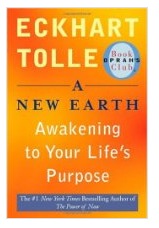
A New Earth by Eckhart Tolle

One measure of a book (for me) is how many passages get highlighted [after the jump]. What ideas will I want to find again? A New Earth by Eckhart Tolle had some on nearly every page. For example:


“Most people are so completely identified with the voice in the head — the incessant stream of involuntary and compulsive thinking and the emotions that accompany it — that we may describe them as being possessed by their mind. You take the thinker to be who you are. … Your thinking, the content of your mind, is of course conditioned by the past: your upbringing, culture, family background, and so on.”

Everything in the book made perfect sense to me. I’m trying to incorporate man of his ideas into my life.


“…when survival is threatened by seemingly insurmountable problems, an individual life-form –or a species– will either die or become extinct or rise above the limitations of its condition through an evolutionary leap.” – pg 20

“A significant portion of the earth’s population will soon recognize, if they haven’t already done so, that humanity is now faced with a stark choice: Evolve or die.” – pg 21

“We are coming to the end not only of mythologies but also of ideologies and believe system. … At the heart of the new consciousness lies the transcendence of thought.” – pg 21

“What a liberation to realize that the “voice in my head” is not who I am. Who am I then? The one who sees that. The awareness that is prior to thought, the space in which the thought–or the emotion or sense perception–happens.” – pg 22

“Thoughts consist of the same energy vibrating at a higher frequency than matter, which is why they cannot be seen or touched.” – pg 146

“You look at the present through the eyes of the emotional past within you. In other words, what you see and experience is not in the event or situation but in you.” – pg 173

“Being present is always infinitely more powerful than anything one could say or do.” – pg 176

“…heaven is not a location but refers to the inner realm of consciousness.” – pg 23

“Words, no matter whether they are vocalized and made into sounds or remain unspoken as thoughts, can cast an almost hypnotic spell upon you. You easily lose yourself in them, bercome hypnotized into implicitly believing that when you have attached a word to something, you know what it is.” – pg 25

“Words reduce reality to something the human mind can grasp.” – pg 27

“Most of the time it is not you who speaks when you say or think “I” but some aspect o fthat mental construct, the egoic self.” – pg 30

“…the shift in identity from being the content of their mind to being the awareness in the background.” – pg 30

“The egoic mind is completely conditioned by the past.” – pg 34

“The unconscious compulsion to enhance one’s identity through association with an object is built into the very structure of the egoic mind.” – pg 35

“Most people don’t inhabit a living reality, but a conceptualized one.” – pg 37

“Being must be felt. It can’t be thought.” – pg 40

“Life will give you whatever experience is most helpful for the evolution of your consciousness.” – pg 41

“The ego isn’t wrong; it’s just unconscious.” – pg 42

“The ego doesn’t mind what it identifies with as long as it has an identity.” – pg 44

“…making yourself right and other wrong is one of the principal egoic mind patterns.” – pg 44

“The ego tends to equate having with Being: I have, therefore I am. And the more I have, the more I am. The ego lives through comparison.” – pg 45

“How do you let go of attachment to things? Don’t even try. It’s impossible. Just be aware of your attachment to things.” – pg 45

“Wanting keeps the ego alive more than having” – pg 46

“The consciousness that says ‘I am’ is not the consciousness that thinks. … When you are aware that you are thinking, that awareness is not part of thinking. … If there were nothing but thought in you, you wouldn’t even know you are thinking.” – pg 55

“The ultimate truth of who you are is not I am this or I am that, but I Am.” – pg 57

“Whenever tragic loss occurs, you either resist or you yield.” – pg 57

“Most people are so completely identified with the voice in the head — the incessant stream of involuntary and compulsive thinking and the emotions that accompany it — that we may describe them as being possessed by their mind. You take the thinker to be who you are. … Your thinking, the content of your mind, is of course conditioned by the past: your upbringing, culture, family background, and so on.” – pg 59

“In most cases, when you say “I,” it is the ego speaking, not you. It consists of thought and emotion, of a bundle of memories you identify with as “me and my story,” of habitual roles you play without knowing it, of collective identifications such as nationality, religion, race social class, or political allegiance. It also contains personal indentifications, not only with possessions, but also with opinions, external appearance, long-standing resentments, or concepts of yourself as better than or not as good as others, as a success or failure.” – pg 60

“Every complaint is a little story the mind makes up that you completely believe in.” – pg 61

“Instead of overlooking unconsciousness in others, you make it into their identity.” – pg 62

“The ego’s greatest enemy of all is the present moment, which is to say, life itself.” – pg 63″The ego’s greatest enemy of all is the present moment, which is to say, life itself.” – pg 63

“Whenever you notice that voice, you will also realize that you are not the voice, but the one who is aware of it. … The moment you become aware of the ego in you, it is strictly speaking no longer the ego, just an old, conditioned mind-pattern. … Every time it is recognized, it is weakened.” – pg 64

“When you complain, by implication you are right and the person or situation you complain about or react against is wrong. There nothing that strengthens the ego more than being right. For you to be right, you need someone else to be wrong. You need to make other wrong in order to get a stronger sense of who you are.” – pg 67

“Every ego is a master of selective perception and distorted interpretation. Only through awareness –not through thinking– can you differentiate between fact and opinion.” – pg 68

“The (church’s) Truth was considered more important than human life. And what was the Truth? A story you had to believe in; which means, a bundle of thoughts. … Thought can at best point to the truth, but it never IS the truth.” – pg 70

“The particular egoic patterns that you react to most strongly in others and misperceive as their identity tend to be the same patterns that are also in you. … Anything that you resent and strongly react to in another is also in you.” – pg 74

“Whatever you fight, you strengthen, and what you resist, persists. … There is a deep interrelatedness between your state of consciousness and external reality.” – pgs 75-76

“All that is required to become free of the ego is to be aware of it.” – pg 78

“Spiritual realization is to see clearly that what I perceive, experience, think, or feel is ultimately not who I am.” – pg 78

“The only thing that ultimately matters: Can I sense my essential Beingness, the I Am, in the background of my life at all times?” – pg 79

“Whatever behavior the ego manifests, the hidden motivating force is always the same: the need to stand out, be special, be in control; the need for power, for attention, for more. … The ego always wants something from other people or situations.” – pg 80

“The ego thrives on others’ attention, which is after all a form of psychic energy.” – pg 85

“Can you cease looking to thought for an identity? … When you play roles, you are unconscious.” – pg 90

“Don’t say, “I’m unhappy.” Unhappiness has nothing to do with who you are.” – pg 95

“Rather than being your thoughts and emotions, be the awareness behind them.” – pg 96

“Awareness is the greatest agent for change.” – pg 99

“Doing is never enough if you neglect Being.” – pg 103

“You are most powerful, most effective, when you are completely yourself. But don’t try to be yourself. That’s another role.” – pg 108

“Assumptions (are) unexamined thoughts that are confused with reality.” – pg 114

“You don’t live your life, but life lives you. Life is the dancer, and you are the dance.” – pg 115

“Before you were the thoughts, emotions, and reactions; now you are the awareness, the conscious Presence that witnesses those states. … To become free of the ego, be aware of your thoughts and emotions — as they happen.” – pg 117

“Your entire personal history, which is ultimately no more than a story, a bundle of thoughts and emotions, (is) of secondary importance.” – pg 117

“Each person is so identified with the thoughts that make up their opinion, that those thoughts harden into mental positions which are invested with a sense of self. Identity and thought merge.” – pg 121

“When work is no more than a means to an end, it cannot be of high quality.” – pg 122

“When work is no more than a means to an end, it cannot be of high quality.” – pg 122

“Strictly speaking, you don’t think: Thinking happens to you. Digestion happens, circulation happens, thinking happens.” – pg 129

“Although the body is very intelligent, it cannot tell the difference between an actual situation and a thought. It reacts to every thought as if it were a reality.” – pg 134

“The ego is the voice in (your) head which pretends to be you.” – pg 134

“Thoughts consist of the same energy vibrating at a higher frequency than matter, which is why they cannot be seen or touched.” – pg 146

“You look at the present through the eyes of the emotional past within you. In other words, what you see and experience is not in the event or situation but in you.” – pg 173

“Being present is always infinitely more powerful than anything one could say or do.” – pg 176

“Who you are requires no belief. In fact, every belief is an obstacle.” – pg 189

“Most people define themselves through the content of their lives. Whatever you perceive, experience, do, think or feel is content. When you think or say, “my life,” you are not referring to the life that you ARE but the life that you HAVE, or seem to have. You are referring to content –your age, health, relationships, finances, work and living situation, as well as your mental-emotional state.” – pg 193

“Only if you resist what happens are you at the mercy of what happens, and the world will determine your happiness and unhappiness.” – pg 200

“It is at this moment that you can decide what kind of relationship you want to have with the present moment.” – pg 201

“The decision to make the present moment into your friend is the end of ego.” – pg 201

“Instead of adding time to yourself, remove time. The elimination of time from your consciousness is the elimination of ego. It is the only true spiritual practice.” – pg 207

“For the ego to survive, it must make time –past and future– more important than the present moment.” – pg 207

“You are present when what you are doing is not primarily a means to an end (money, prestige, winning) but fulfilling in itself, when there is joy and aliveness in what you do.” – pg 211

“People believe themselves to be dependent on what happens for their happiness.” – pg 213

“Become conscious of being conscious. Say or think “I Am” and add nothing to it.” – pg 236

“Breathing isn’t really something that you do but something that you witness as it happens. … Whenever you are conscious of the breth, you are absolutely present. Conscious breathing stops your mind.” – pg 245-246

“Stillness is the language God speaks, and everything else is a bad translation.” – pg 255

“To be still is to be conscious without thought. … When you are still, you are who you were before you temporarily assumed this physical and mental form called a person.” – pg 256

“Awakening is a shift in consciousness in which thinking and awareness separate. … Instead of being lost in our thinking, when you are awake you recognize yourself as the awareness behind it.” – pg 259

“Presence: consciousness without thought” – pg 259

“The separation of thinking and awareness happens through the negation of time. When you negate time, you negate the ego.” – pg 265

“You cannot become successful. You can only be successful. Don’t let a mad world tell you that success is anything other than a successful present moment.” – pg 270

“Your entire life journey ultimately consists of the step you are taking at this moment. This doesn’t mean you don’t know where you are going; it just means this step is primary, the destination secondary. And what you encounter at your destination once you get there depends on the quality of this one step. What the future holds for you depends on your state of consciousness now.” – pg 271

“Thinking cuts reality up into lifeless fragments.” – pg 276

“You can only lose something that you have, but you cannot lose something that you are.” – pg 293