
Why Our Gut Feelings Are No Match For Physics (5 min)
James Gleick, Author and Science Historian

Why Our Gut Feelings Are No Match For Physics (5 min)
James Gleick, Author and Science Historian
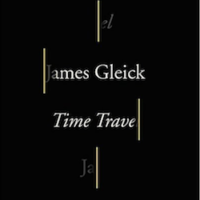 “From the acclaimed author of The Information and Chaos, here is a mind-bending exploration of time travel: its subversive origins, its evolution in literature and science, and its influence on understanding time itself.”
Sleeping into the future is what we do every night.
“Man can do what he will, but he cannot will what he wills.” — Arthur Schopenhauer
“People living in different countries kill each other at irregular time intervals, so that also for this reason anyone who thinks about the future must live in fear and terror. I trust that posterity will read these statements with a feeling of proud and justified superiority.” — Albert Einstein’s message in the time capsule buried at the 1939 New York World’s Fair
We know that complete certainty must always elude us. We know that for certain.
“Time and space are modes by which we think, and not conditions in which we live.” — Albert Einstein
“I have approximate answers and possible beliefs and different degrees of certainty about different things, but I am not absolutely sure of anything.” — Richard Feynman
What is time? Things change, and time is how we keep track.
Schopenhauer asserted that life and dreams are pages from the same book. To read them in their proper order is to live, but to browse among them is to dream.
No one can really explain how memories are formed and retrieved. Nor can anyone explain away Proust’s paradoxical contention: that the past cannot truly be recovered by searching our memories, by interrogating them, by rewinding the film or reaching back into the drawer; rather, that the essence of the past, when it comes to us at all,comes unbidden.
If you ever see yourself coming out of a time machine, run the other way as fast as you can. Nothing good can come from meeting yourself. — Charles Yu
We experience childhood one way when we’re living it and another way when we relive it in memory.
But if memory is the action of recollection, the act of remembrance, then it implies an ability to hold in the mind two constructs, one representing the present and another representing the past, and to compare them, one against the other. How did we learn to distinguish memory from experience?
Our conscious brains invent the concept of time over and over again, inferring it from memory and extrapolating from change. And time is indispensable to our awareness of self. […] You order the slices of your life. You edit the film even as it records.
“There were buttons and switches everywhere—buttons to call for food, for music, for clothing. There was the hot-bath button, by pressure of which a basin of (imitation) marble rose out of the floor, filled to the brim with a warm deodorized liquid. There was the cold-bath button. There was the button that produced literature, and there were of course the buttons by which she communicated with her friends. The room, though it contained nothing, was in touch with all that she cared for in the world.” — The Machine Stops by E. M. Forster
Why do we need time travel, when we already travel through space so far and fast? For history. For mystery. For nostalgia. For hope. To examine our potential and explore our memories. To counter regret for the life we lived, the only life, one dimension, beginning to end.
“We know it all now, with our thoughts travelling at the speed of tweet. We are time travelers into our own future. We are Time Lords.” — Ali Smith
If we confuse the real world with our many virtual worlds, it’s because so much of the real world is virtual.
Time’s winged chariot isn’t taking us anywhere good. […] The past, in which we did not exist, is bearable, but the future, in which we will not exist, troubles us more.
“We perceive time only because we know we have to die.” — Heidegger
Maria Popova describes James Gleick’s new book Time Travel: A History, “a dizzying tour of science, philosophy, and their interaction with literature.” A few snippets from her lengthy review:
“Why do we need time travel, when we already travel through space so far and fast? For history. For mystery. For nostalgia. For hope. To examine our potential and explore our memories. To counter regret for the life we lived, the only life, one dimension, beginning to end.”
“Things have been, says the legal mind, and so we are here. The creative mind says we are here because things have yet to be.”
“The mind is what we experience most immediately and what does the experiencing.”
“If we have only the one universe — if the universe is all there is — then time murders possibility. It erases the lives we might have had.”
One of my favorite topics by one of my favorite writers.
UPDATE: From a good piece in The Guardian: “Howard and his editors also manage a number of celebrity Beatle-fan coups, like the day when, to their astonishment, they spotted a 14-year-old Sigourney Weaver looming lankily over her fellow teenyboppers in footage of a 1964 show.”
James Gleick’s The Information was one of the more interestisng books I’ve read this year. And this piece in the New York Review of Books he talks about “How Google Dominates Us. A few of my favorites:
Almost every article about Google worries about the potential danger of someone having so much information about us. And yet, few seem concerned about how much power, information and control governments have over us. I’ll trust Larry and Sergey over any politician that has come along in my lifetime.
Publishers Weekly review on Amazon:
 “In 1948, Bell Laboratories announced the invention of the electronic semiconductor and its revolutionary ability to do anything a vacuum tube could do but more efficiently. While the revolution in communications was taking these steps, Bell Labs scientist Claude Shannon helped to write a monograph for them, A Mathematical Theory of Communication, in which he coined the word bit to name a fundamental unit of computer information. As bestselling author Gleick (Chaos) astutely argues, Shannon’s neologism profoundly changed our view of the world; his brilliant work introduced us to the notion that a tiny piece of hardware could transmit messages that contained meaning and that a physical unit, a bit, could measure a quality as elusive as information. Shannon’s story is only one of many in this sprawling history of information. Gleick’s exceptional history of culture concludes that information is indeed the blood, the fuel, and the vital principle on which our world runs.”
The following got some highlighter during my read:
“In the long run, history is the story of information becoming aware of itself.” pg 12
“With words we begin to leave traces behind us like breadcrumbs: memories in symbols for others to follow.” pg 31
“All known alphabets, used today or found buried on tablets and stone, descend from the same original ancestor.” pg 33
“The written word was a prerequisite for conscious thought as we understand it.” pg 37