Robert Scoble: The value of “influencers”

“I’ll tell you what executives from big companies (like Kraft, Procter and Gamble, GM, and others) who were at MSN’s OWN ADVERTISING CONFERENCE told me. An influencer is worth THOUSANDS of times more than a non-influencer (influencer is someone who tells other people stuff, which is why blogging is getting so much advertising attention lately). That’s why Google is charging more per click than MSN is (Google has more influential users).”

— Robert Scoble via Gaping Void

Google makes ad deal with XM

“In its biggest offline media play to date, online search giant Google this morning announced plans to begin extending the reach of its online search advertisers to the nation’s largest satellite radio service, XM Satellite Radio. The deal is the latest development in Google’s push to expand beyond the Internet into the traditional media marketplace, and follows a series of tests with print media and radio outlets.”

Media Daily News [Thanks, XM Ben]

Google AdSense for radio: Part Two

From today’s C|NET story on Google and radio advertising:

“So why the excitement? dMarc automates the process of buying ads, placing them in time slots and tracking them, which is usually done by ad agencies over the phone, experts said. Automation could lead to efficiency, and that means lower prices for advertisers while bringing in more sales for the radio stations. … The Google-dMarc system would be a big change from the current ad-buying system, where ad salespeople establish personal relationships with radio stations. Advertisers could better quantify how well an ad campaign is doing and modify the ads quickly depending on the response rate from listeners.”

Which reminded me of this from Chris Anderson’s The Long Tail:

“Meanwhile on the other side, those ad-driven media have their own ad sales forces. They pitch the advertisers and their media buyers on the virtues of their advertising vehicles. If all goes well, millions of dollars change hands. All of it is labor-intensive and made even more costly by the expensive schmoozing that’s required in businesses where a lack of trusted performance metrics makes salesmanship and personal relationships key to winning businesses.”

Only time will tell if Google can make this elephant dance, but revenue in Google’s most recent quarter was $2.5 billion, nearly double what it was a year ago. And Google has the money and time to figure this out:

“What’s neat about this is the radio stations get to preview the creative copy and we pre-approve all rates before they get aired. Radio stations and Google will explore on a case-by-case basis which opportunities make sense.”

The scariest quote in the story for me was:

“The fact that (what Google is trying) is more electronically based gives advertisers more comfort that they are getting what they are buying.” Ad agencies and stations “are still faxing invoices to each other and typing up affidavits.”

All of this brings back memories of Google’s earliest days. Everybody that used it said, “Damn, this is cool! THIS is how search is supposed to work. But, uh, how are they gonna make any money with this service if it’s free?” $2.5 billion last quarter. Maybe they’ll figure it out.

Google AdSense for radio

I’ve been intrigued (anxious?) by Google’s plans for taking AdSense to radio but can’t seem to find out much about it. A Technorati search this morning took me to the Google Operating System blog (pretty sure it’s not connected to Google), and a post featuring excerpts from Google’s Q2 2006 earnings conference call, during which Google CEO Eric Schmidt said this about AdSense for radio:

“We are in the process of introducing AdSense for radio, which is essentially the integration of the dMarc Console and management tools into our advertising network. The dMarc team itself is fully integrated. We’re expanding it both in engineering and sales. We’re also doing it worldwide, not just in the U.S. There’s a number of very, very interesting deals being negotiated. They’re on an integration schedule of about three months from now, so every week there are more milestones, and they’re working very hard.”

From that post I jumped to an earlier one:

“Schmidt thinks that “when he is listening to the radio in his car, radio ads should personally address him about his needs. For example, while driving past a clothing store, a radio ad should remind Eric that he needs a pair of pants and instruct him to turn left at the upcoming clothing store.”

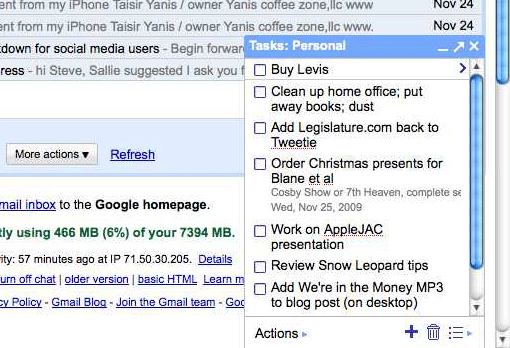
The GPS system should help radios deliver targeted ads based on information about the person. Google Maps could provide details about local businesses, the ads would be audio AdSense ads, while the information about user’s needs could be obtained from the searches or from his ToDo lists (a gadget for Google Desktop and Personalized Homepage).

dMarc Broadasting, recently acquired by Google, “connects advertisers and agencies directly to radio stations with a robust advertising platform that automates everything from sales to scheduling, delivery and report”. So this company is the first brick in the development of a new breed of radio advertising.”

Here’s what the dMarc website promises advertisers:

“dMarc Media Networks brings unprecedented immediacy to radio buys. Imagine the difference. In minutes instead of days or weeks, you can now build your own custom networks, selecting from 100’s of stations in virtually any market, through a single, source.

* Real time reports generated without human intervention
* Buy individual or multiple stations in one market or many
* Buy only those stations you really want
* Monitor feedback in real time
* Be notified instantly when ads play
* Upload spots anytime, in seconds, 24/7

I have no idea if dMarc can do all of that. Or, if radio station would want them to be able to do all of that. But I’m damned sure these are the things advertisers want and –increasingly– are insisting on.

The big question would seem to be, what’s the incentive for radio stations to participate in such a “network?” Station owners must be convinced they can make more money (or more profit) with Google AdSense than they can make on their own. IF …and it’s a big if… Google could find a way to sell EVERY ONE OF MY AVAILS…EVERY DAY… at a rate that didn’t jam me up with my local sales effort… then I might try it.

I confess it’s difficult for me to imagine that. But if Google (and others) can condition advertisers to expect measurable results and accountability — and that seems to be happening — who knows. Newspapers probably could not imagine a time when some oneline service could take away their classified ad revenue.

And during the 17 years I called on radio station managers, the #1 problem (at least in the small and medium markets) was finding good sales people. Owners have automated everything else at the radio station, why not sales?

Can any of you radio guys out there educate me on the dMarc thing?

Update: I received this explanation from a small market PD here in Missouri. Name and some particulars withheld by request.

“We operate Scott Studio’s for on-air. All hard drive audio music, liners, jingles, and commercials…with touch-screen operator computers. dMarc bought Scott Studios, and the primary commercial scheduling software Scott recommended for their system. Then Google bought dMarc.

We build our logs with our local commercials, then they can fill unused avails with their commercials. They fill the avails and upload spots all from their end, we never touch them….other than play them. I believe we have some controll over what hours they can fill, I know they don’t fill in 7a, 8a, 9a, 4p or 5p. They are :60’s and for refinancing, insurance, music collections (surfin USA the best of the beach, and stuff). Right now the clients aren’t any major chains or local businesses.

At the end of the month they send us a check for what they have run. How much I’m not sure per spots but I’ve been told the monthly check is around $X,000.

They run a lot of them in the evenings when we don’t usually have a lot of commercials scheduled. We carry Royals baseball. The 4 hour broadcast has 20 minutes available, they will fill several minutes of that and we get paid. When logs are lighter there are more in midday and afternoon.

The commercial content is not terribly exciting, it’s more spots, but it’s income that comes from unsold inventory mostly in evenings. Not a lot different than the ad’s that used to run where you are paid if someone calls and 800 number and buys Hooked on Phonics or something. I know I should probably understand this better as PD but this comes from a small station where the owner is here and does mornings/logs, etc.”

No, I think you understand (and explain) it just fine. Easy for the station. Easy for the advertiser. And I suspect the Google influence has yet to kick in. Classic Long Tail example. And I’m betting there are thousands of advertisers that will buy this time (if it’s easy enough and the price is right) without ever treading on local sales. If there’s a loser in this equation, I fear it might be programming vendors that operate on a barter basis.

Will Google Audio shake up radio advertising?

Steve Rubel points to a ZDNet report on Google’s plan for a product “…that dynamically generates and changes a terrestrial radio commercial based on demographics and news/conditions in the local market. According to those who have seen the demo, if it’s really hot in one area, McDonalds can switch from their regular burger ad to one that touts their cool drinks and frozen treats. In addition, while most advertising campaigns require a $20,000 spend, the new Google solution would require a mere $200 minimum.”

I sure would like to see that demo.

And I’d love to know what Chris Anderson thinks of Google’s plans to sell radio advertising. In his book, The Long Tail, Anderson demonstrates a clear understanding of how advertising works:

“The traditional advertising market is a classic, hit-centric industry where high cost enforce a focus on the biggest sellers and buyers. The way it works is that an advertiser, say General Motors, has a marketing budget. GM commissions an advertising firm to create some ads and then a media buyer to place those ads in television, radio, and print and online.

Meanwhile on the other side, those ad-driven media have their own ad sales forces. they pitch the advertisers and their media buyers on the virtues of their advertising vehicles. If all goes well, millions of dollars change hands. All of it is labor-intensive and made even more costly by the expensive schmoozing that’s required in businesses where a lack of trusted performances metrics makes salesmanship and personal relationships key to winning business.

These days salespeople don’t just twist arms, they also serve as advertising consultants, informing advertisers about the most effective ways to use a given medium or brainstorming creative new approaches to getting the advertisers’ message out. That works well enough, but because it’s expensive, it imposes a subtle cost: a focus on just the largest and most lucrative of potential advertisers.”

Today, there are thousands of small Google advertisers who had never advertised anywhere before. Because of the self-service model, the measurable performance, the low cost of entry, and the ability to constantly tweak and improve the ads, advertisers are flocking to this new marketplace.”

It’s going to be interesting (Read: scary as hell) to see if Google can/will fundamentally change the way radio advertising is bought and sold.

Google spreadsheets

When I bought the MacBook, I decided not to purchase Microsoft Office. I can’t remember the last time I felt the need to write something in Office. And few things make me go nuts faster than getting an email that says “see attached Word doc” in the body…and the Word doc has two lines of crap that could just as easily have been written in the body of the email (Get a clue you ignorant hillbilly!). What was my point? Oh yeah, MS Office…

Don’t need it. Don’t need Powerpoint. And –as of tomorrow– I don’t need Excel.
Google is set to launch a Web-based spreadsheet program that will allow people to view and simultaneously edit data while conducting “in-document” chat and supports the import and export of documents in the .xls format used in Excel and the .csv (comma-separated values) format.

I’m not a heavy spreadsheet user and I’m guessing the folks in our finance and accounting department couldn’t get by with the new Google spreadsheet. But I’m doing fine without Office and finer tomorrow.

Google-izing radio advertising: Day Two

More on Google’s foray into the world of radio advertising from RAIN’s Kurt Hanson, including quotes and links to The New York Times and the WSJ Online.

“The key to it is that Google is potentiallty bringing 400,000 new advertisers (their AdWords clients) to the radio medium. These new advertisers will (A) fill up unsold inventory and (B) eventually add increased demand for avails. Increased demand, of course, will inevitably drive up prices. That’s how supply-and-demand works.”

I’m still waiting for someone to explain what –if anything– that’s going to mean for barter arrangments with radio stations. Are we looking at a future where every avail can be sold?

Apparantly the dMarc software can automatically send advertisements right into radio station’s traffic ystems, bypassing the largely manual process currently used in the radio industry. Anybody have any first-hand experience with dMarc? Know a station that uses it? I’d love to know more about it.

Google buys dMarc Broadcasting

As a barter radio network, part of our pitch to prospective affiliates has been: Instead of letting your unsold commercial inventory “go to waste,” give them to us in exchange for some top-notch news and sports to enhance your station’s programming. Win-win.

So Google buys dMarc Brodcasting, a radio advertising firm whose technology allows national advertisers to buy unsold station inventory, and automatically inserts those commercials into the stations’ unsold slots.

In the online world, Google AdWords enables advertisers to find the lowest-possible rates publishers will take, and helps publishers find the highest-paying spots. This technology could greatly enhance the process of national ad buys — making it more efficient on both ends. [Analysis by RAIN]

Big Question: Will barter networks like ours someday (soon) have to compete for this inventory? Will station managers put his unsold avails in a big Google basket rather than barter them for programming? That might not be the question at all. I don’t pretend to understand what’s happening here. And there has always been rep outfits that promised to sell a station’s unsold avails, but most stations wisely steered clear of hese guys. Be interesting to see where Google heads with this technology.

Google disrupting advertising business?

Google is also preparing to disrupt the advertising business itself, by replacing creative salesmanship with cold number-crunching. Its premise so far is that advertising is most effective when seen only by people who are interested in what’s for sale, based on what they are searching for or reading about on the Web. Because Google’s ad-buying clients pay for ads only when users click on them, they can precisely measure their effectiveness – and are willing to pay more for ads that really sell their products.

— From an article in the NY Times by Saul Hansell