
Be As You Are by Sri Ramana Maharshi

Excerpts from The Teachings of Sri Ramana Maharshi (Edited by David Godman)


There is a single immanent reality, directly experienced by everyone, which is simultaneously the source, the substance and the real nature of everything that exists.

The Self is not an experience of individuality but a non-personal, all-inclusive awareness.

Sri Ramana’s God is not a personal God, he is the formless being which ustains the universe. He is not the creator of the univers, the universe is merely a manifestation of his inherent power; he is inseparable from it.

The mind turned inward is the Self; turned outwards, it becomes the ego and all the world.

The thoughts are the content of the mind and they shape the universe.

To make room, it is enough that objects be removed. Room is not brought in from elsewhere.

Bliss is not added to your nature, it merely revealed as your true natural state.

Trouble and pleasure are only for the ego.

The state free from thoughts is the only real state.

It is the mind that veils our happiness.

Self-realisation could be brought about merely by giving up the idea that there is an individual self which functions through the body and the mind.

The aim of self-enquiry is to discover, by direct experience, that the mind is non-existent.

The mind and the ego are one and the same.

When the mind unceasingly investigates its own nature, it transpires that there is no such thing as mind. The mind is merely thoughts. The mind is only they thought ‘I’

The ego functions as the knot between the Self which is pure consciousness and the physical body which is inert and insentient.

The essence of mind is only awareness or consciousness. When the ego, however, dominates it, it functions as the reasoning, thinking or sensing faculty.

Realisation is nothing new to be acquired. It is already there, but obstructed by a screen of thoughts.

Reality is simply the loss of ego.

As the practice develops the thought ‘I’ gives way to a subjectively experienced feeling of ‘I’, and when this feeling ceases to connect and identify with thoughts and objects, it completely vanishes. What remains is an experience of being in which the sense of individuality has temporarily ceased to operate.

It is not an exercise in concentration, nor does it aim at suppressing thoughts; it merely invokes awareness of the source from which the mind springs. … From then on it is more a process of being than doing, of effortless being rather than an effort to be. … Ultimately, the Self is not discovered as a result of doing anything, but only by being.

If you are vigilant and make a stern effort to reject every thought when it arises you will soon find that you are going deeper and deeper into your own inner self.

You have to ask yourself question “Who am I?’ This investigation will lead in the end to the discovery of something within you which is behind the mind. Solve that great problem and you will solve all other problems.

One must be completely free of the idea that there is an individual person who is capable of acting independently of God.

(The) final destruction of the ‘I’ takes place only if the self-surrender has been completely motiveless.

If one surrenders oneself there will be no one to ask questions or to be thought of.

You must be satisfied with whatever God gives you and that means having no desires of your own. You can have no likes or dislikes after your surrender.

It is the higher power that does everything, and man is only a tool.

The Self does not move, the world moves in it.

Pleasure or pain are aspects of the mind only. Our essential nature is happiness. But we have forgotten the Self and imagine that the body or the mind is the Self.

So long as there is thought there will be fear. #

The ego is the source of thought. #

Because you identify yourself with the body, you think that work is done by you.

We must play our parts on the stage of life, but we must not identify ourselves with those parts. #

Many a man would be only too glad to be rid of his diseased body and all the problems and inconveniences it creates for him if continued awareness were vouchsafed to him. It is the awareness, the consciousness, and not the body, he fears to lose.

One first creates out of one’s mind and then sees what one’s mind itself has created.

Clearly the world is your thought. Thoughts are your projections. The ‘I’ is first created and then the world. The world is created by the ‘I’ which in its turn rises up from the Self. (We) must admit that the world is (our) own imagination.

The universe is real if perceived as the Self.

You do not know what you were before birth, yet you want to know what you will be after death. Do you know what you are now?

Experience takes place only in the present, and beyond experience nothing exists. Even the present is mere imagination, for the sense of time is purely mental. Space is similarly mental. Therefore birth and rebirth, which take place in time and space, cannot be other than imagination. Real rebirth is dying from the ego into the spirit.

Birth pertains to the ego, which is an illusion of the mind.

God never acts, he just is. He has neither will nor desire. … The totality of all lthings and beings constitutes God.

Whatever this body is to do and whatever experiences it is to pass through was already decided when it came into existance.

As long as individuality lasts there is free will. … Only the ego is bound by destiny and not the Self.

Surrender can never be regarded as complete so long as the devotee wants this or than from the Lord.
The Power of Now

I read Eckhart Tolle’s classic The Power of Now in August of 2010. My usual practice for books like this is to highlight passages I find interesting and share them here. I highlighted so many parts of this book, I never go around to it. If you haven’t read the book, the lack of context will make most of these seem, well, just weird. I can assure you everyone line has been valuable to me.

nothing I ever did could possibly add anything to what I already had.

Self = a fiction of the mind

You have it already. You just can’t feel it because your mind is making too much noise.

the knower in you who dwells behind the thinker

All I can do is remind you of what you have forgotten.

Not to be able to stop thinking is a dreadful affliction.

You believe that you are your mind. This is the delusion.

The beginning of freedom is the realization that you are not the possessing entity — the thinker. Knowing this enables you to observe the entity. The moment you start watching the thinker, a higher level of consciousness becomes activated. You then begin to realize that there is a vast realm of intelligence beyond thought, that thought is only a tiny aspect of that intelligence. You also realize that all the things that truly matter — beauty, love, creativity, joy, inner peace — arise from beyond the mind. You begin to awaken.

The voice isn’t necessarily relevant to the situation you find yourself in at the time; it may be reviving the recent or distant past or rehearsing or imagining possible future situations. Here it often imagines things going wrong and negative outcomes; this is called worry. This is because the voice belongs to your conditioned mind.

“watching the thinker” — listen to the voice in your head, be there as the witnessing presence. … The thought then loses its power over you and quickly subsides, because you are no longer energizing the mind through identification with it.

aware but not thinking. This is the essence of meditation.

Because you are identified with it … you derive your sense of self from the content and activity of your mind. Because you believe that you would cease to be if you stopped thinking.

(Ego) a false self, created by unconscious identification with the mind. (It) can only be kept going through constant thinking.

Even when the ego seems to be concerned with the present, it is not the present that it sees: It misperceives it completely because it looks at it through the eyes of the past. Or it reduces the present to a means to an end, an end that always lies in the mind-projected future. The present moment holds the key to liberation. But you cannot find the present moment as long as you are your mind.

Thinking and consciousness are not synonymous. Thinking is only a small aspect of consciousness. Thought cannot exist without consciousness, but consciousness does not need thought.

The mind is essentially a survival machine. It is not at all creative.

Emotion (is) the body’s reaction to the mind.

If there is an apparent conflict between them, the thought will be the lie, the emotion will be the truth.

You will not be free of pain until you cease to derive your sense of self from identification with the mind, which is to say from ego.

Glimpses of love and joy or brief moments of deep peace are possible whenever a gap occurs in the stream of thought. Usually, such moments are short-lived, as the mind quickly resumes its noise-making activity that we call thinking.

Pleasure is always derived from something outside you, whereas joy arises from within.

Become present. Be there as the observer of the mind.

The pain that you create now is always some form of nonacceptance, some form of unconscious resistance to what is.

The mind always seeks to deny the Now and to escape from it. In other words, the more you are identified with your mind, the more you suffer.

Time and mind are in fact inseparable. … The mind, to ensure that it remains in control, seeks continuously to cover up the present moment with past and future,

Unconscious = a complete absence of the watcher.

You can always cope with the present moment, but you cannot cope with something that is only a mind projection — you cannot cope with the future.

ultimately all fear is the ego’s fear of death,

End the delusion of time. Time and mind are inseparable. Remove time from the mind and it stops

Nothing ever happened in the past; it happened in the Now.
Nothing will ever happen in the future; it will happen in the Now.

In the Now, in the absence of time, all your problems dissolve.

The moment you realize you are not present, you are present. Whenever you are able to observe your mind, you are no longer trapped in it.

Usually, the future is a replica of the past.

Ultimately, this is not about solving your problems. It’s about realizing that there are no problems. Only situations — to be dealt with now, or to be left alone and accepted as part of the “isness” of the present moment until they change or can be dealt with. Problems are mind-made and need time to survive. They cannot survive in the actuality of the Now.

it is impossible to have a problem when your attention is fully in the Now

The mind unconsciously loves problems because they give you an identity of sorts

Everything is honored, but nothing matters.

To complain is always nonacceptance of what is. … leave the situation or accept it. All else is madness.

Die to the past every moment. You don’t need it. Only refer to it when it is absolutely relevant to the present.

You can always cope with the Now, but you can never cope with the future — nor do you have to. The answer, the strength, the right action or the resource will be there when you need it, not before, not after.

Eternity does not mean endless time, but no time.

Being cannot become an object of knowledge.

You are cut off from Being as long as your mind takes up all your attention. When this happens — and it happens continuously for most people — you are not in your body. The mind absorbs all your consciousness and transforms it into mind stuff. You cannot stop thinking. Compulsive thinking has become a collective disease. Your whole sense of who you are is then derived from mind activity

Feeling will get you closer to the truth of who you are than thinking.

As there is more consciousness in the body, its molecular structure actually becomes less dense. More consciousness means a lessening of the illusion of materiality.

when presence becomes your normal mode of consciousness and past and future no longer dominate your attention, you do not accumulate time anymore in your psyche and in the cells of the body. The accumulation of time as the psychological burden of past and future greatly impairs the cells’ capacity for self-renewal.

see yourself surrounded by light or immersed in a luminous substance — a sea of consciousness. Then breathe in that light. Feel that luminous substance filling up your body and making it luminous also.

nothing in this world is so like God as silence

You “get” there by realizing that you are there already. You find God the moment you realize that you don’t need to seek God.

the moment that judgment stops through acceptance of what is, you are free of the mind.

Ego is the unobserved mind that runs your life when you are not present as the witnessing consciousness, the watcher.

You cannot have an argument with a fully conscious person.

The whole advertising industry and consumer society would collapse if people became enlightened and no longer sought to find their identity through things.

every moment — is the best. That is enlightenment.

there is no objective world out there. Every moment, your consciousness creates the world that you inhabit.

Only those who have transcended the world can bring about a better world.

who you are is always a more vital teaching and a more powerful transformer of the world than what you say, and more essential even than what you do.

to surrender is to accept the present moment unconditionally and without reservation.

You are walking along a path at night, surrounded by a thick fog. But you have a powerful flashlight that cuts through the fog and creates a narrow, clear space in front of you. The fog is your life situation, which includes past and future; the flashlight is your conscious presence; the clear space is the Now.

Surrender does not transform what is, at least not directly. Surrender transforms you. When you are transformed, your whole world is transformed, because the world is only a reflection.

The amazing and incomprehensible fact is not that you can become conscious of God but that you are not conscious of God.


The Ego Trick: In Search of the Self by Julien Baggini

Excerpts from The Ego Trick: In Search of the Self by Julien Baggini


We all tend to think there’s a connection between the four-year-old child on our first day of school and us now. What makes us the same is we believe we’re the same. Sense of self over time is therefore the story that we tell ourselves that keeps us together. pg 39
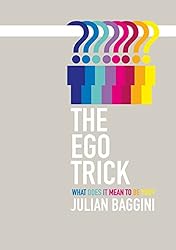
The Ego Trick – The remarkable way in which a complicated bundle of mental events, made possible by the brain, creates a singular self, without there being a singlular thing underlying it. pg 123

There is an Ego Trick, but it is not that the self doesn’t exist, only that it is not what we generally assume it to be. pg 151

Consciousness of self emerges from a network of thousands or millions of conscious moments. pg 40

We are constantly rewriting our histories to keep our inner biographies coherent. pg 40

The self is a construction of the mind, one flexible enough to withstand constant renovation, partial demolition and reconstruction. pg 41

We all ignore and do not commit to memory facts and events that conflict with the way we see ourselves and the world. We remember selectively, usually without conscious effort or desire to do so. And yet because we believe memory records facts, objectively, we fail to see that all this means that we are constructing ourselves and the world. pg 49

“I have a belief that dementia actually makes you more like yourself, so rather than rob you of your self, it robs you of all the exterior things that you pile on through life, all the baggage that you carry and the layers. What you’re left with at the end of the day with dementia is the core person, the soul, or whatever term you want to put on it. We’ve described it as an onion. If you peel an onion, from the brown skin outwards, you’ve got lots and lots of layers. When you get right to the centre of the onion you get to a little pearl in the middle and you can’t peel any more off it. It seems to me that is the real essense of the person.” – pg 54

We are nothing but our parts, but we are more than just our parts. pg 69

The self is not a single thing, it is simply what the brain and body system does. pg 83

18th century philosopher David Hume: “For my part, when I enter most intimately into what I call myself, I always stumble on some particular perception or other, of heat or cold, light or shade, love or hatred, pain or pleasure, colour or sound, etc. I never catch myself, distinct from some such perception.”

(Baggini) Our minds are just one perception or thought after another, one piled on another. You, the person, is not separate from these thoughts, the thing having them. Rather you just are the collection of these thoughts.

(Hume again) “nothing but a bundle or collection of different perceptions, which succeed each other with an inconceivable rapidity, and are in a perpetual flux and movement.” pg 119

“non-reductive physicalism” — The self is not a substance or thing, it is a function of what a certain collection of stuff does. In other words, we are made up of nothing more than physical stuff, but to describe our true nature, you need more than just a physical vocabulary. You cannot full describe what it is to be a person in the language of biology; but that does not mean a person has non-biological parts. pg 120-121

“The Buddha’s idea of self therefore is something we create. Your identity, your sense of being a person is formed through your actions, and that is only possible becasue there is not a fixed self. There is no unchanging essence or substance to which those attributes are then attached at all.” — Stephen Batchelor pg 148

“The existence of the self as an independent, eternal and atemporal unifying principle is an illusion.” — Thupten Jinpa pg 148

The self is not an illusion. What is illusory is an idea of self which sees it as an unchanging, immortal essence. pg 148

The self is an illusion, but not just an illusion. But still, I would prefer to do away with talk of illusion altogether. Talk of illusion suggests there is a way of perceiving onself free from that illusion. But there isn’t. pg 150

The solidity of self is an illusion; the self itself is not. pg 152

“We are responsible for our actions not because they are our products but because they are us, because we are what we do.” — Christine Korsgaard pg 168

The Ego Trick: In Search of the Self

Daniel Kahneman: Riddle of experience vs. memory

This talk runs 20 min and I realize most of you won’t invest that much time. And I’m not sure I can summarize, but let me try: There are the experiences in our lives… and our memories of those experiences. And they are not the same. Our “happiness” ( a word that no longer has much useful meaning) has more to do with the latter.

As for the future?  Kahneman  says “we think of our future as anticipated memories.”

My understanding (based on my reading on this topic): The past and the future are delusions, stories. Created by the mind to protect the ego. Only now -this moment- has any reality.

The Ego Tunnel by Thomas Metzinger

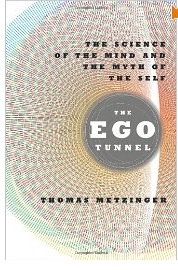
I’ve been doing a good bit of reading about consciousness, reality, ego and such. A lot of it is tough sledding. LIke Thomas Metzinger’s The Ego Tunnel, which –according to this review– is “for the curious and fearless lay person wanting to know who, precisely, we are.”

The best I can do with books like this is highlight the portions that make some sense to me and stick ’em here, completely out of context. The Ego Tunnel (Thomas Metzinger) PDF


“When we speak of conscious experience as a subjective phenomenon, what is the entity having these experiences?”

“Why is there always someone having the experience? Who is the feeler of your feelings and the dreamer of your dreams? Who is the agent doing the doing, and what is the entity thinking your thoughts?Why is your conscious reality your conscious reality?”

“Yes, there is an outside world, and yes, there is an objective reality, but in moving through this world, we constantly apply unconscious filter mechanisms, and in doing so, we unknowingly construct our own individual world, which is our “reality tunnel.” We are never directly in touch with reality as such, because these filters prevent us from seeing the world as it is. The filtering mechanisms are our sensory systems and our brain, the architecture of which we inherited from our biological ancestors, as well as our prior beliefs and implicit assumptions. In the end, we see only what our reality tunnel allows us to see.”

“In dreamless deep sleep, nothing appears: The fact that there is a reality out there and that you are present in it is unavailable to you; you do not even know that you exist.”

“It is unsettling to discover that there are no colors out there in front of your eyes. The apricot-pink of the setting sun is not a property of the evening sky; it is a property of the internal model of the evening sky, a model created by your brain. The evening sky is colorless. The world is not inhabited by colored objects at all.”

“What is really happening is that the visual system in your brain is drilling a tunnel through this inconceivably rich environment and in the process is painting the tunnel walls in various shades of color.”

“The brain constantly creates the experience that I am present in a world outside my brain.”

“Consciousness is knowing that you know while you know.”

“Now-ness is an essential feature of consciousness.”

“There is no immediate contact with reality.”

“Flagging the dangerous present world as real kept us from getting lost in our memories and our fantasies.”

“From an evolutionary perspective, thinking is very new, quite unreliable (as we all know), and so slow that we can actually observe it going on in our brains. In conscious reasoning, we witness the formation of thoughts; some processing stages are available for introspective attention. Therefore, we know that our thoughts are not given but made.”

“There is more to an existence worth having, or a life worth living, than subjective experience.”

“Most of us do not value bliss as such, but want it grounded in truth, virtue, artistic achievement or some sort of higher good. We want our bliss to be justified. … We want a reason for our happiness.”