
Living in the cloud

I’m no longer on the company computer network. My iMac is one of only a half dozen or so Macs in the building and I made very little use of the network anyway. And it’s something of an experiment.
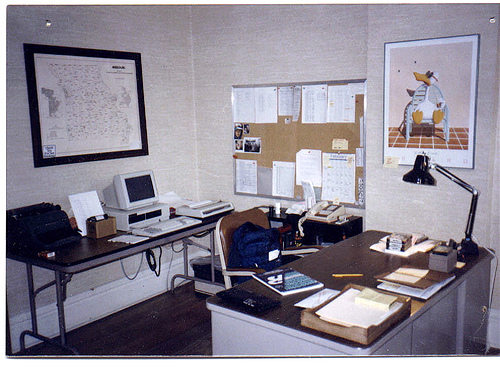
I had one of the first personal computers in our company. I bought a Zenith back in the late 80’s and used it for word processing and for tracking affiliate stuff. It was connected to no thing and nobody (except my little dot matrix printer)

The first “network” in the company –as far as I can recall– was a peer-to-peer lash-up in the Missourinet newsroom. No network server, just individual PC’s (Compaq’s with 20 MEG hard-drives) talking to each other.

I don’t remember the exact evolution after that but before long the building was networked and as we added offices throughout the country, they came online. And we now have two full-time network administrators and the network has become critical to the operation of our company.

So why did I cut the cord?

As one of the “web guys,” most of my work has been taking place “in the cloud” for some time. I access company email from a web browser and can do just about everything I need to do, without being on the company grid.

Plus, anytime there was a software upgrade, I had to ask someone with admin privileges to do it for me. Sort of like having your mom come unzip your pants so you could pee. Unpleasant for everyone.

When coworkers need to send me a file that is too large to attach to an email, they drop it on one of the network drives I can no longer access from my iMac. I’m working around that and will eventually get them to put it up on my iDisk, Dropbox or drip.io. Which works in the other direction, too.

For me the Net has become the network. Lots of storage, nearly ubiquitous access, great tools. I feel like a dog that chewed through his leash. Woof!

Attachments

My pal Keith pinged me this morning to let me know there was a problem with this website. I raised the hood to discover that all content (posts, pages, media, etc) was gone. Eight years of posts. About 5,000. I have a back-up from about 3 weeks ago, but still…

Not so long ago this would have sent me to DEFCON 5. But I’ve been reading about ego and how we become attached to and identify with things and ideas, and I found I was eerily calm. What if all my clever posts and the rest vanished forever?

I spent a few minutes considering this and realized they were/are nothing more than footnotes on a past that no longer exists (except in my head). What’s happening this moment is more important (and real).

What have we learned, grasshopper? That we are not our thoughts, OR our blog posts.

Facebook. One more time.

Yesterday I created a Facebook account. This is the third, possibly the fourth, time I have attempted Facebook. I say “attempted” because I have never quite “gotten” Facebook. I think I understand social networks as well as the next person but this platform has just never been a good fit for me. So why give it another shot?

A couple of reasons. One, I’d like to better understand why FB is home to half a billion people around the world. Two, social networking has become a bigger part of my job and I can’t properly support clients without a feel for Facebook.

Connecting and communicating with people you know seems to be at the core of Facebook. I send you a “Friend Request” and, if you accept it, I can see some for all of what you’re doing on Facebook, depending on how you have your privacy settings configured. If you don’t accept, I’m blocked.

I’ve had lots of conversations with Facebook users in an effort to understand it (without actually using it). A common theme goes something like this:

Jane is miffed that Bill refused to accept (or ignored?) her friend request. He doesn’t want her to be part of his online life and she’s not happy about it. She thought they were, well, friends.

In the next breath, Jane is explaining why she is getting creeped out by the co-worker who keeps sending her friend requests. The irony is completely lost on Jane.

Some Facebook users deal with this by just accepting all friend requests and ignoring the stuff from the not-really-friends. Others just ignore the requests.

I don’t plan on spending any more time on Facebook than is necessary to understand how it works. I’ll auto post from my blog, YouTube, Twitter and all the rest. So, there will be no shortage of stuff on my “wall,” but it all originates from somewhere else where anyone can see what I’m up to. But that’s clearly less convenient that seeing all within the Facebook compound.

How will I handle “friend” requests (assuming I get any)? I’ll probably ignore them unless we already have an online connection (and I probably won’t give you a kidney, either).

So I’m headed off to Facebook with the same enthusiasm as for my first boy-girl dance party mom made me attend (on Bill Wicker’s patio). I didn’t dance there either.

ShowMeGaming.com (3 years later)

Three years ago I helped my friend LeAnn McCarthy set up a blog to help with her communications efforts as Public Information Officer for the Missouri Gaming Commission.

Last week I sat down with LeAnn to see how the blog was working out. She talked about her target audience(s); content; response (internal and external) and other social media tools.

AUDIO: 10 min MP3

A thousand people in the street (millions online)

molotov-cocktailI’ve been thinking about the disruptive power of the Internet. How it can undermine institutions. The record industry, publishing, and media come to mind. I’m sure I could come up with others if pressed.

I’m hoping for even more chaos. Clearly, our two party system of government is broken and I’d really like to see some chaos there. Why not three or four or more political parties? Hard to make a case that our government could be less effective than it is.

The Obama campaign really showed the power of the Internet to raise money and coordinate millions of supporters. I hope we see more of that but with the power on our end of the pipes. I have no idea how this can or might come about but the first step has to be sand in the greased gears of our two party system.

Internet service restored

After a few misstarts, my Internet service was restored yesterday. The problem was a tiny broken wire and as I watched the tech repair it, I marveled at just how much flowed through that gossamer thread (come on, when will I get another chance to write “gossamer thread”?).

Movies, photos, TV shows, audio, conversations from a world away. It makes a boy think about the “digital divide.” Every child should have high-speed access to the net. And I believe they will. Mobile access to the Internet will continue to change the world. And for the better.

Local bank phished. Again.

I received this text message last night. It never occurred to me it was anything but a scam. You call the number and some social engineer asks you for all kinds of questions about your accounts. And, yes, some number of clueless folks apparently called the number. I’d kind of like to know how they got my mobile number. Probably not that difficult. This same bank got hit by an email phishing scam a year or so back.

A new website for under $60.00

On Thursday of this past week one of our company websites “broke.” That’s my non-geek analysis. It wasn’t the first time and we knew it wouldn’t be the last, so –with the support and encouragement of our IT department– we decided to just flush it and start over.

At noon on Friday I installed a new WordPress theme ($59.95 from StudioPress) and started copying and pasting content. By four o’clock, I was pretty much done. Here’s a screen shot of the work-in-progress:

Learfield Communications is comprised of two operating divisions: Sports and News. We have a corporate website; a website for the sports division; one for the news division; and one for each of the networks that make up the news division.

The news division site was a challenge because we really didn’t have any dynamic content for the site and I hated putting up a “brochure” that never changed.

The WordPress site we tossed together in a few hours on Friday afternoon won’t win any awards but it will allow us to do things we couldn’t before. Like video. It’s becoming much easier to shoot, edit and host (yea YouTube and Vimeo!) video, so it makes sense to include it. WordPress has endless plug-ins for this task.

And WordPress is just a very good content management system, at least for our needs. I’ll be able to show folks in our marketing department how to create and update pages which makes it possible to keep the site fresh and current.

WordPress is very social-network friendly. Flickr, YouTube, Twitter… wherever you have content, you can quickly incorporate it.

The effectiveness of this –or any– website will be measured by the quantity and quality of the content and ease of interaction with the people who visit it. WordPress delivers.

It would have been easy to spend a couple of months a  few thousand dollars getting a simple site like this developed. I can now take that money and time and go improve some more of our sites. [END OF COMMERCIAL]

You’re in my Rolodex

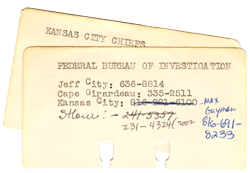
One of the reporters in one of our newsrooms has a Rolodex that goes back 30+ years. The cards are worn from handling and yellowed by the years. I have no idea if he also maintains some kind of computer file as well. Doubtful.

A well-maintained Rolodex was once the most valuable thing on a reporter’s (or salesman’s) desk and the one thing to take with you when the time came.

It’s from a time when the telephone was the sole means of instant communication but not yet smart enough to remember more than a half-dozen numbers (“I’ve got you on speed dial”).

I wonder how many fewer calls are made in our email world. Has Outlook become the new Rolodex? Or has our mobile phones absorbed that function? Losing your phone is only a big deal because it might mean losing all of the numbers of friends and contacts.

Which brings us to social networks.

Will being able to communicate with you –by calling or emailing– become less valuable than having you “friend” me on Facebook or “follow” me on Twitter. The difference is me seeking your attention versus you deciding to give me your attention.

Let’s say you’re a salesman for a paper products company. Let’s call you Stanley. You have the phone number and email addresses of your 20 largest customers. With a little time and patience, you can get them on the phone; get a reply to an email; and even get an appointment.

But suppose those customers elected to follow your Twitter feed because that’s where you posted links to information that they found valuable enough to give their attention. I submit it is a different –more valuable– kind of attention than you get when you punch through with a call or email.

One last example. I can call or email the senior management of our company. Most of them are in the same building, so I can walk down the hall and usually get some face time. But a couple of them read my blog and –in time– will follow my Twitter feed. And the only reason they would invest even a minute or two from incredibly busy days, is they perceive some value (information or entertainment).

Being in someone’s network is far more valuable than being on their call-back list. Or in their Roladex.