
Journals

journal entryI’ve been blogging since February, 2002, and for most of that time I equated the effort with keeping a diary or journal. I was wrong. I came to this conclusion after reading back through some of my journals from the early eighties. (Index below)

I was struck by the personal, private tone of these entries. I would not have wanted to share these thoughts with others, even if there had been a way (Internet, blogs, etc). I usually wrote longhand in a spiral bound notebook. Once in a while I’d type an entry on my manual typewriter.

Reading my thoughts from thirty years ago feels almost… intrusive. That was a very different person. He was anxious and prone to worry. He drank too much ( or thought it did. He worried about it). He lacked self confidence. I feel my shoulders tense as I read these entries. I suspect writing this stuff down was a way of coping. I wish I could time travel back and leave a “note from your future self” telling him to relax. It turns out great in the end.

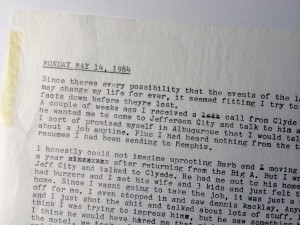
The image above is from an entry on May 14, 1984. Just a couple of weeks after I accepted the job I just retired from (after 29 years). I’m putting all of this stuff in my Google Drive and sharing it with family.

After a dozen years of blogging publicly, I don’t expect to return to the the diary format, but David Cain has some interesting thoughts on the value of putting one’s personal thoughts down on paper:

“The simple act of writing out a thought keeps it still long enough for you to get a good look at it. Once it’s there in front of you, you can decide if it’s true, and whether you ought to do anything about it.”

Journal entries from 1983-1985

We’re trained to need bosses

This post by David Cain looks at what it means to be your own boss. I’ve never been my own boss for many of the reasons mentioned by Mr. Cain. Looking back, I think that need to escape was there much of the time.

I wish somebody had pulled me aside and told me that the education system and working culture I’m going to be marched into are places that are ultimately going to need escaping from.

Parents (I’ve never been one) might bristle at Mr. Cain’s take on children but it seems a valid observation;

Many people deal with the vapidity of their jobs by having children, because parenting lends an immediate seriousness and purpose to one’s role on the planet. Providing for a child is an act that feels intrinsically meaningful to a human being, and so devotion to your job, even a dull one, can become an extension of devotion to your role as a parent, giving meaning to the hoops to be jumped through at work.

If you’ve ever thought of escaping the 9-to-5 life, the full post (below) is worth a read.

Invisible costs

I find great wisdom and insight in the writing of David Cain. He has quit his “day job” to pursue writing full time and shares what that transition feels like. Looking back to my final days, I recognize some of what he describes. Following ‘graphs are part of a longer post I hope you’ll read.

“A weight that had been resting on my mind for long enough for me to forget that it was possible to remove it. For the first time in a long time I didn’t have to answer to anyone. I knew my company-issue Blackberry wasn’t going to ring, I knew nobody was going to ask anything of me. It was like walking up to a glass barrier that had always been there and realizing it was only air.”

“Our lifestyles come with costs, many of which are invisible, or at least become invisible to us once we’re used to paying them. At all times these enormous invisible forces are acting on your life, shaping what it feels like to be you. They only become visible — and only momentarily — when they change.”

“Because we’re so immersed in our lifestyles, it’s hard to see what individual parts of them are pushing and pulling on our minds. Imagine trying to describe what a building looks like when you’ve only ever been inside it. Moving parts of our lifestyles around gives us the necessary angles to know what it is we’ve actually built with our decisions about career, relationships and living situation. If they never change we never know what they’re doing to us.”

The ego is what you think you are

“The face in the mirror, and the haphazard story we associate with it, is the ego. (But) what we think of ourselves is constantly changing, not just day to day, but moment to moment, and mood to mood. At different times, I have thought of myself as anything from an insufferable loser, to a freaking genius, to a guy who can never quite get his shit together, to a guy who’s never had a serious problem in his life. What I think I am is so fickle and so dependent on moods and circumstances, that it can’t possibly be right — ever!”

This is what is people mean when they say the self is an illusion. It is a fictional character that is constantly changing. Therefor, not a real thing in the permanent, unchanging sense of the word real.

David Cain comes closer to explaining this than anyone I’ve read.

Working for The Man

David Cain — once again — delivers The Most Interesting Thing I’ve Read Today. From his interview with The Man:

“Do you know how people with hoards of money get to have those hoards of money? They make some money, and then they don’t spend it all. They keep some each time it comes in, and they use it to make more come in next time. That’s how power is accumulated. Instead of accumulating power, most of my employees accumulate objects in their homes, or they just burn the money as it comes in, on booze and expensive sandwiches. What I see is people setting up their lives such that they become dependent on powerful people like me, which is exactly the opposite of how one ought to build wealth. That’s why I’m The Man and they work for The Man.”

And how did The Man deal with rock and roll’s threat to The Establishment?

“I killed John Lennon. I bought MTV. And, thank God, Bob Dylan went and found Jesus.”

And one more…

“People in the US, more than anywhere else, respond to personal inadequacy by buying stuff or trying to get in a better position to buy stuff later. This is great, because buying stuff eventually creates disappointment, which creates more buying.”

The sun is always setting

“The state of the world is a relative truth. It’s mostly relative to how much news you watch. If you’re a CNN junkie, you live in a more worrisome, dangerous world than I do. You can argue all day that it’s the same world, but all that matters is what world you experience, not what the world is supposed to be likeoutside your experience. So zoom in, live from here. Don’t let others tell you what the world is like, because they live in a different world.”

David Cain on sunsets and how the world works.

One less decision

For the past two weeks, breakfast has been cereal with fruit, OJ and (sometimes) toast. This didn’t seem like an important decision until I read David Cain’s post: Why the minimalists do what they do.

“After years of being confronted with a decision shortly after waking, I decided to be done with deciding what was for breakfast. My usual is now the only thing on the menu, and since I stopped deciding what’s for breakfast, mornings have had a significantly different feel. They are clearer and more spacious.”

And it’s about more than what we have for breakfast.

“When we’re faced with a number of options, we’re always going to assume that one of them is better than all the rest. This means the more options there are, the more likely we are to choose one that isn’t the best one. […] Our satisfaction with what we have shrinks as the number of things we don’t have — or could have — grows.”

This notion resonates with me. Even to having fewer shirts or pants to select from each morning.

Your head would explode

I’ve never met David Cain but when I think of “enlightenment,” he comes to mind. If I could pick one person to give me tips on how to live, I think it might be him. From a recent post:

“I now see all instances of minor physical discomfort as a chance to get better at being relaxed. I relax into the discomfort, I let it hang out with me. When you first try it it’s an exhilarating experiment — to voluntarily open up to minor pain when that’s what the moment brings you, to refrain from listening to the impulse to cringe or harden. It feels like you’re walking freely in an area you thought you weren’t allowed to go.”

“The present moment is the only concrete reality you will ever have to deal with. Sometimes it contains pain. We prefer that our realities don’t contain pain. But that can only ever be a preference, because ultimately we don’t have control over the present once it becomes the present. If you truly needed reality to be something other than reality, your head would explode that instant. But it doesn’t. You prefer it to be one way, but don’t need it to be.”

How much of your life are you selling off?

This post below by David Cain is probably the best thing I’ve ever read about retirement. More accurately, it’s about people who are retiring much earlier than “normal” (45, or 40 or even 30) It’s long (for a blog post) but worth a read. A few excerpts:

“Those of us with jobs have arranged to sell off large parts of our lives (8 hours a day, 5 days a week, for decades) to employers, in exchange for money that we can use to build a life that makes us happy.”

“When you compare the amount of happiness we actually derive from our unnecessary spending habits to the amount of happiness that can be derived from years of paid-for freedom (not to mention a clear and secure financial position the whole way there), most of those consumer habits come to appear glaringly absurd.”

“Would you rather have five all-expenses-paid years off to spend with your family, learn a language or build a business — or drive a big car instead of a small car?”

“Common Western fallacy: that for you to be as happy as you currently are, you need to spend as much as you currently do.”

You don’t want to be typical

It took me a long time to learn that typical is no good. There’s no reason to regard it as the “good enough” line. Typical health is pretty bad. A typical career is draining and unrelated to the worker’s real interests. Typical credit card debt is in the thousands. The typical level of fulfillment in a person’s life is far below where it could be with some self-examination and habit overhauls.

Nobody dreams of being typical. You do not want a typical job. You do not want typical credit card debt. You do not want typical health. You do not want to retire at the typical age. You do not want typical results. You do not want a typical level of fulfillment. Nobody does. Stop pretending.

From another inspiring post by David Cain »