
Life gets real when the TV goes off

David Cain says things come into sharper focus when the TV is off:

“For some reason just having the TV on seemed to soften the reality of those mornings, and turning it off seemed to intensify my problems. It was like life finally had room to square up and confront me directly, whereas with the TV on it could only make glancing contact.”

Yes. Everything seems to come into sharper focus when the TV is off. I can go days without turning it on when Barb is out of town. As Mr. Cain points out, nothing wrong with watching something on TV, but it’s so often used as mindless background noise. (I confess I tend to use my smaller screens in a similar manner.)

“One of the least-acknowledged peculiarities about human beings is that we can scarcely bear being in the moment we’re already in. It’s rare for us to truly be at ease in an ordinary present moment, if we’re not being entertained, gratified or otherwise occupied by something. We’re always planning better moments than this current one, or at least trying to soften or improve it with entertainment or food, or anything else that delivers some predictability to our experience.”

Planning better moments. There you have it. How many moments have I missed because I was somewhere back in my head planning a better one?
Truths About Life

David Cain has 88 of these on his list. These are just my favorites.

“If you go home with someone, and they don’t have any books, don’t fuck them.” — John Waters

The main reason we argue online is because it feels good, but we like to imagine it’s also somehow noble or helpful.

The news doesn’t show you how the world is. It shows you whatever will make you watch more news.

Every generation thinks the one that came before them and the one that came after them are the worst.

We evolved to go days without food. Missing a meal shouldn’t be a big deal, but if you skip the odd lunch people will assume you have an eating disorder.

We are all atheists, in a sense. Every person denies the existence of either most or all of the gods that have been proposed.

When a party has degenerated into people showing each other their favorite YouTube videos, it’s time to call a cab.

Busyness is a kind of debt

“Having zero clutter is an entirely different experience than having a little clutter. The psychological effect of reducing any type of mess to zero is profound. It feels like a noisy fan has shut off. Now I love the feeling of being at zero, and I never want to be far from it. Every neglected possession, unanswered email or open browser tab is like a little hook in your brain. There isn’t a huge difference in how it feels to have six of these hooks in your brain versus having eighty, but there is a vast difference between having some and having zero.”

David Cain expands on this at Raptitude

How to make bad days okay

“A human life is too vast, too rich and varied in content, for any given day’s events to be critical to the whole thing. Therefore, our willingness to be calm in the face of day-to-day unsettledness is much more important than the specifics of what is so unsettling about right now.”

“This is true even of the big, permanent events: deaths, losses, diagnoses and breakups. A death, for example, is clearly permanent, but it is your relationship to that event that gives it meaning, and that relationship is not at all permanent. It will change fairly rapidly, in fact. It will be quite different a week later, and very different a year later. And by then, it will be someone slightly (or greatly) different who is experiencing it. You don’t have to bear the weight of the entire catastrophe today. Other days, and other Yous, will split the burden, in ways you perhaps can’t see from here.”

From an essay by David Cain »

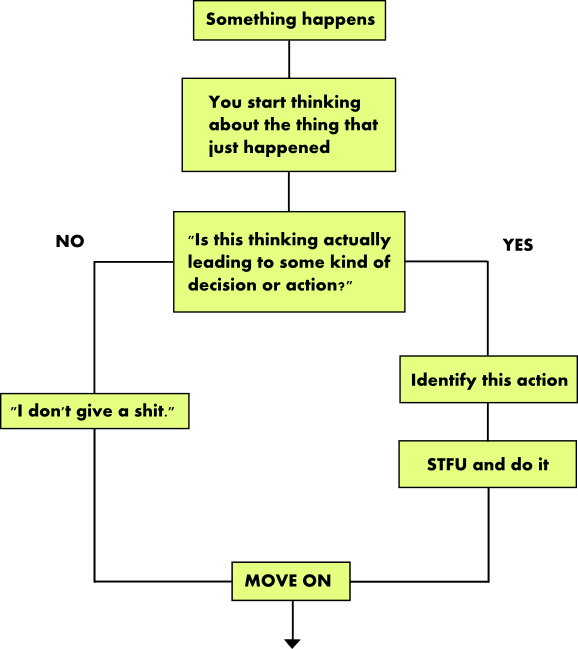
David Cain on the art of not giving a shit

“Not giving a shit sounds like apathy, but it’s not. It’s simply a refusal to waste your energy and time on thoughts you’re not going to act on. So when you do give a shit, make sure that the point of this shit-giving is to figure out what you’re actually going to do in response to what happened, and then move on to the action part.”

“We often believe that our thoughts are accomplishing something just because they’re emotionally charged, or because they’re “about” something we consider important, like fairness, respect, or the state of society. No. They are useful only insofar as they get you to move your body and do something useful.”

Mr. Cain provides a handy flow-chart:
dontgiveashitflowchartresize1

Read his full post