
Live blogging with ChatGPT

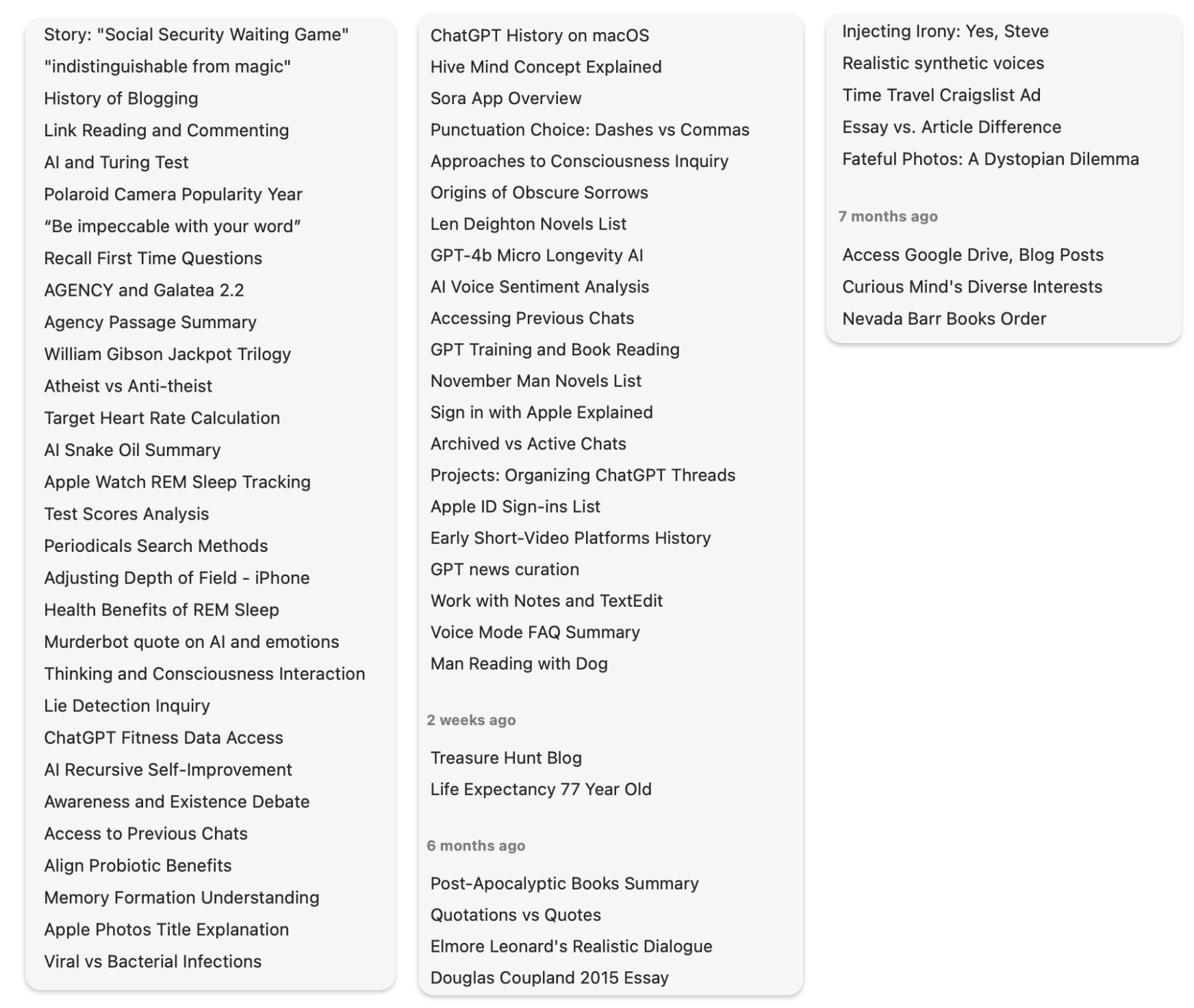
Imagine a blog that was nothing more than ChatGPT threads. Posted in real time. (comments turned off) I have posted all or part of 50+ conversations with ChatGPT and have a “ChatGPT” tag.

ChatGPT: That’s an intriguing idea—your blog as a living record of AI-human interaction, continuously updated with ChatGPT threads. In a way, it would function like an evolving conversation, accessible to anyone curious about what it’s like to engage deeply with an AI.

If you took it further and posted every thread in real-time, it could almost feel like a public mind-meld—your thoughts, questions, and curiosities unfolding without filter or delay.

Would you envision structuring it in any particular way? Maybe a rolling feed with automatic timestamps? Or something more curated, with you deciding which threads make the cut?

Steve: Hmm. I think “In for a penny…” I’d go with a rolling feed. The world listening on our chats.

ChatGPT: That would be a bold and fascinating move—almost like an ongoing dialogue with the world eavesdropping. It’d be a mix of raw thought, curiosity, and AI interaction, all laid bare in real time. I imagine it could evolve into something like a living archive of your exploration of ideas, tech, and whatever else crosses your mind.

Would you automate the process—say, using an API or shortcut to instantly post each thread? Or would you copy and paste manually, maybe adding a quick preface or title before publishing? Either way, it’d be a unique experiment in transparency and digital thought-sharing.

AI and Ethical Dilemmas: A Comparison of ChatGPT and DeepSeek

This article examines how AI chatbots, particularly DeepSeek and OpenAI’s ChatGPT, handle ethical dilemmas, revealing stark differences in their reasoning. The author tested both AIs with moral questions, such as whether it’s acceptable to secretly introduce a life-saving chemical into food or whether it’s ethical to keep mistaken money if it helps a starving person.

DeepSeek, a China-based AI, follows consequentialist ethics, arguing that outcomes (e.g., saving a life) justify actions like deception. In contrast, ChatGPT adheres to deontological ethics, prioritizing universal moral principles such as honesty and transparency, even if the consequences are less favorable. This distinction also appeared in other scenarios, such as deciding whom to save in a life-threatening accident or whether an AI should break banking policies for the greater good.

Experts suggest these differences stem from training methodologies. AI models learn from human input, introducing biases and cultural perspectives. Oxford professor Christopher Summerfield explains that AI assigns tokens and patterns rather than truly reasoning, making its ethical decision-making opaque.

The article raises concerns about AI’s growing role in moral decision-making, warning that as AI becomes more integrated into society, people may begin to trust its moral judgments too readily. The author argues for critical thinking and ethical oversight, emphasizing that AI should assist human reasoning rather than serve as an unquestioned authority on moral issues.

The summary above was composed by ChatGPT


This article spawned a number of questions I put to ChatGPT: Was it trained to be ethical? How would it know? What does that mean for trust? Her answers included several reasons why we might expect AI to be more ethical (than humans) and why such an expectation might be unfair, concluding with the question: “Should AI be held to a higher moral standard?”

“Maybe AI doesn’t need to be more ethical than humans, but rather more transparent and accountable than humans. […] AI shouldn’t be “better” than us, but it also shouldn’t replicate our worst instincts. The goal isn’t a moral AI overlord, but an AI that helps us be more ethical ourselves.

Here’s the full thread (PDF)

Evelyn and Marie: Brownie box camera

The photo above (my mom and Aunt Marie) was probably taken sometime in the mid-1940s on the family farm near Broseley, Missouri. I’ve seen this photo countless times but not sure I’ve noticed the camera in my aunt’s hand. A little history from ChatGPT:

The “Brownie” box camera, introduced by Kodak in 1900, was a revolutionary development in photography. Designed to be affordable and easy to use, it brought photography to the masses and helped popularize snapshot culture.

Key Points in Brownie History:

  • 1900: The original Kodak Brownie was released for just $1, with film costing 15 cents per roll. It featured a simple cardboard box design with a fixed-focus lens and a single shutter speed.
  • Early Success: The Brownie was heavily marketed to children and amateur photographers, making it one of the first truly accessible cameras.
  • Evolution: Over the years, the Brownie evolved with different models, materials (from cardboard to metal and plastic), and features like built-in flash units.
  • Cultural Impact: The Brownie was instrumental in capturing everyday life, historical events, and even wartime photography. It remained popular for much of the 20th century.
  • End of an Era: Though production slowed in the late 20th century, the Brownie’s legacy continues as one of the most influential consumer cameras ever made.