
“Instead of shouting the message, hide it”

Will we still get carpet bombed by mindless 30 second commercials in the future? (And by future I mean a couple of weeks from now.) Seems unlikely, but how will savvy marketers reach –and more importantly– engage us? How do you “reach people who are so media-saturated they block all attempts to get through.”

Perhaps with alternate reality games (ARG’s). That’s the subject of a fascinating article by Frank Rose in this month’s Wired Magazine (Issue 16.01).

“The initial clue was so subtle that for nearly two days nobody noticed it. On February 10, 2007, the first night of Nine Inch Nails’ European tour, T-shirts went on sale at a 19th-century Lisbon concert hall with what looked to be a printing error: Random letters in the tour schedule on the back seemed slightly boldfaced. Then a 27-year-old Lisbon photographer named Nuno Foros realized that, strung together, the boldface letters spelled “i am trying to believe.” Foros posted a photo of his T-shirt on the Spiral, the Nine Inch Nails fan forum. People started typing “iamtryingtobelieve.com” into their Web browsers. That led them to a site denouncing something called Parepin, a drug apparently introduced into the US water supply. Ostensibly, Parepin was an antidote to bioterror agents, but in reality, the page declared, it was part of a government plot to confuse and sedate citizens. Email sent to the site’s contact link generated a cryptic auto-response: “I’m drinking the water. So should you.” Online, fans worldwide debated what this had to do with Nine Inch Nails. A setup for the next album? Some kind of interactive game? Or what?”

I’m not a gamer. At all. But I love shit like this. Reminds me of the viral video snippets in William Gibson’s Pattern Recognition. The Wired article is well worth the read.
Scott Adams: Religion and Politics

“Why would you vote for a president who has a different religion than you? If you are certain of the rightness of your own beliefs, and equally certain of the wrongness of a presidential candidate’s belief, that proves the candidate has, in your opinion, bad judgment about the most important question in reality.”

“You wouldn’t vote for a candidate who believes in Ouija boards or horoscopes, because such beliefs would be a reliable indication of simple-mindedness. So why would you vote for a candidate who can’t figure out what version of God is right? If he can’t get that right, according to you, how good is his judgment? You probably think picking the right religion is not a hard challenge, because you got it right without much struggle. You want your leader to be at least as smart as you.”

“No one really believes what they say they believe, at least not in the same way you believe you have to open the front door in order to walk through it. There are two sorts of belief. One is the type you act on, and the other is the type you use to feel good about your place in the universe. As long as a president doesn’t use religion as a guide to action, then it has no bearing on his potential job performance. And he is not a liar or a hypocrite if you accept the notion that there are two types of belief, and they don’t need to interfere with each other.”

[Full post]

Make iPhone listen to radio, tell you what’s playing

“You’re riding in the car and a great song comes on the radio. You’re dying to know what it is so you can go buy it ASAP but there’s no satellite radio receiver to tell you what’s playing. How can you find out what song it is? Whip out your iPhone, put it near the car speakers, and watch the screen. Poof! There’s the song, artist, and album.” — TUAW.COM

Okay. This could make me trade in my Tracfone. iPhoner Tom promises to try this out and let me know how it works.

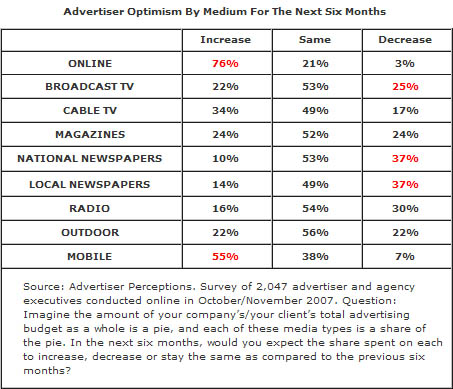
Advertiser Optimism by Medium

From Terry Heaton’s PoMo Blog:

"Advertiser Perceptions latest survey of 2,047 ad executives (published twice yearly) — as published by Online Media Daily — reveals growing pessimism among ad buyers about traditional forms of advertising. I view this study as significant, because it speaks directly with people who are making decisions about spending money."

Adforecast

Only newspapers face a smaller increase and larger decrease than radio? [Emphasis/red from original post]

Changing newsroom culture

“The feeling in newsrooms, especially among the people on the new-media side, seems to be that there are an awful lot of people within organizations that aren’t on board with a vision of changing for the future. Even when top management has developed a new corporate vision for a digital, multi-media and less print-centered future, and communicated it to “the troops,” implementation is being slowed by many people in the organization — including mid-level managers — who still don’t buy into the idea that a total transformation of the news organization is necessary.”

“Everyone’s got work to do to put out the “daily miracle,” but in an era when the old industry model is in decline, we can no longer afford to have a workforce where the majority are solely doing the work of “putting out the paper.”

“The smart news organization in 2008 will be the one that encourages innovation — no, requires it — from ALL its employees. It will get everyone involved: in planning meetings; in committees charged with specific research and/or implementation projects. It will create some time in the schedules of everyone in the organization to do the work of innovation, and make that an integral assignment.”

“Most importantly, it will develop a training program to teach new-media skills to those still lacking, and regularly bring in innovation and creativity experts to guide both managers and employees. With the latter, exposure to and interaction with those experts will be company-wide.”

— Steve Outing at Editor & Publisher