The Singularity Is Near

“The technological singularity is a theoretical future point of unprecedented technological progress, caused in part by the ability of machines to improve themselves using artificial intelligence.” [Wikipedia]

I’m clawing my way through Ray Kurzweil’s The Singularity is Near. It’s not an easy read. Lots of charts and graphs and stuff I skipped in college. But it’s a wonderfully optimistic view of the near future.

“I set the date for the Singularity –representing a profound and disruptive transformation in human capability– as 2045. The nonbiological intelligence created in that year will be one billion times more powerful than all human intelligence today.”
“Despite the clear preponderance of nonbiological intelligence by the mid-2040s, ours will still be a human civilization. We will transcend biology, but not our humanity.”

I’m only about a third of the way through the book but I think “transcend biology” might be good news if I’m still around in 2045. I’ll be 93 and in serious need of a tune-up.

I originally posted this on 8/13/08 and re-post here with some of my a-ha’s.

Continue reading →

Web specs

I stopped buying/reading newspapers a long time ago. But there are times –breakfast, for example– when it is inconvenient or impractical to open the MacBook. My solution has been to print articles I find online and take them with me.

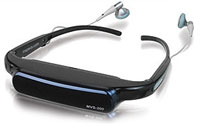
KowonvideoglassesI’d really love to have a pair of reading “glasses” with some flash memory to which I could Blue Tooth these articles, including photos and video. I don’t see why that would be technically difficult and damned handy. This is close but likely to get my ass kicked at the local diner where I have breakfast. I’m thinking more along the lines of Clark Kent glasses.

No, I don’t need wifi access. That would be cool but would add a lot of cost. And, yes, I know there are all kinds of portable readers out there but I don’t want to tote around even a book size device.

What I haven’t tried is saving the text to my iPod. Not a great reading experience on the nano but it would work fine on the Touch. Hmmm. And if wifi was available… I suspect this wheel has already been invented.

Latest news consumption survey

The latest Pew biennial news consumption survey is out and offers no big surprises. Two new (to me) terms caught my eye: Integrators and Net-Newsers:

“Integrators, who get the news from both traditional sources and the internet, are a more engaged, sophisticated and demographically sought-after audience segment than those who mostly rely on traditional news sources. Integrators share some characteristics with a smaller, younger, more internet savvy audience segment – Net-Newsers – who principally turn to the web for news, and largely eschew traditional sources.”

I certainly think of myself as “engaged” and “sophisticated,” but long to be “younger” and “savvy.” Sigh.

These surveys often make no mention of radio. I was pleased to see that radio is hanging in, at least against TV.

“Notably, radio news also is an important element in Integrators’ news diet. Nearly half of Integrators (46%) listen to news on the radio during a typical day. While the internet is the main news source for Integrators during the course of the day, about as many in this segment rely on radio news as TV news during the day (32% radio vs. 36% TV news).”

The Big Question (assuming it is still up for question) is what happens when the Integrators have all gone to that Community Center In The Sky?

Google CEO Eric Schmidt

Last week Google CEO Eric Schmidt was interviewed by CNBC’s Jim Cramer (Mad Money). Terry Heaton provides an insightful summary of special interest to local media companies:

“He said the company gives up billions in revenue by keeping ads off the home page. Why? Because it would upset users. “We prioritize the end user over the advertiser,” he told Cramer. This simple statement — if truly adopted by media companies — would revolutionize all of online media. We’d have a race to see who could better serve the wants and needs of the people formerly known as the audience, and that would be a refreshing change from words like capture, drive, and my favorite, monetize.

Google doesn’t provide any guidance whatsoever to stock analysts, and Schmidt’s answer, again, is profoundly simple when he says it would “get in the way” of running the business, adding, “If we started giving quarterly guidance, all of a sudden the whole company would start focusing on the quarter rather than trying to change the world.”

On the company’s heretofore unsuccessful attempts to make money from YouTube, Schmidt said it didn’t matter, at least not right now. He said they make plenty of money already, because YouTube places users in the stream of Google’s other businesses, and that cannot be overlooked. “I’d be worried if people weren’t using to YouTube,” he told Cramer. “Since it’s an enormous success globally, we know we will eventually benefit from it.”

Biography

Mom was a farm girl. Dad was a city boy. The war was over and they met in St. Louis. I was born in 1948 in Poplar Bluff, Missouri, and grew up in Kennett (about an hour to the south). Dad was a “radio announcer” and mom worked for the “welfare department.” Job titles that –like my youth–vanished years ago.

A little piece of shrapnel from the Baby Boom, I watched a lot of TV. In the early 50’s I sat two feet from the Motorola, staring at the Indian-head test pattern until the afternoon programming got underway. The spirit of Norman Rockwell hovered over me through a near-perfect childhood.

The Beatles released I WANT TO HOLD YOUR HAND in the US just after Christmas in 1963 and it a very big deal by February of ’64. Hard to imagine a better time to be a high school sophomore. We weren’t paying much attention to Viet Nam, yet.

By the time I started college in the fall of 1966, getting and keeping a draft deferment was top of mind. I quickly switched my major from Business to Theater. Guys were coming back from Viet Nam and bringing good drugs and great music and protesting was catching on, even in the Midwest.

I was part of the first draft lottery and drew number 210, just low enough to be dangerous. Following graduation in 1970, I goofed off all summer before –at my father’s suggestion– entering law school at the University of Missouri-Kansas City. I attended classes and kept my deferment until Nixon froze the draft (in December of 1970) at lottery number 195. I quit law school the following week, just before finals.

In the spring of 1971, I went to work for the U.S. Postal Service as a Postal Inspector. After three months of training in D.C. I was sent to Pendleton, Oregon, where I audited small post offices in Oregon and Washington. I counted stamps and money orders for almost a year and investigated exploded rural mail boxes (a federal crime). Like law school, not what I had in mind.

In early ’72 I returned to the Midwest and hung around Memphis for a few months before returning to Kennett in early summer. In July, I started working at KBOA on the overnight shift and found my true calling. For the next dozen years I spun records and MC’d the Little Miss Christmas Belle Pageant.

In March, 1973, I met Barb at Tommy’s North-End Cafe and fell in love. We dated for six years and married in 1978.

In June, 1984, we moved to Jefferson City, Missouri, to work for Learfield Communications. For the next 15 years or so, I handled affiliate relations for the company’s various radio networks. When the Internet came along, I got the bug and slowly started migrating in that  direction. I now spend most of my waking hours online –with periodic breaks for Barb and the dogs–and look forward to every day.

March 8, 2003
