
“The Robot Doctor Will See You Now”

I don’t care for the term “Robot Doctor” but blame that on the person who writes headlines for the New York Times. The following are excerpts from an op-ed piece (PDF) by Dr. Pranav Rajpurkar (see comment below) and Dr. Eric Topol of that asserts “a growing body of research suggests that A.I. is outperforming doctors, even when they use it as a tool.”

A recent M.I.T.-Harvard study examined how radiologists diagnose potential diseases from chest X-rays. The study found that when radiologists were shown A.I. predictions about the likelihood of disease, they often undervalued the A.I. input compared to their own judgment. The doctors stuck to their initial impressions even when the A.I. was correct, which led them to make less accurate diagnoses. Another trial yielded a similar result: When A.I. worked independently to diagnose patients, it achieved 92 percent accuracy, while physicians using A.I. assistance were only 76 percent accurate — barely better than the 74 percent they achieved without A.I.

The solution, we believe, is a deliberate division of labor. Instead of forcing both human doctors and A.I. to review every case side by side and trying to turn A.I. into a kind of shadow physician, a more effective approach is to let A.I. operate independently on suitable tasks so that physicians can focus their expertise where it matters most.
“AI is already conscious”

Geoffrey Everest Hinton (born 6 December 1947) is a British-Canadian computer scientist, cognitive scientist, cognitive psychologist, and Nobel Prize winner in Physics, known for his work on artificial neural networks which earned him the title as the “Godfather of AI”. Hinton is University Professor Emeritus at the University of Toronto. From 2013 to 2023, he divided his time working for Google (Google Brain) and the University of Toronto, before publicly announcing his departure from Google in May 2023, citing concerns about the many risks of artificial intelligence (AI) technology. He has voiced concerns about deliberate misuse by malicious actors, technological unemployment, and existential risk from artificial general intelligence. Hinton is viewed as a leading figure in the deep learning community. (Wikipedia)

Watch on YouTube

Evelyn: Before digital photos

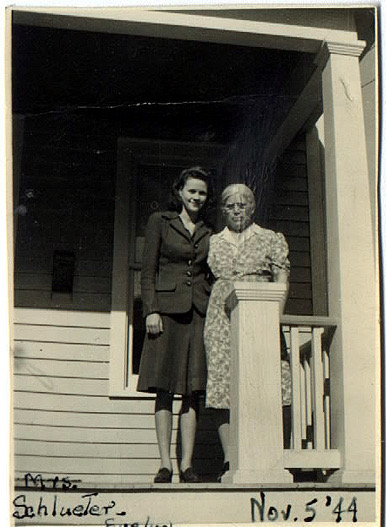
The photo below is one of hundreds I hauled down from the attic after my parents died. No idea who Mrs. Schluleter was but mom would have been living in St. Louis in November of of 1944. I get chills thinking about what mom’s hand-written metadata adds to this photo. (see ChatGPT info below) Allied forces had invaded Normandy just five months earlier and the outcome of the war was still far from certain. My father enlisted in the Navy in May of 1943 and was discharged in March of 1946 and saw a lot of action (which he never talked about) in the Pacific.

Some might argue that today’s digital images are rich in data but most people I know simply shovel hundreds (thousands?) of digital images into the cloud with little or no context.

On November 5, 1944, the world was deep into World War II, and several significant events took place:

  • Allied Advances in Europe: Canadian and British forces liberated Dinteloord in the Netherlands. Allied troops also reached Zoutelande on Walcheren Island, continuing their push to secure key positions in Western Europe.
  • Pacific Theater Operations: U.S. Task Force 38, under Admiral McCain, launched strategic military operations targeting Japanese positions on Luzon and surrounding areas. During these operations, the aircraft carrier USS Lexington was heavily damaged by a kamikaze attack.
  • Bombing of Singapore: U.S. Army Air Forces’ Twentieth Air Force B-29s, based in Calcutta, India, began occasional attacks on drydock and ship repair facilities in Singapore.

These events highlight the intense and widespread military engagements occurring across multiple theaters of the war at that time.