
What Technology Wants by Kevin Kelly (TED Talk)

I finished Kevin Kelly’s What Technology Wants (PDF) this weekend. I rank this book up there with Ray Kurzweil’s The Singularity is Near in terms of importance. I won’t attempt to review the book, since I’m still try to absorb some of the mind-bending ideas. Like the evolution of technology:

Here are a few ideas that got some highlighter:

Technology and life must share some fundamental essence. … However you define life, its essence does not reside in material forms like DNA, tissue, or flesh, but in the intangible organization of the energy and information contained in those material forms. Both life and technology seem to be based on immaterial flows of information.” – pg 10

Technium – The greater, global, massively interconnected system of technology vibrating around us. – pg 11

How many neurons do you need to have a mind? – pg 13

We can think of technology as our extended body. – pg 44

Ideas fly in flocks. To hold one idea in mind means to hold a cloud of them. – pg 45

Even the tiniest disposable item with a bar code shares a thin sliver of our collective mind. – pg 48

For most humans, for most of time, real change was rarely experienced. – pg 73

“What was impossible billions of years ago becomes increasingly inevitable.” — Simon Conway pg 126

There is only one life. All life today is descended along an unbroken line of duplication from one ancient molecule that worked inside one primeval cell that worked. – pg 127
Continue reading →

Kevin Kelly loves technology

The full quote (by MIT sociologist Sherry Turkle) is: “We think with the objects we love, and we love the objects we think with.” I came across it near the end of Kevin Kelly’s new book, What Technology Wants. (More on that in a later post.) Mr. Kelly beautifully captures my own feelings about technology:

“I am no longer embarrassed to admit that I love the internet. Or maybe it’s the  web. Whatever you want to call the place we go to while we are online, I think it is beautiful. People love places and will die to defend a place they love, as our sad history of wars proves. Our first encounters with the internet/web portrayed it as a very widely distributed electronic dynamo –a thing one plugs into– and that it is. But the internet as it has matured is closer to the technological equivalent of a place. An uncharted, almost feral territory where you can genuinely get lost. At times I’ve entered the web just to get lost. In that lovely surrender, the web swallows my certitude and delivers the unknown. Despite the purposeful design of hits human creators, the web is a wilderness. Its boundaries are unknown, unknowable, its mysteries uncountable. The bramble of intertwined ideas, links, documents, and images creates an otherness as thick as a jungle. The web smell like life. It knows so much. It has insinuated its tendrils of connection into everything, everywhere. The net is now vastly wider than I am, wider than I can imagine; in this way, while I am in it, it makes me bigger, too. I feel amputated when I am away from it.”

“In that lovely surrender, the web swallows my certitude and delivers the unknown.” Who can ask for more.

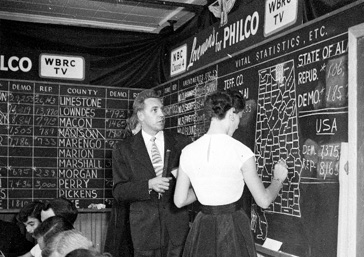
Covering election returns

Election night was a big night for radio station news departments. Or, they were back in the 70’s in the little town where I worked.

The candidates would crowd into the county clerk’s office and watch as the votes were written on a big chalk board. The radio station news guy would setup a small transmitter and send back updates that were broadcast live. You were either there… listened to us… or heard the results the next morning at the local coffee shop.

When I started working with The Missourinet (a statewide radio network) in the mid-80’s, it wasn’t that different. One of our reporters would set up at the Secretary of State’s office with a dedicated land-line (before cell phones). Maybe they used one of the state’s phones, I don’t recall. But the reporter would phone in regular updates to the network newsroom where they’d go out to affiliate stations around the state.

Sometime in the 90’s technology improved to the point where we could Telnet into the the state computers (via very slow modem’s) and access the numbers directly. And then report them over the network.

Fast forward to the Web. No more Telnet but those early websites were very glitchy. And slow. But they got better every election. It was a wonderful thing. Anyone with internet access could see the returns as they were tabulated. But it was still easier for radio stations (and their listeners) to take our reports than produce their own.

Last week one of our news directors stopped by my office to talk about what we would do online for the upcoming election. Missouri’s Senate race is the Main Event and we’ll have reporters at both candidates venue. They’ll do interviews and feed those back to the network where reporters will be working the Secretary of State’s website.

One the other end of the information pipe, people will still be listening to the radio and watching TV but I expect Twitter and Facbook to be where many get their first information. (Does the Secretary of State have a Twitter feed?). And most of it will be mobile.

Eventually we’ll all vote electronically, without standing in line. And we’ll see the results in near real time.

Will this elections more susceptible to fraud? Girl, please! Is the TSA making flying safer?

Scott Adams: The “I Wonder” App

Posted in 2010

“You’ll be wearing your Bluetooth earpiece –  a future version of it – most of the day. And it will be listening to everything you say. When it hears you say, “I wonder…” it will fire up a search engine and wait for the rest of the sentence.  The software will know you’re using an earpiece, so the answer will be delivered as a brief verbal summary, like a smart friend whispering in your ear.

In the first versions of this service, you’ll ask simple questions, such as “I wonder what ingredients go into a margarita,” or “I wonder where the nearest Starbucks is.”  In later versions, as search engines and content sources evolve, you’ll have access to more complicated answers, all with whisper-friendly brevity.

Now imagine that your earpiece has a camera. Google is already working on a search engine that will identify an object from a digital image. Someday you will be able to look at a flower and say, “I wonder what type of flower that is,” and the answer will be whispered in your ear.

Now here’s the cool-spooky part. As the technology improves, the voice in your ear will become more natural, and smarter, and it will be like your invisible friend. It will learn your preferences in a way no human ever has.  I think it will be able to keep you company and make you less lonely. The whisper-in-your-ear aspect of this technology has the potential to feel like human contact but without the inconvenience of an actual human.”