Does my vote really matter?

All my life I have been told that it does. The candidates have told me that. The news anchors told me that. My civics teacher told me that. And like many such givens, I beleived it must be true.

But this thoughtful post by David Cain has made me reconsider. I’m just pulling a graf to keep this short so if you give a shit one way or the other you really should read his entire post:

“Many people are uncomfortable with the idea of not voting because they feel like they would then be forfeiting the only power they have over who governs. But your vote contains no power. It is a virtually inert token of your participation, which does carry some sentimental value to some people. But it has no election-swinging ability. There are plenty of actions that can make a difference but casting your vote isn’t one of them.”

For some bizarre reason, Mr. Cain’s post caused me to flash on the carnival midway. One of the “games” involved trying to toss a wooden hoop around a small fishbowl that contained a goldfish. The bowl was just two feet away and you could almost lean over and drop the hoop on the bowl. But not quite. The carney guy understood something that I didn’t. Even if I got the goldfish, he wins.

Mr. Cain also argues that if the election is really important to you, you’ll do more than vote. You’ll knock on doors and work your ass off in other ways. I can find no flaw in that logic.

Before you dismiss the idea that your vote doesn’t really make a difference, read the post.
Trackpad puts ambi in my dexterous

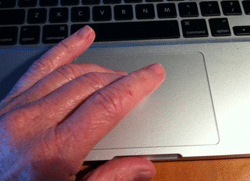
Since switching from PC to Mac a few years ago, I have turned into one of those annoying Apple Fanboys. And while the Apple Magic Mouse didn’t click for me (as it were) the trackpad did. Does.

I’m right-handed and –as a result of spending every waking moment online– developed a little soreness in my wrist this week.

Back in my old mouse days, no way could I have switched hands. My dexterous is not ambi.

To my delight, I find that I can manipulate my trackpad with the left hand, almost as well as the right. Good design.

iPads just what the doctor ordered

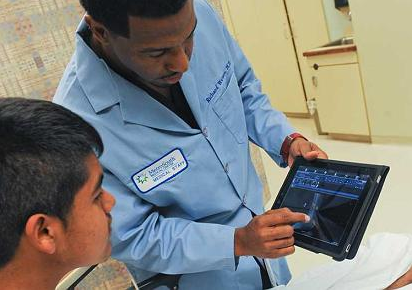
That clipboard your doctor used to carry around is getting replaced by the iPad. From the Chicago Sun-Times:

“Emergency room doctors are using iPads to order lab tests and medication. Plastic surgeons are using them to show patients what they might look like after surgery. And medical residents are using them as a quick reference to look up drug interactions and medical conditions.

Since Apple’s iPad hit the market in April, doctors at Chicago area hospitals are increasingly using the hot-selling tablet as a clinical tool.

Not only does the iPad allow doctors to view electronic medical records, wherever they are, it also gives them a way to show patients their X-rays, EKGs and other lab tests on an easy-to-read screen. Plus, it’s lighter and has a longer battery life than many laptops, making it convenient for doctors to take on rounds.

Within the next month, the University of Chicago Medical Center plans to provide iPads to all of its internal medicine residents, expanding on a pilot program launched earlier this year. Similarly, Loyola University Medical Center in Maywood has given iPads to all of its orthopedic residents as part of a pilot program.

Other doctors are buying their own iPads and using them to interact with patients. At U. of C., for instance, plastic surgeon Dr. Julie Park uses her iPad to show breast-cancer patients what they might look like after reconstructive surgery.

Another hospital that has embraced the iPad is MetroSouth Medical Center in Blue Island. Once doctors there learned that they could access the hospital’s electronic medical records with the iPad, “it went through here like wildfire,” said Dr. Richard Watson, an emergency room physician at MetroSouth. “At least half of our staff here in the emergency room has their own iPad and carries it and uses it.”

Though the iPad provides a portal to the hospital’s electronic record, patient information isn’t actually stored on the device. And both the iPad and the hospital server are password-protected, lowering the chances that sensitive data could be swiped from a lost or stolen iPad.

Dr. Eric Nussbaum, MetroSouth’s emergency room chief, said the iPad also solves one of the problems created by switching from a paper-based record system to an electronic one: having to go to a desktop computer to order lab tests or type in notes on a patient.

“With this, I’m back to the convenience of being in the patient’s room, talking to them and plugging in my orders right then and there,” he said.

If you’ve spotted the iPad in the medical wild, let us know in the comments.