
“… we’re in the midst of a massive global reinvention. Not just a shift from analog to digital, but a shift from centralized control to distributed systems. From isolated single user experiences to a global social fabric. These mobile devices are the of Gutenberg presses of our generation. This is not a bubble, this is a revolution.” – Blog post
1Password
With more 120 logins and passwords to keep up with, a post-it note on the side of my monitor just doesn’t cut it. As for using one password for ALL of my accounts… I won’t dignify that with a comment. This little (6 min) tour doesn’t begin to do justice to 1Password, the Best of Category.
paper.li
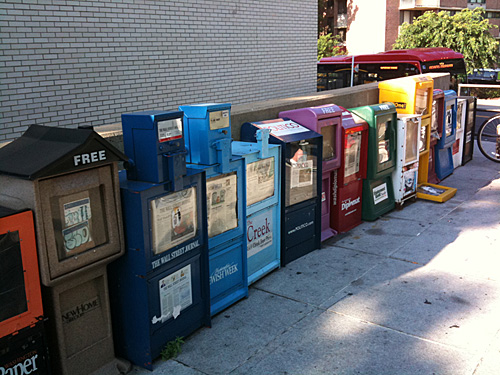 I LOVE Twitter. It’s where I follow the insights and links of 131 like-minded souls. I tweet with some regularity but it’s the sum of these parts that makes Twitter so valuable/interesting to me.
paper.li compiles all of those tweets into a daily “paper.” While I prefer to follow my Twitter stream on my iPhone app or Tweeti on the MacBook, paper.li offers a better answer to: “What do you see in Twitter?!”
It’s like having 131 hand-picked editors, commentators and comedians, continuously scouring and curating the web just for me.
“How to make trillions of dollars”
David Cain is (Raptitude) helping me (and many others) “get better at being human.” In this post he explains how television has been used by “very-high-level marketers” to create a nation of people who typically:
- work almost all the time
- absorb several hours of advertising every night, in their own homes
- are tired and unhealthy and vaguely dissatisfied with their lives
- respond to boredom, dissatisfaction, or anxiety only by buying and consuming things
- have disposable income but can’t find a more fulfilling line of work without losing their health insurance
- create health problems for themselves, which can be treated with drugs they can “ask their doctor about”
- own far more items than they use, and believe they don’t have enough
- are easily distracted from the unhealthy state of their lives and their culture by breaking news and celebrity gossip
- perpetually convince themselves it is not the right time to make major lifestyle changes
- happily buy stuff that breaks within a year, and which nobody knows how to fix
- have learned, through the media’s culture of blame-mongering, that the key to solving public and private issues is to find the right people to hate
Wow. Sound like anyone you know?
I’m trying to stop watching the evening network news. A tough habit to break. It’s been part of my life since… well, since the beginning of network news. Thanks to DVR technology I can skip all the adds to which Mr. Cain refers.
My friend (and one of the 5 smartest guys I know) Henry has eliminated “news” completely. Or so he says. I’m not sure how one does that. But if anyone can, it’s Henry. He makes a compelling case that knowing the news adds nothing to his life. He’s very well (selectively?) informed, so…
The excerpts above don’t tell you much about “how to make trillions of dollars” so I encourage you to read the full post if that’s something you’d like to do.
Dave Winer’s advice to Keith Olbermann
This post doesn’t depend on knowing who Dave Winer or Keith Olbermann is (are?). It’s about media and brand. My favorite part of Mr. Winer’s advice:
“…the future of communication is not about the bottleneck that MSNBC and their competitors control. I don’t think you really need them. Unless of course you need to make $5 million a year, in which case you probably do need them. But if what you’re interested in is power to influence public opinion, and becoming more relevant over time, not more niched over time — if being influential is what you’re about, they really did you a favor.
So here’s what I recommend. Borrow a page from Conan O’Brien’s playbook, and use the social network to communicate with your fans.
Get a video camera and put it in your living room or den at home. Hit Record. Sit down in front of the camera and rant for 15 minutes. You can do that, I’m sure. Then without any production at all, upload it to YouTube and send the link around on Twitter. The first time you do it, it will be the most watched video of the day. Far more people will see it than used to see you on MSNBC, or O’Reilly or Beck or any of them. Depending on how fresh and interesting it is, and how real it is, and how compelling you really are (I know that’s a lot of “depends”) there won’t be much of a dropoff on Day 2 and 3 and so on. Now you’ve got your own network. And no one can shut you down. And you’ll have a lot more people watching you.”
Leo Laporte has done such an amazing job of this. Same for Arianna Huffington, and I’m sure there are others that don’t come to mind. Begs the question: Who owns the Keith Olbermann brand? MSNBC/Comcast? Or Keith Olbermann? Who owns your brand? Have you established a brand? What is it and where can I find it?