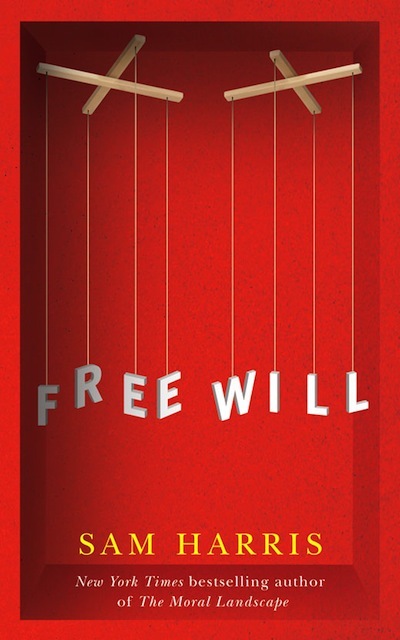
Sam Harris is the author of the New York Times bestsellers, The End of Faith, Letter to a Christian Nation, and The Moral Landscape. Mr. Harris is a Co-Founder and CEO of Project Reason, a nonprofit foundation devoted to spreading scientific knowledge and secular values in society. He received a degree in philosophy from Stanford University and a Ph.D. in neuroscience from UCLA.
A lot of my reading over the last few years has touched on the idea of free will. Real or illusory? I’ll confess that it sure feels as though I have free will. But the more I read about the subject… and think about it… the less certain I am.
The intention to do one thing and not another does not originate in consciousness — rather, it appears in consciousness, as does any thought or impulse that might oppose it.
Some moments before you are aware of what you will do next — a time in which you subjectively appear to have complete freedom to behave however you please — your brain has already determined what you will do. You then become conscious of this “decision” and believe that you are are in the process of making it.
I cannot decide what I will next think or intend until a thought or intention arises.
You are not controlling the storm, and you are not lost in it. You are the storm.
Unconscious neural events determine our thoughts and actions — and are themselves determined by prior causes of which we are subjectively unaware.
The next choice you make will come out of the darkness of prior causes that you, the conscious witness of your experience, did not bring into being.
You are no more responsible for the next thing you think (and therefor do) than you are for the fact that you were born into this world.
You can decide what you decide to do — but you cannot decide what you will decide to do.
My choices matter — and there are paths toward making wiser ones — but I cannot choose what I choose.
What I will do next, and why, remains, at bottom, a mystery — one that is fully determined by the prior state of the universe and the laws of nature (including the contributions of chance).
Take a moment to think about the context in which your next decision will occur: You did not pick your parents or the time and place of your birth. You didn’t choose your gender or most of your life experiences. You had no control whatsoever over your genome or the development of your brain. And now your brain is making choices on the basis of preferences and beliefs that have been hammered into it over a lifetime — by your genes, your physical development since the moment you were conceived, and the interactions you have had with other people, events, and ideas. Where is the freedom in this?
You will do whatever it is you do, and it is meaningless to assert that you could have done otherwise.