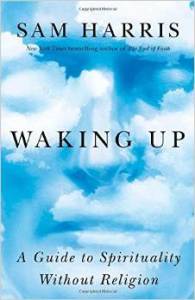
 Just finished Waking Up – A Guide to Spirituality Without Religion by Sam Harris. Amazon reviews here; more about Mr. Harris here. Ideas I found highlighter-worthy below.
Our minds are all we have. They are all we have ever had. And they are all we can offer others. Every experience you have ever had has been shaped by your mind.
It is your mind, rather than circumstances themselves, that determine the quality of your life.
Everything we want to accomplish is something that promises, if done, it would allow us to finally relax and enjoy our lives in the present. […] Each of us is looking for a path back to the present: We are trying to find good enough reasons to be satisfied now.
Twenty percent of Americans describe themselves as “spiritual but not religious.”
Is it possible to be happy before anything happens, before one’s desires are gratified, in spite of life’s difficulties, in the very midst of physical pain, old age, disease, and death?
On one level, wisdom is nothing more profound than an ability to follow one’s own advice.
A true spiritual practitioner is someone who has discovered that it is possible to be at ease in the world for no reason, if only for a few moments at a time.
It is impossible for any faith, no matter how elastic, to fully honor the truth claims of another.
We manage to avoid being happy while struggling to become happy.
(Mindfulness is ) a state of clear, nonjudgmental, and undistracted attention to the contents of consciousness. […] Being mindful is not a matter of thinking more clearly about experience; it is the act of experiencing more clearly, including the arising of thoughts themselves.
The problem is not thoughts themselves but the state of thinking without knowing we are thinking.
Most people who believe they are meditating are merely thinking with their eyes closed.
Most of us spend every waking moment lost in the movie of our lives.
Meditation is a technique for waking up.
Investigating the nature of consciousness is the basis of spiritual life.
Consciousness is the one thing in this universe that cannot be an illusion.
If you shut your eyes at this moment, the contents of your consciousness change quite drastically, but your consciousness (arguably) does not.
Are we unconsciousness during sleep or merely unable to remember what sleep is like?
We are not aware of all the information that influences our thoughts, feelings, and actions.
I’ve forgotten most of what has happened to me over the course of my life.
Subjectively speaking, the only thing that actually exists is consciousness and its contents. […] Reality vastly exceeds our awareness of it.
(I am) a continuum of experience.
The feeling of “I” is a product of thought. […] Having an ego is what it feels like to be thinking without knowing that you are thinking.
(Thoughts are) transient appearances in consciousness.
We tell ourselves the story of the present, as though some blind person were inside our heads who required continuous narration to know what is happening.
Even if your life depended on it, you could not spend a full minute free of thought. […] We spend our lives lost in thought. […] Taking oneself to be the thinking of one’s thoughts is a delusion.
One must be able to pay attention closely enough to glimpse what consciousness is like between thoughts — that is, prior to the arising of the next one.
We imagine that we are conscious of our selves within our bodies. We seem to be riding around inside our bodies.
(The self) is the feeling that there is an inner subject, behind our eyes, thinking our thoughts and experiencing our experience.
It may be that an awareness of other minds is a necessary condition for an awareness of one’s own.
Consciousness is the prior condition of every experience; the self or ego is an illusory appearance within it; look closely for what you are calling “I,” and the feeling of being a separate self will disappear; what remains, as a matter of experience, is a field of consciousness — uncontaminated by its ever-changing contents.
Consciousness is intrinsically free of self.
That which is aware of sadness is not sad. That which is aware of fear is not fearful. Notice thoughts as they emerge and recognize them to be transitory appearances in consciousness. In subjective terms, you are consciousness itself — you are not the next, evanescent image or string of words that appears in your mind.
Consciousness is intrinsically undivided.
Nothing is intrinsically boring — boredom is simply a lack of attention.
We need not come to the end of the path to experience the benefits of walking it.
We read for the pleasure of thinking another person’s thoughts.
It is by ceasing to cling to the contents of consciousness — to our thought, moods, and desires — that we make progress.
There is experience, and then there are the stories we tell about it.
Consciousness is never improved or harmed by what it knows.