
Confide for the desktop
Confide is a messaging app with which you can “Communicate digitally with the same level of privacy and security as the spoken word. With encrypted messages that self-destruct.” I installed the app on my phone a few day ago after seeing a story about how it has become popular inside the Beltway.
The folks at Confide sent me an email letting me know they have a desktop version, which I installed on my Mac this morning. In the screenshot below, image #1 is what you see when you get a message. #2 is what you see when you move your cursor over the text.
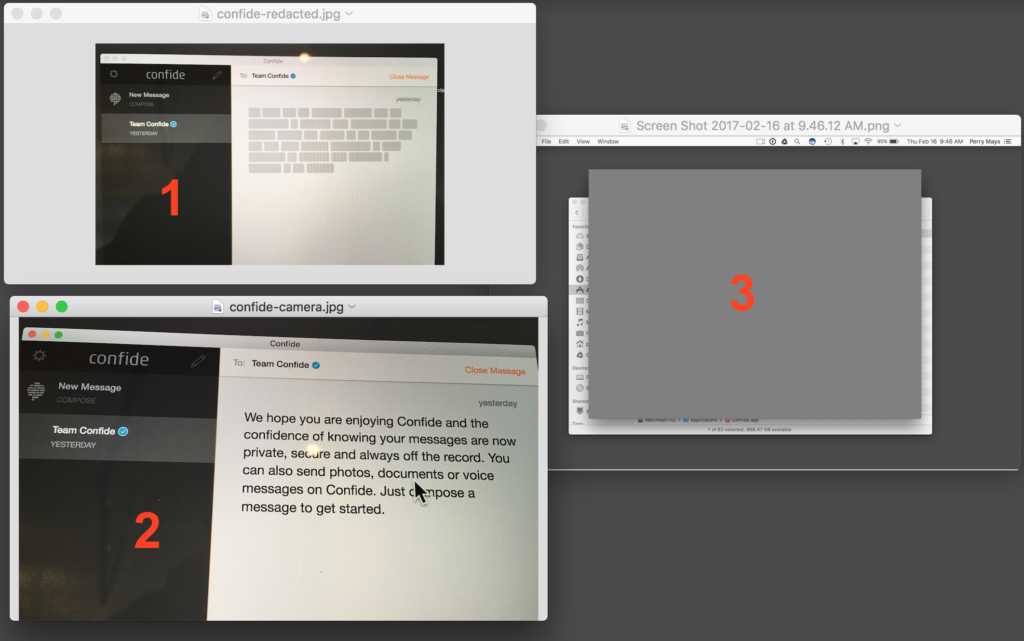
Security? I don’t think so. I’ll just do a screenshot of the clear text. (click) Image #3 is what showed up on my desktop. Hmmm. The only way I could capture the text was to use my iPhone to snap a photo of my monitor. Pretty clever.
Your cremated loved one’s ashes can be pressed into a vinyl record
Paying for good TV
I grew up glued to the TV and could have never imagined a time when I watched almost nothing on the boob tube. But here we are. Almost no regular viewing since starting my news fast. The one exception is the ABC sitcom, Modern Family. I find the writing so fast and flawless that I have to watch each episode twice to get all the jokes.

This week it occurred to me that we didn’t start watching until the third or fourth season so I went searching for earlier shows and wound up buying the first season (24 episodes) for $30. This might be the first time I’ve done that. (I’m not counting Netflix) $1.25 per episode and no commercials. That’s a good deal in my book. Going forward I see myself (willingly) paying for more of what I watch and listen to. And I’ll be more discriminating. I already have the sense more and more of the good stuff requires a subscription. The crap will come loaded with commercials.
Be Impeccable with your Word
While waiting for my car to be serviced yesterday morning, I watched a few minutes of a CBS News feature on how patients in the early stages of ALS are preparing (to the extent that’s possible) for the later stages of the disease.
“Before her speech becomes severely impaired, Hubner turned to speech pathologist John Costello at Boston Children’s Hospital. He gives patients a voice recorder and tells them to think of phrases that reflect who they are.”
As I watched the woman making notes and recording simple statements I found myself thinking about all the things I say during the course of a day (“Hey, Lucy. You want to go outside?” “Hattie! Come sit to the couch and get some loving’” “Have I told you today how much I love you?”) and what it would be like if I could no longer say those things.
In the CBS piece they entered the patient’s recordings into a computer so she could play them back with a keystroke. As I watched I wondered what would I want to say if I could no longer speak the words. Whew.
A list of things I take for granted would be too long to list here, but the simple act of speaking would be high on the list. How many spoken thoughts have I wasted? What would I say if today was my last day to speak?
The woman in the news story was writing down things she wanted to record. Not a lot of negative or mean things on that list, if I had to guess. Probably not a lot of political comments or complaints about waiting in line.
In an ancient blog post I imagined getting a printed transcript of every word I uttered in during the course of the day. With a red pencil I crossed out everything that didn’t need to be said. What would I be left with? If I could say only 20 things tomorrow, what would I choose?