“I wonder if TV will now help us undo the damage they unwittingly begat. Perhaps by having a Trump-like character get what’s coming to him. Put him in Archie Bunker’s chair, and see what happens.” — Dave Winer
Hard for me to imagine Aaron Sorkin isn’t hammering away on his MacBook at this moment. I’ve been thinking in terms of a tell-all book or movie (Primary Colors, Game Change, etc) but a TV series would have a longer life span. Gotta be HBO or Netflix or Amazon to properly portray the monster. Stay tuned.
“For the first time ever, more people die from eating too much than from eating too little; more people die from old age than from infectious diseases; and more people commit suicide than are killed by soldiers, terrorists and criminals put together. The average American is a thousand times more likely to die from binging at McDonalds than from being blown up by Al Qaeda.” Amazon
Dataism is a new ethical system that says, yes, humans were special and important because up until now they were the most sophisticated data processing system in the universe, but this is no longer the case. The tipping point is when you have an external algorithm that understands you—your feelings, emotions, choices, desires—better than you understand them yourself. That’s the point when there is the switch from amplifying humans to making them redundant.
Will tech companies become our new rulers, even gods?
When you talk about God and religion, in the end it’s all a question of authority. What is the highest source of authority that you turn to when you have a problem in your life? A thousand years ago you’d turn to the church. Today, we expect algorithms to provide us with the answer—who to date, where to live, how to deal with an economic problem. So more and more authority is shifting to these (technology) corporations.
Northern Exposure is an American comedy-drama television series that ran on CBS from 1990 to 1995. My favorite character was Chris Stevens (played by John Corbett). “A philosophical ex-convict who works as the disc jockey at KBHR 570 AM. Between songs, Chris offers comments on events in Cicely and on more intellectual and controversial subjects.”
The Chris character was the DJ we all wanted to be. Okay, “I” wanted to be. Fortunately, I was smart enough to know I couldn’t pull off those long, zen monologues without John Corbett’s wonderful voice and delivery, and a room full of writers. There are a few “Chris Stevens tribute videos” on YouTube that painfully illustrate the folly of those who tried.
My buddy Bob Hague (also a radio guy) told me of an acquaintance that “went bonkers” because Chris never wore headphones in the series.
My father was a Radio Operator (?) in the Navy during WWII. Based on the little he told me of that experience, it was Morse Code rather than than voice transmission. After the war he went to watchmaker school until he figured out he could get paid (GI Bill) to go to the Pathfinder School of Broadcasting (Kansas City).
I recall him saying the the “announcers” didn’t wear headphones because they were in one studio and the engineers (who did wear ‘phones, suppose) were in another. I believe this was common and the reason you’d see announcers from that era cupping a hand behind one hear (holding copy in the other) in order to better hear the golden sound of their voice.
When pop got hired at the little station in Kennett, MO, he was shocked to learned he’d have to “run his own board” and that necessitated wear phones. But I remember (as a child) seeing him or one of the other announcers being on the air without headphones.
I recently stumbled upon Wikiquote (“a free online compendium of sourced quotations from notable people and creative works”). I have a quotation jones. When I read a book I obsessively underline passages for hoarding on Google Docs. So I can get lost for hours on Wikiquote. Here’s one from Neal Stephenson’s Anathem (Erasmas theorizing why others are joining his journey):
“The work that people did had been broken down into jobs that were the same every day, in organizations where people were interchangeable parts. All of the story had been bled out of their lives. That was how it had to be, it was how you got a productive economy. But it would be easy to see a will at work behind this: not exactly an evil will, but a selfish will. The people who’d made the system thus were jealous, not of money and not of power, but of story. If their employees came home with interesting stories to tell, it meant that something had gone wrong: a blackout, a strike, a spree killing. The Powers That Be would not suffer others to be in stories of their own unless they were fake stories that had been made up to motivate them. People who couldn’t live without story…had to look somewhere outside of work for a feeling that they were part of a story, which I guessed was why Sæculars were so concerned with sports, and with religion. How else could you see yourself as part of an adventure?”
Has all the story been bled out of your life? My life?

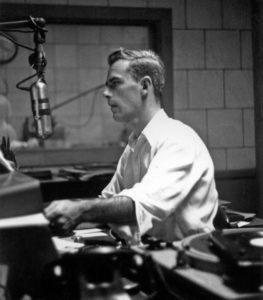 I recall him saying the the “announcers” didn’t wear headphones because they were in one studio and the engineers (who did wear ‘phones, suppose) were in another. I believe this was common and the reason you’d see announcers from that era cupping a hand behind one hear (holding copy in the other) in order to better hear the golden sound of their voice.