
Thanks to my pal Jamie for sharing this amazing 5 min video showing the relationship between health and wealth over the last 200 years. This gives me hope.
Your uncle killed my uncle
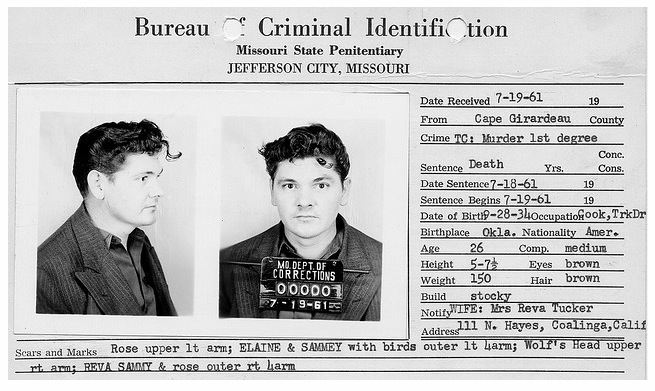
Sammy Tucker was executed in Missouri’s gas chamber in 1963. I found this BCI card in the state archives and included it on a website I created some years ago. I posted the image a on Flickr.
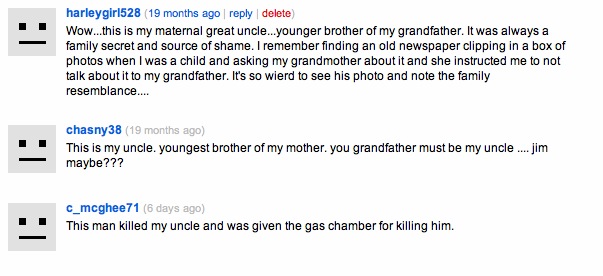
I have no way to know if the comments below are legit but then, I have no reason to doubt them.
First iPad on (and before) Missouri Supreme Court
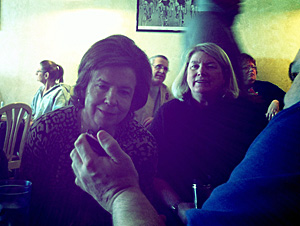 Missouri Supreme Court Judge Mary Russell received an iPad for Christmas and she stopped by the Coffee Zone on Saturday to get some tips on apps. In this photo Mac God George Kopp is showing her something on his iPhone (that’s my Barb in the middle).
Judge Mary is rightly proud of being the first member of the court to have a iPad and mentioned that one of the attorneys arguing before the court this past week used an iPad for notes. Another first.
I’m telling you, these things are going to be everywhere
Saturday afternoon thoughts on the iPad
 Today I’ve been reading a book with the Kindle app on my iPad. When I come across a word or a name I’m unfamiliar with, I double-click and jump over to the dictionary app or Safari/Wikipedia. Or I’d hear the ping of a new email or text message (which I usually check, but not always)
If a big story breaks (like the shooting in Arizona) I can watch news updates for any number of sources.
I’ve started taking this connectedness for granted. Yeah, we’ve been doing this for a while on our laptops, but something about getting all of this from a little slab of aluminum and glass propped on my chest amazes me.
Even the book I was reading when all of this occurred to me. I came across it in a blog post… downloaded from Amazon… and started reading on the same device where I first learned of the book. All within 5 minutes. Damn!
A bunch of Mac Heads meet most Saturday mornings at the local coffee shop. Bigger than usual group this morning and as I looked around, we all had iPads. As far as I could tell, nobody brought their laptops.
Someday soon I’ll stop noticing the wonderful things the iPad (and similar devices) brings to me. But maybe there will something new and even more amazing.
Matt Taibbi: “It was good times in America for a while”
“Back when America was still a feared international bully that was flush with borrowed Saudi and Chinese cash and could stand to blow a few hundred extra billion in public funds every year on budget-padding deals — back in the Bush years — John Boehner was the perfect candidate for congressional leadership, a lifetime company man who didn’t give a shit about most Americans but could shed tears on national television on behalf of Jamie Dimon’s (CEO of JP Morgan) bottom line.”
“Things are different now. America is so broke, there’s no longer really any money in the Treasury to give away — the job of overseeing corporate handouts that used to belong to the leaders of Congress has now moved to the Federal Reserve, which itself is so broke that it has to invent dollars out of thin air before it can give them away to influential billionaires. This leaves congressional leaders with nothing to do but their ostensible jobs — i.e., fixing the country’s actual problems — and few of the current leaders have any experience with that, Boehner being a prime example. The new speaker represents an increasingly endangered class of Beltway jobholders who know how to raise money and get elected, but not much beyond that. He now finds himself the party’s last line of defense against millions of angry voters who, for the first time in recent memory, are at least attempting to watch what Congress is up to.”
Matt Taibbi on John Boehner (Rolling Stone)
iPad Killer: HP Slate 500
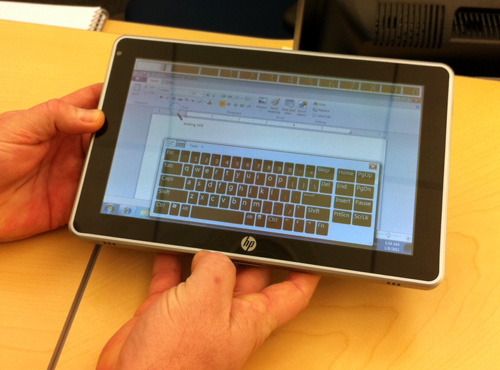
Our HP rep brought in the long-awaited Slate 500 today and we all got hands on. No way I could be objective about a device that’s smaller than the iPad, weighs the same; has half the battery life; runs Windows and costs $800. So here’s the PC Magazine review from a from a few months back.
Would like to hear from anyone that has one of these… or can snap a photo in the wild.
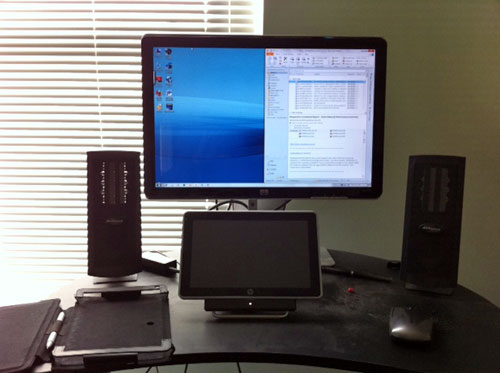
UPDATE: Jim Boettger sends along this photo of his docked Slate. “The dongle plugged into the top of the slate is for my Kensington Slimblade kbd and mouse set. Also have Monsoon speakers plugged into dock.”
David Brazeal: Too funny for his job
 My friend and co-worker, David Brazeal, is leaving Learfield. After 17 years. He has two kids and he doesn’t have another job lined up. David is casting his fate to the digital winds (and his wife has a good job) and I admire him greatly for taking the leap.
David has been spending nights and weekends covering Republic Tiger Sports (the local high school). He’s built a strong following (blog and facebook) and wants to turn it into a real business if he can. I’m betting he’ll be successful. David is very good at this kind of stuff. It’s what he now does for Learfield clients.
This is happening all over the country. What was once the exclusive turf of the local newspaper and radio station is being invaded by bloggers and podcasters who operate with virtually no overhead and –more importantly– no legacy media baggage to weigh them down.
Another Learfield alum, Chuck Zimmerman (and his wife Cindy), have built a very successful business built around event blogging and “new” media consultation.
David is one of the most creative people I know. He’s quick and smart and way too funny for the job he’s leaving. He’ll be able to give full vent to his creativity in his new venture and I’m looking forward to watching. I won’t miss David because we’ll be as connected as ever.
Blogger Screening
Starting and maintaining a blog (any website?) is like buying a hamster. You hurry home and put together the cage with brightly colored tunnels and the little wheel that spins round and round. The sawdust in the bottom of the cage smells fresh and sweet.
And then it becomes work. A chore that must be attended to every day.
I help people (clients and internal staff) set up blogs and websites and the initial conversation goes something like this:
ME: So what will you put on this website?
THEM: Well, there will be an “about” page… and maybe photos and bios of our people.
ME: Okay, what else?
THEM: Uh, how about a map showing where we’re located?
ME: Alright, although it’s pretty easy to Google us for that. Anything else?
Nobody really cares about your bios and company history. They really don’t. They care about stuff that will be useful to them. If you don’t have that –and have it regularly–I’d argue a blog probably isn’t the right tool.
As for the Web 1.0 static “home page,” name one you’ve visited twice.
Going forward, I think I might use the following test:
Before we start building your new website, I want you to pick a topic that you know something about. Ideally, something about which you are passionate. Skeet shooting, counted cross-stitching, raising llamas, whatever.
Send me an email every day for the next 10 days. It should include an excerpt and link to something related to your topic… along with 150 words explaining why you think this is interesting or important.
That’s it. If you can’t do that, you’re probably wasting your time (and mine).
Every good blogger I know would have no problem with this. It would take them 5 min each day. Maybe 10. Comments?
Dolphins cheerleaders video shot on iPhone
Shot and edited on the iPhone by Jonathan Brownfield.
Present. Silent. Paperless.
Every year Chris Brogan comes up with three words as his “guiding pillars” for what to focus on in the coming year.
“Instead of resolutions, which don’t usually help me very much, I work hard on using these words as a lighthouse for my actions and efforts.”
I like that. I’ve never been one for resolutions because… well, because I lack resolve. But his post prompted me to pick three words to guide me in the coming year.
Presence. To be fully present, “in the now” as the new-agers say. I’ve been working on this for a while and it’s easily the most challenging thing I have undertaken.
Silence. Somewhere there’s a post in which I fantasize about going 24 hours without speaking. No, I have not accomplished that. Yet. Frequent reviews of Scott Adams’ Wiki Ignorance Test is helping. This is a tough one because it has much to do with ego and the need to be noticed.
Paperless. This one is actually within striking distance. I have a couple of junk-filled drawers at work the contents of which I plan to scan/discard. Eliminating paper is part of a larger –less tangible goal– of having few ‘things’ in my life.
UPDATE: I spent a couple of hours at the office getting rid of paper. Hauled 2 or 3 boxes to the dumpster. All that’s left are some archival docs and I’ll get those scanned and up on Google Docs tomorrow. I’ll keep a pad of post-it notes but the beloved yellow legal pads went back to the supply closet.
While tossing, I found a quaint list of “silent interrupters” (from Entrepreneur Magazine – August 1989):
- Multiple calendars – keep all activities recorded in one calendar system
- Open fils are a distraction. Keep them closed.
- Phone messages and reminders – scraps of paper strewn on a desk are easily lost. Use a “To Do” list.
- Business cards should be alphabetized and filed
- “Someday” files should not be in sight
- Reading matter should be filed in one place and read at a specific time.
- In-box material should be reviewed daily and the contents thrown out, delegated, filed or acted upon. Keep the box out of sight.
- Reference books should be organized and out of sight.
- Multiple card files should be consolidated into one file. Input frequently called numbers into memory phones or a reference book/box.
- Pens, staplers, and tape dispensers should be in a drawer and out of sight.
Once I’ve convinced myself I can eliminate paper from my work office, I’ll tackle the files at home.