Moving mulch

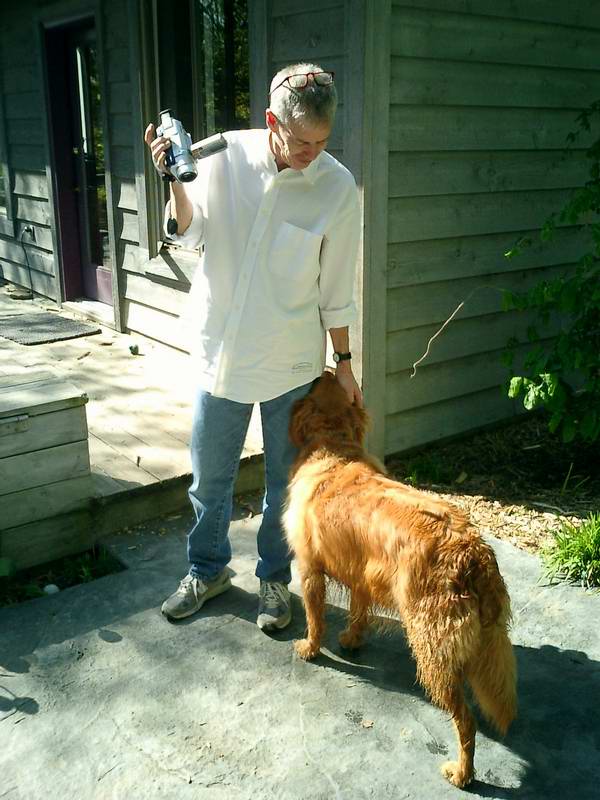
The Mulch Fairy visited my house this morning and left these two piles. Barb recently had some landscaping done and this is the culmination. She and a dozen gal pals are in Destin for a week and she expects this mulch to be… whatever you do with mulch… by the time she returns.

Knowing me as well as she does, she has hired some big strong lads to do what needs to be done, which –I assume– involves the red wheelbarrow thing you see peeking up from behind Mount Backache. Just so you know, if I choose to.

“Why did the world shatter at the touch of a hyperlink?”

Dr. David Weinberger asks (and answers?) the question: “Why did the world shatter at the touch of a hyperlink?”

“Newspapers, encyclopedias, record companies, telephones, politics, education, analytics, scientifics, genetics, libraries, mass media, high culture, television, classrooms, assholism, channels, columns, stations, tours, travel, marketing, picketing, knitting, hectoring, picturing, gossiping, friendship redefined, attention redefined, leadership redefined, defamation redefined, curating, editing, publishing, correcting, crowds, mobs, shopping, bar-hopping, catalogs, sing-alongs, fact-checking, being together, being apart, staying together, moving on. Social forms and major institutions, many set in the Earth on stone foundations, fell down at the flick of a hyperlink.”

This started me thinking about tech changes over the last ten years. Digital cameras; high speed Internet access; social media (blogs, Twitter, Facebook); iTunes; smart phones; Google; Tivo; ebooks and on and on.

And, finally, how has our company changed during the past ten years? Can we list the Ten Biggest Changes? Five? Three? And is that even a relevant question?

Random thoughts on death of OBL

  • He was living in a mansion instead of hiding in the mountains with his Holy Warriors

  • He could have taken his own life and had his remains hidden, denying his enemies the “victory” of his capture/death. Why didn’t he?
  • If he was “dropped into the sea,” the body was probably weighted. What did they use for this purpose?
  • Somewhere there is film of the raid and the disposal of the body
  • The screenwriter has been hired
  • There are no 72 virgins in Paradise

The end of radio coverage maps?

A radio station coverage map is just what it sounds like: a cirle showing how far your station’s signal reaches. The bigger the circle the better. Now a new BMW option might make coverage maps less important (obsolete?)

Yes, I know, not everyone can afford a BMW but is there any doubt this technology will find its way into every vehicle? Not for moi.

Mark Ramsey sees the car as “a digital lifestyle accessory” and wonders how broadcasters fit into the consumer’s mobile digital lifestyle?

“Maybe it’s with unique and exclusive content. Maybe it’s with digital bells and whistles that make your content sing. It’s not with the same old same old. And no number of debates about FM on mobile phones will solve this problem for you.”

On more than one occasion I’ve wondered what would I do to stay fresh and relevant if I were running a radio station. How might I insure that my station was on that BMW dashboard/iPhone? And I don’t have a good answer. But smarter folks than I are figuring this out.

Scott Adams: “The sum of your actions”

“You’re a collection of molecules and those molecules are made of smaller bits, and those bits are made of even smaller bits. The smallest bits in the universe are all identical. You are made of the same stuff as the concrete in the floor and the fly on the window. Your basic matter cannot be created or destroyed. All that will survive of what you call your life is the sum of your actions. Some might call the unending ripple effect of those actions a soul, or a spirit.”

— Scott Adams, The Religion War

Desk Toy

All that’s missing is the satisfying little metal “click.”

UPDATE: If you stare at this for a few minutes, you will start “hearing” the click.

Scott Adams: Idea People

“There are two types of people in the world. One type is people-oriented. When they make conversation, it is about people — what people are doing, what someone said, how someone feels. The other group is idea-oriented. When they make conversation, they talk about ideas and concepts and objects. Idea people are boring, even to other idea people.”

“When a person talks about people, it is personal to everyone who listens. You will automatically relate the story to yourself, thinking how you would react in that person’s situation, how your life has parallels.”

God’s Debris 

The Information, by James Gleick

Publishers Weekly review on Amazon:

“In 1948, Bell Laboratories announced the invention of the electronic semiconductor and its revolutionary ability to do anything a vacuum tube could do but more efficiently. While the revolution in communications was taking these steps, Bell Labs scientist Claude Shannon helped to write a monograph for them, A Mathematical Theory of Communication, in which he coined the word bit to name a fundamental unit of computer information. As bestselling author Gleick (Chaos) astutely argues, Shannon’s neologism profoundly changed our view of the world; his brilliant work introduced us to the notion that a tiny piece of hardware could transmit messages that contained meaning and that a physical unit, a bit, could measure a quality as elusive as information. Shannon’s story is only one of many in this sprawling history of information.  Gleick’s exceptional history of culture concludes that information is indeed the blood, the fuel, and the vital principle on which our world runs.”

The following got some highlighter during my read:

“In the long run, history is the story of information becoming aware of itself.” pg 12

“With words we begin to leave traces behind us like breadcrumbs: memories in symbols for others to follow.” pg 31

“All known alphabets, used today or found buried on tablets and stone, descend from the same original ancestor.” pg 33

“The written word was a prerequisite for conscious thought as we understand it.” pg 37

Continue reading

“The new normal”

“What’s actually happening is this: we’re realizing that the industrial revolution is fading. The 80 year long run that brought ever-increasing productivity (and along with it, well-paying jobs for an ever-expanding middle class) is ending. The promise that you can get paid really well to do precisely what your boss instructs you to do is now a dream, no longer a reality.”

From a post by Seth Godin.