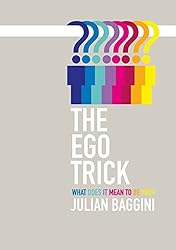
Excerpts from The Ego Trick: In Search of the Self by Julien Baggini
 We all tend to think there’s a connection between the four-year-old child on our first day of school and us now. What makes us the same is we believe we’re the same. Sense of self over time is therefore the story that we tell ourselves that keeps us together. pg 39
The Ego Trick – The remarkable way in which a complicated bundle of mental events, made possible by the brain, creates a singular self, without there being a singlular thing underlying it. pg 123
There is an Ego Trick, but it is not that the self doesn’t exist, only that it is not what we generally assume it to be. pg 151
Consciousness of self emerges from a network of thousands or millions of conscious moments. pg 40
We are constantly rewriting our histories to keep our inner biographies coherent. pg 40
The self is a construction of the mind, one flexible enough to withstand constant renovation, partial demolition and reconstruction. pg 41
We all ignore and do not commit to memory facts and events that conflict with the way we see ourselves and the world. We remember selectively, usually without conscious effort or desire to do so. And yet because we believe memory records facts, objectively, we fail to see that all this means that we are constructing ourselves and the world. pg 49
“I have a belief that dementia actually makes you more like yourself, so rather than rob you of your self, it robs you of all the exterior things that you pile on through life, all the baggage that you carry and the layers. What you’re left with at the end of the day with dementia is the core person, the soul, or whatever term you want to put on it. We’ve described it as an onion. If you peel an onion, from the brown skin outwards, you’ve got lots and lots of layers. When you get right to the centre of the onion you get to a little pearl in the middle and you can’t peel any more off it. It seems to me that is the real essense of the person.” – pg 54
We are nothing but our parts, but we are more than just our parts. pg 69
The self is not a single thing, it is simply what the brain and body system does. pg 83
18th century philosopher David Hume: “For my part, when I enter most intimately into what I call myself, I always stumble on some particular perception or other, of heat or cold, light or shade, love or hatred, pain or pleasure, colour or sound, etc. I never catch myself, distinct from some such perception.”
(Baggini) Our minds are just one perception or thought after another, one piled on another. You, the person, is not separate from these thoughts, the thing having them. Rather you just are the collection of these thoughts.
(Hume again) “nothing but a bundle or collection of different perceptions, which succeed each other with an inconceivable rapidity, and are in a perpetual flux and movement.” pg 119
“non-reductive physicalism” — The self is not a substance or thing, it is a function of what a certain collection of stuff does. In other words, we are made up of nothing more than physical stuff, but to describe our true nature, you need more than just a physical vocabulary. You cannot full describe what it is to be a person in the language of biology; but that does not mean a person has non-biological parts. pg 120-121
“The Buddha’s idea of self therefore is something we create. Your identity, your sense of being a person is formed through your actions, and that is only possible becasue there is not a fixed self. There is no unchanging essence or substance to which those attributes are then attached at all.” — Stephen Batchelor pg 148
“The existence of the self as an independent, eternal and atemporal unifying principle is an illusion.” — Thupten Jinpa pg 148
The self is not an illusion. What is illusory is an idea of self which sees it as an unchanging, immortal essence. pg 148
The self is an illusion, but not just an illusion. But still, I would prefer to do away with talk of illusion altogether. Talk of illusion suggests there is a way of perceiving onself free from that illusion. But there isn’t. pg 150
The solidity of self is an illusion; the self itself is not. pg 152
“We are responsible for our actions not because they are our products but because they are us, because we are what we do.” — Christine Korsgaard pg 168
The Ego Trick: In Search of the Self