“With advertising revenue being the significant contributor to Facebook’s success, the risk for Facebook lies in the possibility that users will get bored of its properties – or of its ads,” Littleton said.
Advertising has been a part of my life for as long as I can remember. My dad was in radio for 30+ years and I was in or around it for 40. And advertising paid the bills. In 1971 I was road-tripping across the country with a friend when the radio station we were listening to broke for a commercial. I remember thinking, “I could write a radio commercial.” A year later I started working at a small town station and —over the next dozen years— wrote and produced a shit load of commercials. In the 70s, in our little town, you could advertise in the daily newspaper, on the radio, or you could rent a billboard.
In the late 40’s and 50’s, small town radio was such a new thing that listeners were happy to listen to anything on the radio. Music, news, commercials… how cool is that?! Joe Bankhead tells this story well.
Did any/all of those ads “work?” Were they effective? Not sure I thought about it at the time. If we wanted to keep the station on the air, we had to sell ads. I’ve thought about advertising a lot in the ensuing years. We pointed out to advertisers that our ads were “intrusive.” A good thing. Before they could hear the next song or the rest of the newscast, they had to listen to the commercial(s).
Somewhere along the way music radio stations came up with the idea of “stop sets.” Instead of mixing “spots” in with the songs, they’d stop twice an hour and play as many as eight commercials in a row. Advertisers would pay a premium to be the first, or the last, in the set.
In those days a radio spot was either “price and item” or “image.” Those of us who wrote and produced the spots liked to do image ads because it gave us creative freedom. Small market radio guru Jerrell Shepherd insisted all spots on his stations be price-and-item because it was the only way the advertiser could know his ads were working. Someone would come in and ask about the lawnmower sale he heard on the radio.
Any time an advertiser would question whether or not the ads were working, we’d explain they were “branding” his business in the (subconscious) minds of listeners.
In traditional media (radio, TV, print) it was pretty easy to tell what was a commercial and what was programming/content. When the internet came along someone figured out it might be useful to make a paid commercial message look like the content on the page. Finally we knew for certain: people hated ads. They installed software to block them. They used their DVR’s to skip them.
Today, the best advertising doesn’t really look like advertising. I think Amazon has probably perfected the art. An Amazon product page includes images of the product; reviews; and recommendations of similar products in which you might be interested. And if you don’t like something you bought, no problem. Easy returns.
I’ll admit to being a little amazed anyone keeps buying ads. They must believe they work. And it’s difficult to imagine our “consumer economy” working without advertising. Despite my life-long dependence, I am advertising averse. It’s like your next door neighbors inviting you over for drinks only to spring an Amway pitch on you. Or that Jehovah’s Witness who interrupts your nap with a fistful of Watchtowers.

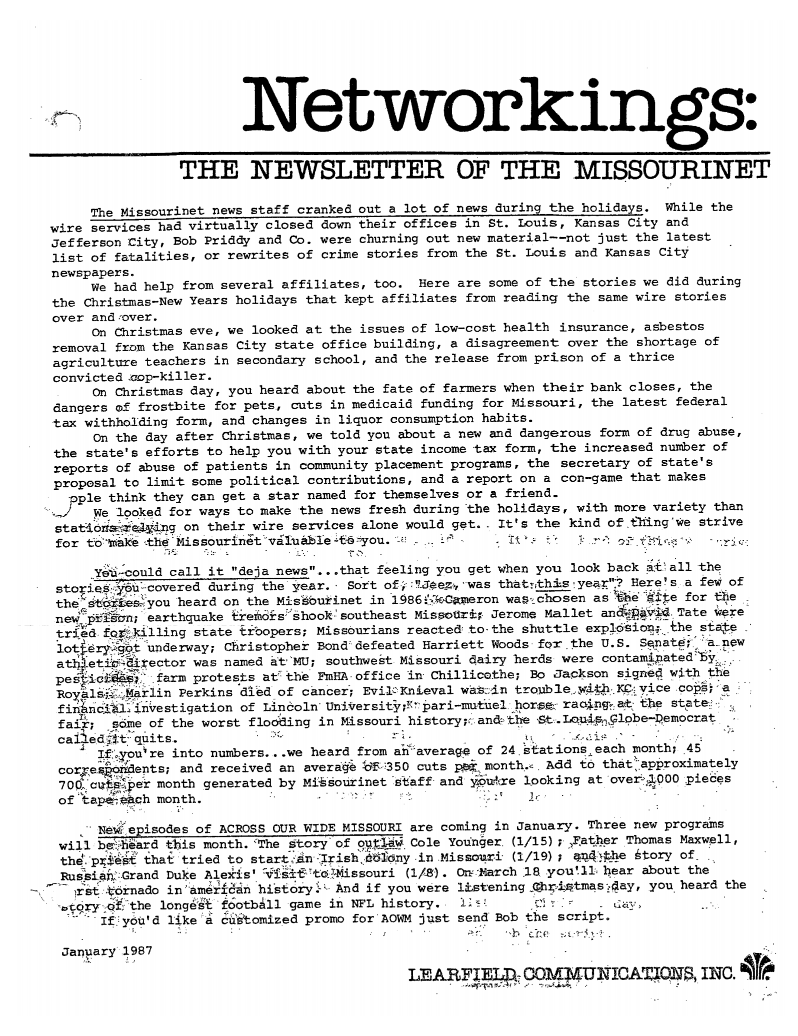 I try not to long for “the way things used to be,” but it’s difficult. Newsletters, for example. In the late 80’s we sent a monthly newsletter to affiliated radio stations. One page, front and back. Typed, photocopied and mailed (took 4 days to reach some stations). Because the space was limited, one gave thought to what to put in and what to omit.