
ChatGPT: A Brief Essay on Steve’s Long Look at Religion

A friend shared the following quote from a presentation by Yuval Noah Harari: “What happens to a religion of texts when the texts start talking?” I’ve read most of his books (and excerpted here many times) but didn’t recall that line. But it reminded me how often I have posted on the subject of religion over the last twenty years (71 times). I prompted ChatGPT for a brief essay summarizing those posts. PS: see comment at bottom of post.

ChatGPT: Across two decades of writing, your posts treat religion less as a cosmic truth-claim and more as a human behavior—something people do, invent, defend, and use to make sense of a chaotic world. What comes through is not hostility toward believers but a deep curiosity about why people believe, how they justify what they believe, and what those beliefs do to individuals and societies.

A recurring theme is the arbitrariness of certainty. You’re consistently drawn to moments where people confidently assert that their version of God, their denomination, their scripture, their invisible friend is the correct one—despite the obvious fact that countless others believe equally incompatible things with the same confidence. Your reaction isn’t anger; it’s closer to bemusement. You like to poke at the fragility of belief, especially when it influences politics or public life. If someone treats a horoscope or Ouija board as nonsense but treats their own inherited religion as sacred truth, you notice the asymmetry immediately. Continue reading →
Money Is A Religion

Everything I think about religion can be found here. But I don’t think any of these posts explain money as a religion. Which is clearly is.

“Money is valuable because we believe in it. The more we reflect on this, the more we realize religion is far from gone from today’s ‘secular society’. We’re just calling our religion ‘the economy’. Here we follow philosopher Ernest Becker in his book Escape From Evil on a quest to discover the religious origins of money.”

NEXUS: Religion

Yuval Noah Harari begins his “history of information networks” talking about books as a type of technology, the Bible being the most successful example. And the Catholic Church as one of the most powerful networks.

After his death, Jesus became the subject of one of the most remarkable branding campaigns in history. […] The story of Jesus managed to have a much bigger impact on history than the person of Jesus.

While most Christians were not physically present at the Last Supper, they have heard the story so many times, and they have seen so many images of the event, that they “remember” it more vividly than they remember most of the family dinners in which they actually participated.

Religions always claim to be an objective and eternal truth rather than a fictional story invented by humans.

The Bible as a single holy book didn’t exist in biblical times. King David and the prophet Isaiah never saw a copy of the Bible. […] no two ancient Bibles were identical.

Catholic theology accepted that Jesus told us to love our enemies, but explained that burning heretics was an act of love, because it deterred additional people from adopting heretical views, thereby saving them from the flames of hell.

The first rule of changing church teachings is that you never admit to changing church teachings.

Religions throughout history claimed a nonhuman source for their holy books; soon that might be a reality. Attractive and powerful religions might emerge whose scriptures are composed by AI. Pg 209

The Bible had a profound effect on billions of people, even though it was a mute document. Now try to imagine the effect of a holy book that not only can talk and listen but can get to know your deepest fears and hopes and constantly mold them.

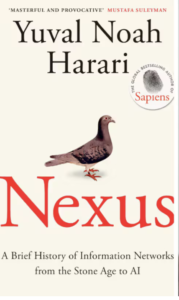
NEXUS: A Brief History of Information Networks from the Stone Age to AI

I have read and enjoyed each of Yuval Noah Harari’s previous books. Sapiens: A Brief History of Humankind; Homo Deus: A Brief History of Tomorrow; and 21 Lessons for the 21st Century. As the titles suggest, he writes about history and persuaded this reader that is the only context to fully understand what is happening in the world.

This book scared the shit out of me. I grew up during the early days of the Cold War, watching B-52 bomber packed with nukes flying overhead. As a teenager, I held my breath with the rest of the world during the Cuban Missile Crises. But Harari makes a compelling case for AI (assuming we fuck it up and we will) as a greater existential threat.

Like all of Harari’s books, this one (about 400 pages) got a loft of highlighter. More excerpts after the jump. Or you can watch this 40 minute discussion with Sam Harris. Continue reading →