Interview with William Gibson

My favorite author, far and away. Just finished his new novel, Zero History. Here are a few bits that caught my attention in the interview:

  • I find Twitter to be the most powerful aggregator of sheer novelty that humanity has yet possessed.
  • “I think the concept of “mainstream” is probably becoming archaic in some sense.”
  • “The mainstream is more digestible by osmosis”
  • “I wonder if we’ll ever have consensus (again)?”
  • “Generally, we don’t know what we were doing with something until we quit doing it.”
  • “When I see Glenn Beck –to the very small extent I do, if I can help it– it’s like Devo’s vision made flesh”
  • “I now write with the assumption that someone will google every unfamiliar word and term as they go through the book.”
  • “The footnote now lives in cyberspace, a click away”

Scott Adams: “Shape Shifters”

“One idea we all share is the narrow view that ideas are not alive in any way we like to define such things. We believe ideas are our tools, not our masters. That is exactly what the Shape Shifters have programmed us to believe. While we know that the ideas in our head control our behavior, we have an idea that we can choose any path we like, so we are blind to the fact we are little more than milk cows for our non-corporeal overlords. Everything we humans do is in the service of creating a better environment for ideas to reproduce. We create more babies so there are more brains to fill with ideas. We write books, make movies, build schools, and expand the Internet, all to help the reproduction of ideas.”

Dave Winer’s proposal for a new kind of blog comment system

“I know some people think that blogs are conversations, but I don’t. I think they’re publications. And I think the role of comments is to add value to the posts. If you want to rebut a post, then you can create your own blog and post your rebuttal there.”

This makes a lot of sense to me. If there is ever an easy-to-implement version of Mr. Winer’s system, I’m there.

“The Internet Weakens Authority”

There are a handful of people I regularly read in an effort to understand what’s happening in the world: Scott Adams, Seth Godin, Clay Shirky, Bruce Sterling, William Gibson and Terry Heaton (I’ve left some out).

In this essay, Mr. Heaton explores what he calls the “second Gutenberg moment” we are experiencing:

“It isn’t technology that’s changing culture as much as it is the ability of people to act on long-held dissatisfaction. People, therefore, are the issue, empowered, connected and, yes, angry people. Nobody’s “in charge” of the revolution underway, but more and more people are realizing that if we’re going to fix what’s wrong, we’re going to have to do it ourselves.”

We’re sure to see some of that in November. And then there’s the question of who controls the knowledge:

“One-directional authority — especially that which is based in deliberately protected knowledge — cannot maintain control for long, once that knowledge is acquired and spread throughout its constituency. All that we know today in terms how we govern our lives will evaporate and be replaced by something very different in the decades to come.”

We see this in every institution: Busines, Religion, Education, Media, Medicine, Finance. I was certainly “guilty” of this when I was a Manager. Deciding what information got passed along and to whom. I still see it every day. But it’s getting harder.

Employees are connected. Nobody is walking around the office leaving memos on people’s desks. Email, Facebook, Twitter, texting… shit, the boss is often the last know something.

I’m confident I’ll be around for the disruptions to come and expect many will be painful, but necessary. I’m looking forward to them.

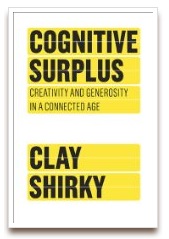
Cognitive Surplus

From Amazon: “For decades, technology encouraged people to squander their time and intellect as passive consumers. Today, tech has finally caught up with human potential. In Cognitive Surplus, Internet guru Clay Shirky forecasts the thrilling changes we will all enjoy as new digital technology puts our untapped resources of talent and goodwill to use at last.”

A few of my highlighted excerpts from Cognitive Surplus by Clay Shirky (more after the jump).

“The postwar trends of emptying rural populations, urban growth, and increased suburban density, accompanied by rising educational attainment across almost all demographic groups, have marked a huge increase in the number of people paid to think or talk, rather than to produce or transport objects.” – page 4

“Someone born in 1960 has watched something like fifty thousand hours of TV already, and many watch another thirty thousand hours before she dies.” – page 6

“…in the whole of the developed world, the three most common activities are now work, sleep, and watching TV.” – page 6

“Americans watch roughly two hundred billion hours of TV every year. … We spend roughly a hundred million hours every weekend just watching commercials.” – page 10

“As long as the assumed purpose of media is to allow ordinary people to consume professionally created material, the proliferation of amateur-created stuff will seem incomprehensible.” – page 19

“Imagine that everything says 99 percent the same, that people continue to consume 99 percent of the television they used to, but 1 percent of that time gets carved out for producing and sharing. The connected population still watches well over a trillion hours of TV a year; 1 percent of that time is mor than one hundred Wikipedias’ worth of participation per year.” – page 23

“In 2010 the global internet-connected population will cross two billion people, and mobile hone accounts already number over three billion. Since there are something like 4.5 billion adults worldwide (roughly 30 percent of the global population is under fifteen), we live, for the first time in history, in a world where being part of a globally interconnected group is the normal case for most citizens.” – page 23

Continue reading →