
500 Days (minus 1)

I try to avoid talking about meditation. (Those who know don’t talk. Those who talk don’t know.) I’ve been meditating for years. I started listening to guided meditations but for several years now simply sit (30-45 minutes) each day, “following the breath.” Had something of a streak (371 days) going last year when a bout with pneumonia caused me to miss a day. But that’s okay, the only day that counts is today. Today is 500 consecutive (almost) days on the cushion.

I bring this up for those who might have thought about this practice. It’s the best half hour of my day. Here are a few books (and some quotes) I’ve found helpful.

Books on Meditation

  • Living As a River: Finding Fearlessness in the Face of Change – Bodhipaksa
  • Zen Mind, Beginner’s Mind – Shunryu Suzuki
  • Opening the Hand of Thought: Foundations of Zen Buddhist Practice – Kosho Uchiyama Roshi
  • Meditation Now or Never – Steve Hagen
  • Still the Mind: An Introduction to Meditation – Alan Watts

Quotes

  • Meditation is the only intentional, systematic human activity which at the bottom is about _not_ trying to improve yourself or get anywhere else, but simply to realize where you already are.
  • (We meditate to realize) “…that things are already perfect.”
  • Meditation is about deeply seeing what’s going on within your own mind.
  • At the heart of meditation is the intention to be awake. (To experience) Reality as it is,before goals, ideas, or desires sprout. … Meditation is never a means to an end.
  • Meditation is a matter of zero or 100 percent. Either you’re present or you’re not. There are no in-betweens.
  • Meditation is awareness.
  • The desire of one who is awake is simply to be awake.
  • Meditate just to meditate.
  • Most people who believe they are meditating are merely thinking with their eyes closed. Meditation is a technique for waking up.
The Jackpot

William Gibson defines the Jackpot Years from The Peripheral [ m1k3y on Vimeo.]

“No comets crashing, nothing you could really call a nuclear war. Just everything else, tangled in the changing climate: droughts, water shortages, crop failures, honeybees gone like they almost were now, collapse of other keystone species, every last alpha predator gone, antibiotics doing even less than they already did, diseases that were never quite the one big pandemic but big enough to be historic events in themselves.”

Eternal Now

string

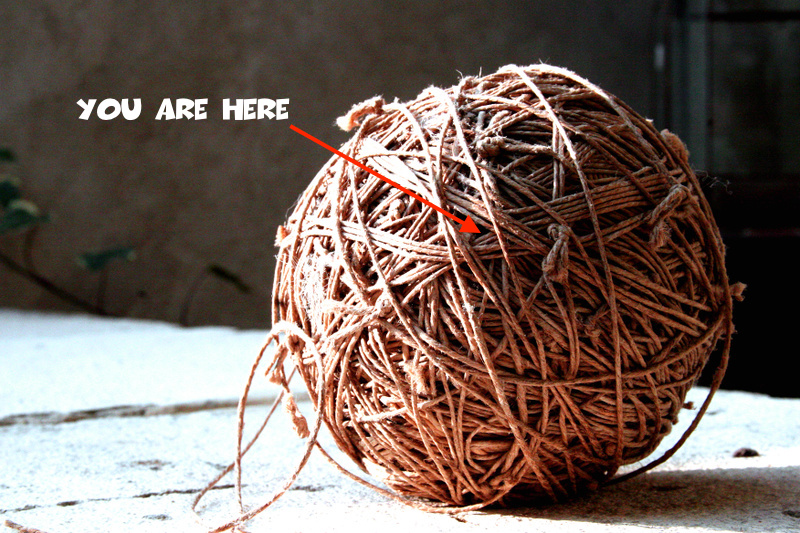
“The days and nights of Brahman are spread out in time in rather the same way as a ball of thread an inch in diameter is unrolled to the length of a hundred yards. Its real state resembles the ball but to be presented to the human mind it has to be unrolled. For our idea of time is spatial; it has length, which is a spatial dimension. But eternity has no length, and the nearest thing to it in our experience is what we call the present moment. It cannot be measured, but it is always here.”

My favorite excerpts from Become What You Are (Alan Watts) (PDF)

The Smartphone is Eating Television

“TV viewership peaked in the 2010 season and has been falling ever since. […] Smartphones are winning and traditional television is losing, especially when it comes to viewers in the most desirable 18 to 34 demographic. […] TV viewing by all age groups peaked in the 2009-2010 season, and has been on the decline ever since. Until that point, the audience for TV had grown every year since 1949.”

The Smartphone is Easting Television (Fortune)

Little Rice: Smartphones, Xiaomi, and the Chinese Dream

Amazon: “Smartphones have to be made someplace, and that place is China. In just five years, a company names Xiaomi (which means “little rice” in Mandarin) has grown into the most valuable startup ever, becoming the third largest manufacturer of smartphones, behind only Samsung and Apple. China is now both the world’s largest producer and consumer of a little device that brings the entire globe to its user’s fingertips. How has this changed the Chinese people? How did Xiaomi conquer the worlds’ biggest market” Can the rise of Xiaomi help realize the Chinese Dream, China’s bid to link personal success with national greatness? Clay Shirky, one of the most influential and original thinkers on the internet’s effects on society, spends a year in Shanghai chronicling China’s attempt to become a tech originator–and what it means for the future course of globalization.”

A few excerpts:

The mobile phone is a member of a small class of human inventions, a tool so essential it has become all but invisible, and life without it unimaginable.

There are only three universally personal items that someone will carry with them no matter where they live. The first two are money and keys; the third is the mobile phone, making it the first new invention added to that short list in three thousand years.

The number of mobile phone users crossed 4.5 billion last year, and because of dual accounts, there are now more mobile subscriptions in the world than there are people.

A smartphone is as different from a standard-issue Nokia 1100 as a computer is from a typewriter.

Mobile phones are a funny product, midway between commodity and luxury. They are a commodity in that everyone needs one. They are a luxury in that a phone makes a significant personal statement.

Status is a bigger feature of the iPhone (in China) than in the U.S. Electronics stores display phones running Android with the screen facing out, as usual, but iPhones are often displayed case out, to show off the Apple logo.

Nokia went from being the world’s most important mobile phone company to an also-ran in three years, collapsing into Microsoft’s waiting arms after another three, a generation of dominance undone in half a decade

If you make something that appeals to 5 percent of the Chinese population, you have a potential market the size of France.