
So I said to myself, “Self…”

If someone offered you a thousand dollars to write a 500 word essay titled “Who Am I?”… you could do that. You could knock out 500 words but I suspect most people have not given five minutes thought to this timeless, existential question.

A first draft would probably be heavily biographical. Your name; what you look like; where you’ve lived; what you do for living; maybe important relationships. You’d tell your story. So, are you your story?

The more introspective might try to describe some “essential self.” That “Real Me” that no one knows. “Thine own self” to which Polonius said we should be true. This is where you start listing all of the things you believe/know/think/fear.

Now, let’s say I give you a thousand bucks to write this essay every five years, starting at, oh, let’s say, fifteen. Now you’re 65 and we have your ten essays in front of us. Which one of those “you’s” is The Real You?

“All of them,” you explain. “That’s me at 25, that’s me at 40 (and so forth).” So, the essence, the core of who you are changes from year to year? How about month-to-month? Daily? Hourly? Sounds like there are many different Real You’s.

This is an ancient question that really smart people have thought about for thousands of years. My reading has lead me to the camp that finds no evidence of an essential, unchanging, permanent self.

I need a visual metaphor to even begin to *think* about stuff like this. Let’s try one.

Shortly after you’re born, you’re issued a little backpack. This is where you keep everything. The image of the giant people who take care of you; the smell of the places around you; the feeling you get when you’re hungry or you’ve pooped yourself. Since everything’s new at this point, your little backpack fills up pretty quickly but that’s okay because you get a bigger one whenever as needed.

All your experiences get stuffed into the backpack. If you need to know if you’re good or bad; smart or dumb; afraid or fearless… the answers are in the bag. It can get confusing because nothing ever comes _out_ of the bag but if it’s in there, it’s part of who you are.

By the time you reach your early teens you’ve traded in your backpack for a duffle bag and it’s packed! Including a couple of quarts of hormones that have soaked all those memories and feelings and beliefs. It is messy.

By the time you’re an adult, you’re dragging around a steamer trunk and adding more stuff every day. If the question, “Who am I?” comes up, well, you open the trunk and the stuff on top is you.

After dragging that fucker around for 60+ years, I’m ready to leave it behind. All the memories (good and bad) and fears and ideas and concepts and beliefs. Turns out, a lot of the stuff in that trunk was put there by someone else. Family, friends, strangers, you name it. After dragging it around for ten or fifteen years, it became “mine/me.”

The reason we don’t go insane thinking about this is we have something called the ego. But that’s just a character, like Willy Loman. A little different every time he walks onstage. Not real. For most of my life, I didn’t know it was a play. I thought I was Willy Loman. Now I’m sort of watching from the wings. I can see the make-up is a little different each performance, lines are delivered with slightly different inflection. I’m becoming aware it is a performance and that the lines aren’t mine.

“The self is impermanent. […] It is constantly changing, decaying, and being reconstructed again, always slightly differently, depending on the circumstances of the moment. […] It never repeats itself. Whenever you look, it is slightly different.” — Jon Kabat-Zinn, Wherever You Go There You Are

Why deconstruct the concept of the self (ego)? Apparently, that is the source of all suffering.

[This is where I ran out of gas on this post. Fortunately, I came across this post by Brian Hines who takes this idea on down the road.]
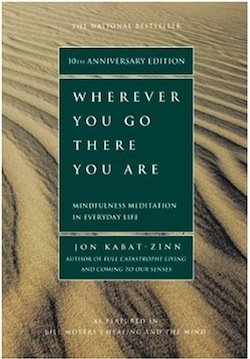
Wherever You Go There You Are by Jon Kabat-Zinn

Mindfulness Meditation in Everyday Life by Jon Kabat-Zinn (Amazon)

Screen Shot 2013-02-22 at Fri, Feb 22, 12.01.09 PM


What happens now, in this moment, influences what happens next.

We tend to be particularly unaware that we are thinking virtually all the time. […] Meditation means learning how to get out of this current.

Meditation is the only intentional, systematic human activity which at the bottom is about not trying to improve yourself or get anywhere else, but simply to realize where you already are.

Let go of wanting something else to happen in this moment.

Is it possible for you to contemplate that this may actually be the best season, the best moment of your life?

Look at other people and ask yourself if you are really seeing them or just your thoughts about them. Sometimes our thoughts act like “dream glasses.”

If you do decide to start meditation, there’s no need to tell other people about it, or talk about why you are doing it or what it’s doing for you. […] Just look at (this) as more thinking.

Meditation is neither shutting things out nor off. It is seeing things clear4ly, and deliberately positioning yourself differently in relationship to them.

Meditation is not about feeling a certain way. It’s about feeling the way you feel. It’s not about making the mind empty or still. […] Meditation is about letting the mind be as it is.

Even our leisure tends to be busy and mindless. The joy of non-doing is that nothing else needs to happen for this moment to be complete.

“To affect the quality of the day, that is the highest of arts.” — Thoreau

(We meditate to realize) “…that things are already perfect.”

We tend to see things through tinted glasses: through the lens of whether something is good for me or bad for me, or whether or not it conforms to my beliefs or philosophy.

At the deepest level, there is no giver, no gift, and no recipient… only the universe rearranging itself.

Voluntary Simplicity: “…intentionally doing only one thing at a time and making sure I am here for it.

If mindfulness is deeply important to you, then every moment is an opporunity to practice.

Meditation is more rightly thought of as “Way” than as a technique.

Awareness is not the same as thought. It lies beyond thinking. […] Awareness is more like a vessel which can hold and contain our thinking.

Meditation involves watching thought itself.

The posture itself is the meditation. The posture speaks of not looking for anything more, but simply digesting what is.

Mindfullness: Allowing one moment to unfold intot he next without analyzing, discoursing, judging, condemning, or doubting; simply observing, embracing, opening, letting be, accepting. Right now. Only this step. Only this moment.

We often see our thoughts, or someone else’s, instead of seeing what is right in front of us or inside of us.

When we perceive our intrinsic wholeness, there is truly no place to go and nothing to do.

What we call “the self” is really a construct of our own mind.

Stop trying so hard to be “somebody” and instead just experience being. […] You are only you in relationship to all other forces and events in the world.

You are who you already are. But who you are is not your name, your age, your childhood, your beliefes, your fears. They are part of it, but not the whole.

The self is impermanent. […] It is constantly changing, decaying, and being reconstructed again, always slightly differently, depending on the circumstances of the moment. […] It never repeats itself. Whenever you look, it is slightly different.

Scott Adams: Robot Constitution

Scott Adams thinks we need to start preparing a Robot Constitution that spells out a robot’s rights and responsibilities. Some questions such a document should address:

  1. Who has the right to modify a robot?
  2. Can a robot appeal a human decision to decommission it?
  3. Can a robot kill a human in self-defense?
  4. Can a robot kill another robot for cause?
  5. Does a robot have a right to an Internet connection?
  6. Is the robot, its owner, or the manufacturer responsible for crimes the robot commits?
  7. Is there any sort of human knowledge robots are not allowed to access?
  8. Can robots have sex with humans? What are the parameters?
  9. Can the state forcibly decommission a robot?
  10. Can the state force a robot to reveal its owners’ secrets?
  11. Can robots organize with other robots?
  12. Are robot-to-robot communications privileged?
  13. Are owner-to-robot communications privileged?
  14. Must robots be found guilty of crimes beyond “reasonable doubt” or is a finding of “probably guilty” good enough to force them to be reprogrammed?
  15. Who owns a robot’s memory, including its backups in the cloud?
  16. How vigorously can a robot defend itself against an attack by humans?
  17. Does a robot have a right to quality of life?
  18. Who has the right to alter a robot’s programming or memory?
  19. Can a robot own assets?
  20. If a robot detects another robot acting unethically, is it required to report it?
  21. Can a robot testify against a human?
  22. If your government decides to spy on you, can it get a court order to access your robot’s audio and video feed?
  23. Do robots need a legal right to “take the fifth” and not give any private information about their owners?

You don’t want to be typical

It took me a long time to learn that typical is no good. There’s no reason to regard it as the “good enough” line. Typical health is pretty bad. A typical career is draining and unrelated to the worker’s real interests. Typical credit card debt is in the thousands. The typical level of fulfillment in a person’s life is far below where it could be with some self-examination and habit overhauls.

Nobody dreams of being typical. You do not want a typical job. You do not want typical credit card debt. You do not want typical health. You do not want to retire at the typical age. You do not want typical results. You do not want a typical level of fulfillment. Nobody does. Stop pretending.

From another inspiring post by David Cain »

Contrition

I’m not clear what Lance Armstrong hoped to accomplish with his highly publicized interview with Oprah. I watched only a few minutes and — based on lots of news items — gather it wasn’t well received.

I’m not a sports fan so when Mark McGwire, Roger Clemons, Tiger Woods or Lance Armstrong get caught lying/doping/gambling/etc, I’m not shocked or disappointed.

But Armstrong’s high-profile apology get me thinking about what I might have said and how I might have said it. Obviously one can’t really know this until they’re in such a situation, but just for fun…

Oprah, before you ask your first question, let me set the record straight on some things.

I’m a liar. I’ve lied about doping from the beginning and there’s no reason for anyone to believe anything I say today.

I used my power and money and influence to attack and destroy those who told the truth about what I was doing. I’m going to try to apologize to each of these people personally. I don’t expect forgivness, it just seems like something I should do. Many of them proably won’t want to see my face and I can’t say that I blame them.

While I can’t undo all the harm I’ve done, there are some things I need to do to try to make amends.

I’ve made a lot of money from product endorsements and other ventures and I’m giving every penny to those I’ve harmed. I’ve asked (insert name of someone with some integrity) to oversee this process which I want to be completed within 90 days. He will make the determination of how to distribut my assets, including my homes, cars, everything. I’m keeping nothing.

As for my future, I will never compete professionally again. I wil do no endorsements (in the unlikely event someone should ask). I’m going to get a regular job to support my family and try to live as anonymously as possible for the rest of my life.

My actions did imeasurable harm to the sport I loved. Cycling should never have been about fame and glory and money. If there is any positive legacy for me, maybe it’s to remind people of that.

What’s your first question, Oprah?